


 Vusumuzi Dube
Brigadier-General (Rtd) Ambrose Mutinhiri
Continued from last week
ALFRED Nikita Mangena used to say that a cadre can be given all ammunition and logistics but if they are weak and not properly trained, they are as good as dead.
We needed to make cadres fit. This is the reason why there were intense physical drills, judo, use of explosives, logistics, cartography, map reading, political commissariat lessons and weapon handling, among others. Those helped to prepare an all round cadre. If you check these are modern-day subject lessons still taught now although they are now packaged using modern names.
Some conspiracies are said about Mangena. That he wanted to overthrow party President and Commander-in-Chief Dr Joshua Nkomo and the entire leadership. That is not true at all. On several occasions, he exhibited loyalty and made it clear that the army was answerable to the War Council, not individuals within the leadership.

There were individuals in the leadership who wanted to control or interfere with the daily operations of the army. Mangena would block them and tell them that they needed to first train or belong to the command structure in the War Council to access information about the army.
There are of course instances where politicians preferred certain decisions which did not fit well in the military vision of Mangena. Hence, Mangena would block some decisions or recommendations from the politicians. For example, politicians would want to take decisions based on political contexts and situations whereas military decisions look at both the politics and the military. At times decisions taken by the military were unpopular to the politicians as they involved loss of lives through operations.
However, Mangena would defend the decisions taken by the military command. This is where some leaders viewed Mangena as dictatorial and yet he was not. It is unfair for some elements to say Mangena was dictatorial. What I can say is that in any organization you cannot satisfy all people, grumbles and complaints will always be there.
Those who are saying Mangena was a bad person were people who could not keep pace with his demands as a commander. These are people who were failing to meet the targets and deadlines. Yes, he was tough to such characters who never delivered as expected. I can say assertively that we never treated lazy cadres with kid gloves. War was no child’s play where people would just play when deployed or assigned.
Mangena hated cadres who would want to experiment on duty and fail to deliver. According to Mangena when a cadre was deployed, they had two options either to deliver or deliver beyond the expected as per the plan! I have also heard some saying Mangena was training a parallel army to fight the leadership.
These are all lies that are supposed to be relegated to the dustbins where they belong! For example, a decision taken by the army was to have operations that target colonial tourism in the then Rhodesia.
Mangena made it clear that the army needed to target and disrupt tourist facilities and activities. This was after a realization that the colonial regime led by lan Smith was refusing to admit that there was war as the tourists kept on coming into the country.
Mangena made it clear in one of the meetings when he said: “I note with regret that Ian Smith has decided to cover up our pursuit of self-determination by claiming that there is no war in Rhodesia.
Going forward we are disrupting and stopping tourism forthwith.”

A war against colonial tourism was ignited. To him, if the tourists kept on coming into the country it meant that the enemy was still comfortable and hence no impact was made. The first operation to that effect was to attack The Elephant Hills Hotel in Victoria Falls in November 1977, which was successfully done. The deliberate successive operation to that effect was to bomb a plane in Kariba, which was also carried out. That was to send a message to the world that there was war in Rhodesia as opposed to the sentiments by Ian Smith that there was no war in the country.
However, Nkomo was very bitter about the said operations, saying they were negatively impacting the civilians. Mangena had to respond to Nkomo by saying: “Commander-In-Chief be reminded that there is no white civilian. We are pursuing war.”
On the fateful day when there was an attempt on his life at the Freedom Camp (FC), I think we were coming from Lusaka.
What happened was that I was driving the Land Rover into the camp and Mangena’s vehicle was following behind. So, I drove into the camp and parked some 60 metres away waiting for the commander and his bodyguards to drive through and park.
As I came out of the vehicle, I heard at least six-gun shots. I pondered and said, ‘What is happening here?’ I ran to the entrance and found that the commander had been attacked. He had been shot in the thigh and finger. Fortunately, Mangena had managed to repel them.
We managed to round them up and capture them. However, they escaped, and we only learned later that they were taken to someplace. These are real stories when we say the struggle had its own struggles. I still do not understand that after certain individuals tried to take the life of the commander they were protected. Who was behind this? That’s a question for another day!
Seeing that the commander was injured I took charge of the situation and drove him to a hospital in Lusaka.
His left hand ring finger had been injured. On our way, Mangena was making fun of the whole situation saying: “Ambrose, I think I will never wear a wedding ring, how will it fit here on my finger.”
He was such a character! Days after the attempt to take his life at Freedom Camp, I went to his office and he said: “Ambrose, I am under fire, there are some people who are setting us up.”
He was very concerned, and, in that engagement, he highlighted that there was a need to be security conscious. One of the blows that Mangena suffered was the sudden death of Jason Ziyaphapha Moyo (JZ). JZ was one of the trusted cadres in the struggle that I and Mangena looked up to, especially for advice and direction. JZ was a practical and pragmatic leader.
The death of JZ affected Mangena and I could tell that he was very devastated. What happened is that we, that’s I, Mangena and JZ were coming from Maputo after attending a Patriotic Front preliminary meeting.
When we got to Lusaka, JZ requested that I drive him to do his shopping. Within a few minutes, Nkomeni Nleya who was the official driver came and drove off with JZ. Hours later when he had left us, we learnt that he had died. That greatly affected Mangena as JZ was more of his mentor.
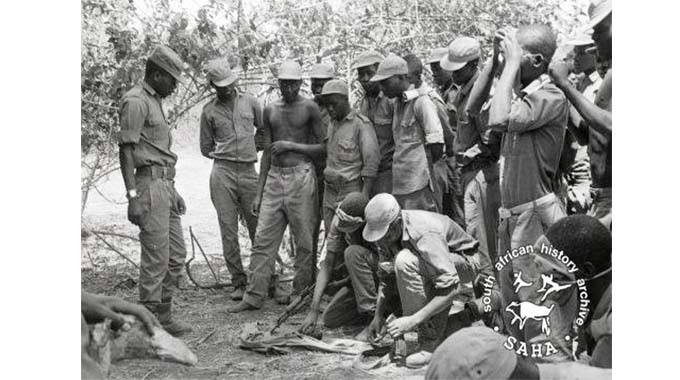
The death of Mangena also affected me as I knew that the military wing ZPRA was never to be the same again. What happened is that the Assaf Ndinda (Herbert Mutema) unit got ambushed and died at the behest of the enemy, Mangena decided to go to the front to ascertain and assess the situation before their burial.
Militarily, he was justified in doing so because as the commander he needed to understand the context to inform the operations. However, it was also volatile to do so as there were signs that the situation that they were confronted with was dire.
Mangena came to me and said he intended to visit the area where Assaf’s unit got ambushed. I told him not to go but he just said I should organize the relevant logistics for him to visit the place. I then decided to play my delaying tricks instead of discouraging him from visiting the operational area. I delayed with the fuel, ammunition, and other logistics that were to facilitate the visit.
My delaying tricks took me two days up until he discovered that I had taken a deliberate effort to discourage him from visiting the area. He then approached me and said: “Ambrose, look here, are we fighting? Please facilitate my logistics and you have a few minutes to do so.” I then saw that the commander was now angry. I gave in and released all the logistics and finances for that visit although
I felt in me that something was not all right about their visit based on the nature of how the unit was ambushed.
Worse, Nkomo had originated a memo requesting us to deter the command element from visiting the front. When Mangena and others went to the area for the said visit, I remained in Lusaka. A day after his trip I then learnt that Mangena had died after his Land Rover detonated a landmine. This was on 28 June 1978. He was a brave and trusted commander and even as his senior, I admired him!
Brig-Gen (Rtd) Mutinhiri served as ZPRA Chief of Staff during the armed struggle and is Zimbabwe’s Ambassador to Russia. This article was extracted from a book titled: Alfred Nikita Mangena: Oral Histories of the First ZPRA Commander edited by historian Methembe Hillary Hadebe. Besides Ambassador Mutinhiri other tributes are from former Vice-President Phelekezela Report Mphoko, late Cabinet Minister Dumiso Dabengwa, field commanders Moffat Hadebe, Lt-Col (Rtd) Stanford Moyo, senior commanders Abel Mazinyane, Marshal Mpofu, Mangena’s wife, Mrs Sikhubekiso Mandeya-Mangena etc.



 Bongani Ndlovu
 Online Reporter