Sundaymail Editor
WHEN we were growing up, schools used to be convenient and lucrative hunting grounds for various artistes, who angled to milk us the few cents we used to get as pocket money.
They included the odd drama groups that would put up energetic and animated performances; the karatekas, who would demonstrate their craft and athleticism; as well as the disc jockeys (well, they were not quite DJs in the strictest sense of the word), who would play music for us to sing along and dance, usually when the school term was about to come to an end.
But, by far, the showstoppers were always the magicians.
We used to call them “abracadabra” after the incantations they invariably made during their performances.
These conjurers could literally pull a rabbit out of a hat and make things disappear and reappear.
One of the famous tricks involved taking a wristwatch from a volunteer and pulverising it into debris, before seemingly plucking the fully restored watch out of thin air by sleight of hand.
To our young and impressionable minds, this was as mind-blowing as it was breathtaking. However, no one ever stepped forward when the magicians asked, as they often did, for a brave volunteer who was willing to take part in a trick in which they would be turned into a rabbit.
Inherent in the reluctance to volunteer was the torment of thinking what could happen if something went horribly wrong and the trick could not be reversed.
You could be condemned to live out the rest of your life as a miserable rabbit.
Yet this was not true. Calling them magicians was just euphemism to sanitise their art and craft.
To all intents and purposes, these were literally tricksters, for there was no magic at all, but simply illusions. With hindsight, Bishop Lazi would call them scammers.
Our pocket money could have been put to good use on something else. Nxa!
The hocus-pocus of money changers
But this is the same trick that had been mastered by our money changers, who were systematically milking fretful locals desperate to offload the erstwhile volatile local currency for a perceivably and relatively stronger US dollar.
To this day, the Bishop still struggles to understand the logic and explanation of why one would get a ridiculously low amount when one sells one’s hard-earned US dollars but would conversely be expected to pay an arm and a leg when buying back the same amount.
For example, what would be the logic of selling your greenback at US$1:ZiG17 and buying the same at US$1:ZiG20-21?
It is irrational — nay, it is criminal.
There are absolutely no fundamentals to explain this phenomenon, but simply hocus-pocus economics that is steeped in greed, indiscipline and general lawlessness.
A comparison with Botswana’s fortunes could be helpful in putting this into perspective. You see, in January, the sister republic’s exports topped US$360,5 million (P4,9 billion) as compared to imports at US$566 million (P7,7 billion), yielding a trade deficit of about US$206 million.
In February, its exports slumped to US$213 million (P2,9 billion), while imports, however, declined to US$537 million (P7,3 billion), translating to a deficit of US$323 million. For Harare, exports came in at US$540 million in January and further jumped to US$644 million the following month, while imports were U$687 million and US$725 million, respectively.
This resulted in trade deficits of US$147 million and US$81,4 million in that order.
Yet the Botswana pula held steady, while the Zimbabwe dollar precipitously declined in value over the same period.
This, folks, gives credence to the claim that has always been made that some of the currency volatility we have been experiencing has nothing to do with economic fundamentals, but everything to do with unadulterated market indiscipline.
And this has to be crushed.
Jesus showed the way.
Matthew 21:12-13 tells us: “Jesus entered the temple courts and drove out all who were buying and selling there. He overturned the tables of the money changers and the benches of those selling doves. ‘It is written,’ he said to them, ‘My house will be called a house of prayer,’ but you are making it ‘a den of robbers.'”
Our law-enforcement agents should, therefore, not let up but double down in rigorously enforcing the law so that the nonsense of illegal foreign currency trading is definitely brought to an end.
Behold the ZiG
But the narrative is slowly changing.
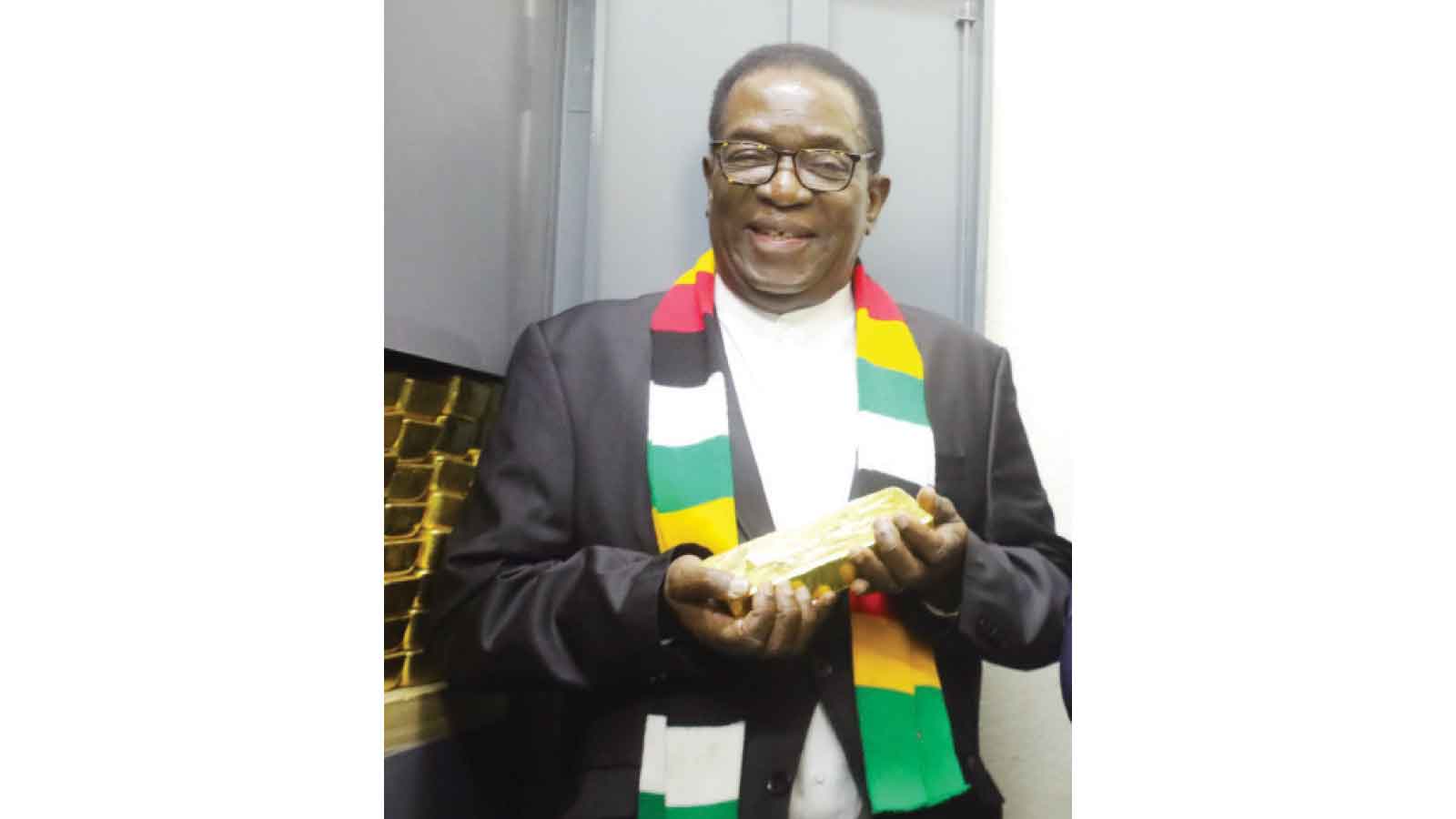
Wednesday will mark two months to the day the Reserve Bank of Zimbabwe (RBZ)’s Governor, John the Second, introduced the Zimbabwe Gold (ZiG) to replace the flagging Zimdollar, and it has worked wonders.
When it was introduced, the new currency was trading at US$1:ZiG13,56, but it had firmed to US$1:ZiG13,3 by last week on the interbank market, which, in simple terms, means it has strengthened against the US dollar.
And stability in the exchange rate has happily translated to stable prices of goods and services, as well as renewed consumer purchasing power.
Demand is gradually creeping up. In line with the central bank’s projections, the Zimbabwe National Statistics Agency indicated last week that month-on-month inflation for the ZiG had declined to minus 2,4 percent in May.
We are on the right track.
As Bishop Lazarus said before, the secret behind the ZiG lies in it being gold-backed, gold-linked and also supported by reserves that include foreign currency deposits.
This gives John the Second the awesome power to intervene in the market in order to defend the local currency. But this could be a month of reckoning for those who bet against the ZiG, as, according to new regulations, companies are expected to pay half their quarterly taxes (QPDs), worth a cumulative US$300 million, in the local currency.
So, as we move towards the end of the month, we could see growing demand for the local unit.
By the way, at the material time of the currency conversion, all the local stock of the Zimbabwe dollar was equivalent to US$80 million. Ceteris paribus, this mismatch and the concomitant rising demand for the ZiG would naturally result in its further strengthening.
Not only will this lead to increased buying power of our currency, but hopefully a behavioural shift by retailers, such as fuel traders, among others, through increasingly accepting the local unit. So, for professional exchange rate gazers, this could be the month to watch.
ANC in a Mavambo/Kusile/Dawn moment
It would be remiss for the Bishop to leave without commenting about the sobering outcome of the just-ended elections in South Africa. By now, we can almost hear the uproarious and guttural laughter coming from Cde Jacob Zuma’s Nkandla residence from here, especially after he pulled the rug from underneath the feet of his former comrades in the ANC. For the first time, the 112-year-old former liberation movement will have to form a coalition to govern after losing its majority in Parliament.
Zuma’s newly formed uMkhonto weSizwe (MK) party ate the ANC’s lunch and managed to eclipse Julius Malema’s leftist EFF party to become the third-biggest party.
This phenomenon, far from demonstrating the declining popularity of the ruling ANC, rather demonstrates the extent of the rapture in the movement. Most of these splinter parties — the EFF, Mosiuoa Lekota’s COPE, Ace Magashule’s ACT and recently MK — have been spawned by internal contradictions in the party, which seem to have climaxed through the recent loss.
All these comrades are quintessentially and ideologically ANC, which is a glue that could bind them together and form the nucleus around which they could coalesce in future. But could this be ominous in a country where successive post-independence leaders have failed to complete their terms?
Your guess is as good as mine.
Essentially, the ANC has faced the Mavambo/Kusile/Dawn moment, which ZANU PF faced in 2008 when it lost its majority in Parliament and had to negotiate an Inclusive Government with Morgan Tsvangirai’s MDC.
But ZANU PF managed to look the eye in the beast and rose to the occasion to become the predominant party in local politics that it is today.
The ANC has to bite the bullet and materially address the source of people’s pain.
The issue of land and economic empowerment cannot be further kicked down the road, especially at a time when burgeoning youth populations in Sub-Saharan Africa continue to add to the disillusioned and discontented rank of the unemployed.
Such a major transformative project will inherently be painful, but it is necessary.
Like medicine, it is bitter, but it has to be swallowed. This is a moment of reckoning for South Africa.It should seize the moment and do the needful by uniting and listening to the voice of ordinary South Africans.
Therein lies its answers.
But other former liberation movements should also take heed.
Bishop out!


 Online Reporter