

 admin
admin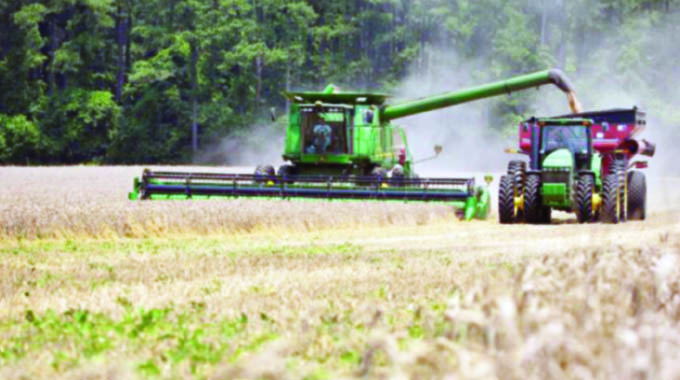
Elita Chikwati
Features Editor
Zimbabwe has been a wheat importer as local production could not meet 360 000 tonnes required for national consumption annually.
There have been efforts to boost wheat production to cut on imports and also ensure self-sufficiency.
Farmers had abandoned growing wheat due to high costs of production.
Unreliable electricity supply also discouraged farmers as constant power cuts disrupted irrigation activities.
Thus wheat had been a high risk with few banks willing to fund production of cereal.
For the past few seasons, Government has worked with important stakeholders to ensure all things were in place for wheat production.
This saw farmers being put into clusters so they could have uninterrupted power supply while inputs providers availed seed and fertilisers on time. Efforts were also made to avail combine harvesters so that the wheat could not be damaged by early rains.
The country registered significant yields in wheat and had to only import low volumes to meet the deficit.
Now that Russia and Ukraine are in conflict, it is important that farmers maximise wheat production to ensure self-sufficiency.
Russia and Ukraine used to be major wheat producers and this could be affected by the on-going conflict between the two countries.
Zimbabwean farmers should take it upon themselves to produce their own wheat.
Tobacco farmers can diversify and use their irrigation facilities to produce the cereal.
According to the Ministry of Lands, Agriculture, Fisheries, Water and Rural Development, tobacco farmers have the potential to produce 100 000 tonnes and contribute 26 percent of the targeted production during the 2022 winter cropping season.
Government has set a target of 75 000 hectares under wheat to produce 383 500 tonnes of wheat.
Minister Masuka said tobacco farmers could utilise their land for the irrigated tobacco for wheat production to ensure the country attain self-sufficiency and build a strategic grain reserve for the cereal.
Government is urging all farmers with land and access to water for irrigation to grow wheat because of the geopolitics and the attainment of Vision 2030 so the nation can be self-sufficient in terms of cereals.
The tobacco industry has a sizeable hectarage that they put to irrigated tobacco about 20 000 hectares.
All this land could be utilised to grow wheat. The tobacco farmers’ 20 000 hectares can be used to produce a 100 000 tonnes of wheat and that is about 26 percent of the country’s target of 383 000 tonnes,” he said.
It is pleasing that service providers such as Zesa Holdings and the Zimbabwe National Water Authority have indicated their preparedness for the 2022 winter cropping season.
Zesa has indicated that wheat growers would be given more preference on power supply while Zinwa said the water in the country’s dams was enough to cater for the targeted hectarage.
Seed companies also have 12 459 tonnes of seed for wheat which is enough for the targeted hectarage. Financial support is also coming from CBZ Agro-Yield is targeting to contracting 36 500 hectares, AFC Land Bank targeting at contracting 10 000 hectares
The Presidential Input Scheme is targeting at contracting 5 500 hectares for wheat, compared to the 5 000 hectares targeted in the 2021 season.
Winter wheat in Zimbabwe is wholly irrigated with the production period spanning the months from May to October.
In 2021, wheat production was achieved on 66 436 hectares for the Presidential, NEAPS and Private Sector Scheme. Zimbabwe requires 360 000 tonnes of wheat annually.
Farmers can access tractors from the Belarus and John Deere facilities which are currently accessible to all winter wheat farmers, while individual farmers can buy the equipment through local banks.
Cabinet has resolved that the preparations for an expanded winter wheat programme will be supported by timely Government guarantees and the facilitation of the private sector value chain financing.
With a view to augmenting the existing tractor fleet and implements, Government has put in place two mechanisation programmes, namely the Belarus and John Deere Farm mechanisation facilities.
The US$103 million Belarus Farm Mechanisation Facilities is divided into two phases and will see the country receiving 1 813 tractors, 76 combine harvesters, 210 planters, 5 lowbed trucks and 5 disc harrows.
The Agricultural Finance Corporation Equipment Leasing Company has received 210 tractors, 32 combine harvesters and 130 planters under Phase 1, which are currently accessible to all winter wheat farmers, while individual farmers can purchase the equipment through local banks.
The equipment that is being manufactured includes 500 rippers, 500 disc ploughs, 800 disc harrows, 500 boom sprayers and 200 maize shellers.
Part of the funds for procurement of these locally manufactured implements has been availed.
The drying of summer maize is critical to allow a timely shift from summer to winter cropping and this has necessitated the procurement of 20 mobile grain dryers which will be stationed at GMB depots.
So far seven dryers have been installed at GMB depots.



 Online Reporter
 dyton mupawaenda