admin
admin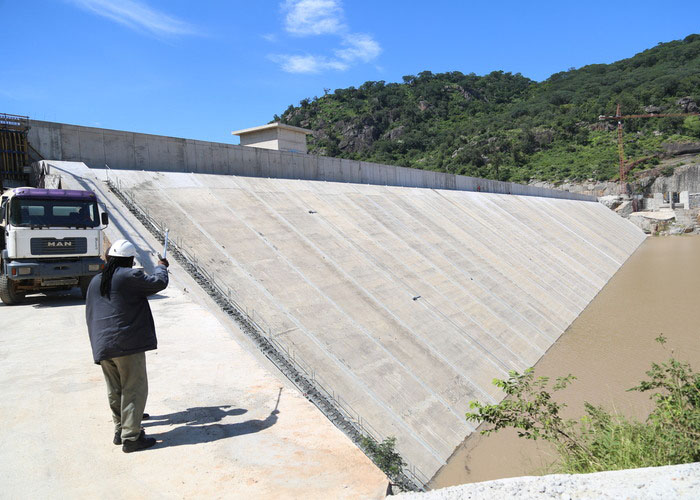
After decades of frustration, work stoppages and many false-starts, the country’s biggest inland dam, Tokwe-Mukosi, has finally been completed and as of Friday was 62,2 percent full.
This translates to a depth of 77m, just seven metres shy of the spilling level of 84m.
“We are gaining half-a-metre of water every day and if this trend continues we might reach full capacity by the end of this rain season,” said resident Engineer Paul Dengu in a telephone interview on Friday.
The dam now has 1,12 billion cubic metres of water immersing 7 300ha hectares of land, prompting Eng Dengu to appeal to people near the dam to carefully mind their livestock.
He also appealed to the Zimbabwe National Parks And Wildlife Authority to survey the area surrounded by the dam for any wild animals that might be stranded so that they are moved to safety.
When The Sunday Mail Extra visited the dam in mid-February, Tokwe-Mukosi was then sitting at 25 percent capacity.
To give a perspective of the magnitude of Tokwe-Mukosi, Lake Mutirikwi in Masvingo – which was until recently Zimbabwe’s largest inland dam – at full capacity holds 1,4 billion cubic metres of water covering about 9 000ha.
Tokwe-Mukosi is 400 million cubic metres bigger. By any stretch, the completion of Tokwe-Mukosi is an exciting development for Zimbabweans and their economy.
“The options are many and several,” explained Eng Dennis Dziike, the assistant resident engineer. “But the primary function of this dam is irrigation. Now all the farmers downstream of the dam can apply to use the water.
“If there is any time to turn the Lowveld into a greenbelt, that time is now. Sugar cane, citrus, maize, cotton, in fact all the crops that favour the climatic conditions of the Lowveld can now be farmed without regard to season, because the water is now in abundance.”
There many other prospects for investors. What will probably heighten interest in the dam will the soon-to-be-implemented upgrading of the Beitbridge-Harare-Chirundu Highway. The new road will mean that eco-tourists will have a new destination apart from the traditional Kariba visits.
For water sports to flourish, there is need for ancillary services like lodges, hotels, restaurants, service stations, a game park, among others.
“For any serious investor, this is the time to come and have a look at the investment opportunities that the completion of this dam hold. But the opportunities are many,” enthused Eng Dziike.
“Apart from wanting to come and marvel at this engineering spectacle, people would like to engage in some other activities like water sports. They will need to stay overnight. In fact, look at Tokwe-Mukosi as Kariba, the only difference being that Kariba is shared by Zimbabwe and Zambia and this one is not.”
Not to be outdone by Kariba, Tokwe-Mukosi has the capacity to generate hydro-electricity and there is provision for the construction of a 15MW power plant.
“The planning of the dam included a provision for the construction of a power station. The initiation of that power generation plan depends on what arrangement is put in place by the different line ministries involved in such a project. As Zinwa, our mandate is capture water and ensure that it helps the nation in meeting its water needs. The construction and provision of electric power will involve other ministries like that of Energy and Power Development.”
The Environment, Water and Climate Ministry, headed by Mrs Oppah Muchinguri-Kashiri, which oversees the Zimbabwe National Parks and Wildlife Authority, will likely oversee creation of a national park around the dam.
“There are a number of wild animals that are found around and near the dam and it will be the mandate of the Ministry of Environment, Water and Climate to ensure that these animals are protected; or even fencing the dam so that it becomes a national park,” further explained Eng Dziike.
Another opportunity awaiting investors is establishment of a crocodile farm and aquaculture in general and pisciculture in particular.
“Don’t forget that this dam was built at the confluence of the Tokwe and Mukosi rivers (hence its name), which by any measure were big rivers in their own rights. As such, these rivers had flourishing aqua life, like crocodiles and fish, before the dam was built. So already, there is a considerable population of crocodiles and fish in the dam.”
The first of its kind in the country in that it is a concrete-faced, rock-fill dam, the projections were that the dam would take three years to reach full capacity.
“The rains have been good for our purposes and if this trend continues, we will have full capacity this year. Then it will be up to stakeholders to utilise the dam,” said Eng Dengu.
The dam wall stands at a height of 89,2m from the river bed. Karigamombe Building in Harare, at 20 floors, stands 92m above the ground.
Explaining the rockfill structure during a tour of the dam in February 2016, Eng Dengu said most of the dams in the country, for example Chivero and Osbourne, were earth-fill dams.
“But just the same manner in which the Great Zimbabwe was built, Tokwe-Mukosi Dam used rock, without any mortar, from the ground up. But because water can flow through the rock fill, we had to put an impervious concrete face, about 40 centimetres thick, to hold up the water.”
Covering some 9 640 hectares at full supply level and with a catchment area of over 7 000 square kilometres, the dam has displaced about 5 000 families in its basin, families that have since been relocated to Chingwizi.
When the idea to build the dam was mooted in 1955, construction was to be stalled by the liberation struggle that saw Zimbabwe win Independence in 1980.
At Independence, the popular majority Government was saddled with a number of challenges and the dam only got the attention it deserved around the ‘90s. Cabinet approval came in 1995 and the tender was floated in 1996.
Just when construction was to begin, the Zimbabwean dollar fell on the infamous Black Friday of November 14 1997, rendering work which was meant to commence the following year largely academic. Construction started in March 1998 but stopped in April the following year.
Up to December 2001, the project was under full suspension and when construction began, there were a number of amendments to the tender agreement, part of which was the agreement that part of the payment to the project was to be in local currency (25 percent) with the remainder being in foreign currency.
In April 2004, another set of problems forced the suspension of the project and it was not until July 2011 that the final phase of the completion of the project got into full stride, a development that Eng Dengu attributed in large part to the adoption of the multi-currency regime.
Now Zimbabwe awaits official commissioning of the dam, which should be any time from now.
“That would not be for us to say, save to say that this dam is ready to turn around the fortunes of the country,” said Eng Dziike.



 Online Reporter