admin
admin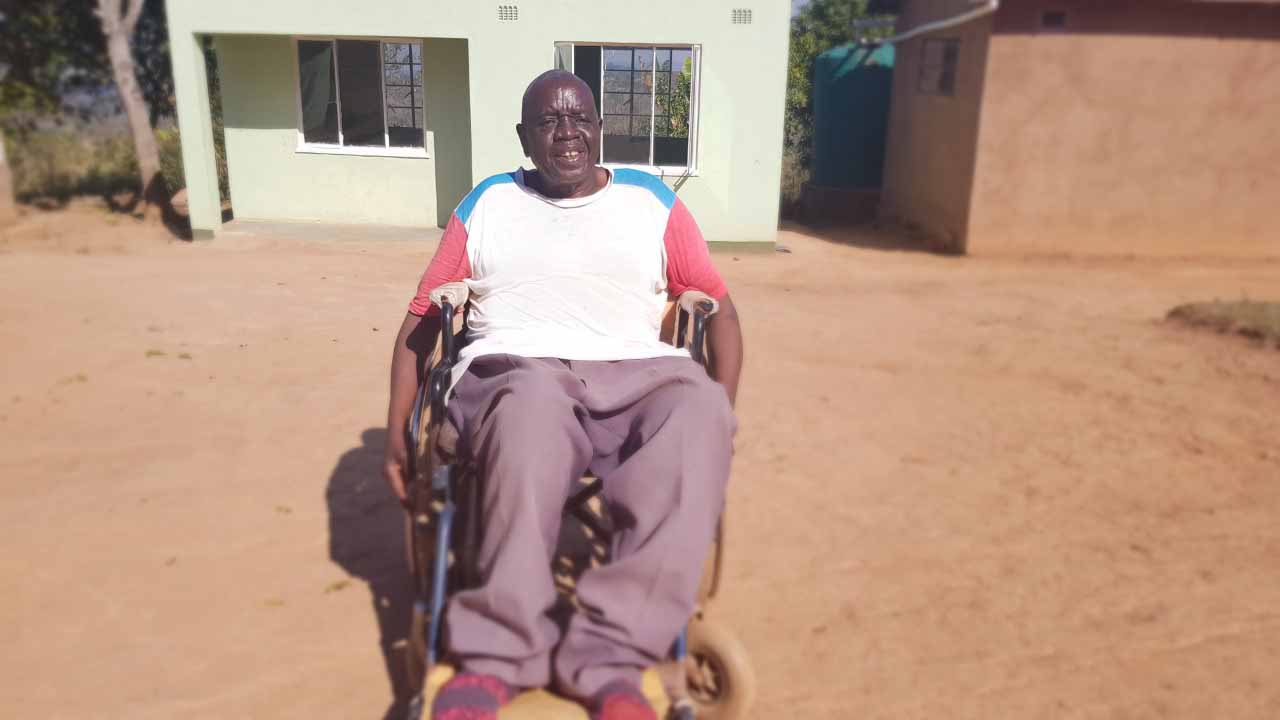
Sunday Mail Reporter
It took what probably many people might describe as a “simple slip”. But that “was not so simple for Samson Sithole’s life”.
It left him wheelchair-bound.
At the height of his career, Sithole was an accomplished electrician at Ratelshoek in Chipinge. He would respond swiftly to faults and fix them effortlessly to the satisfaction of his colleagues.
During one of his routine inspections, Sithole mounted a ladder onto a pole, in preparation for an electricity transformer check.
Oblivious of the tragedy that awaited him, Sithole climbed the ladder with ease.
As he worked on the transformer, Sithole missed a step, slipped and fell.
The moment he hit the ground, his life changed and he is now unable to perform his much-beloved profession.
Although the day of the life-changing incident is now a distant past, Sithole vividly remembers it.
“I worked at Tanganda (Tea Company) as an electrician and was injured while trying to repair a transformer that was mounted on a 12-metre-high pole,” he said.
“As I was fixing the transformer, one of my feet slipped and I fell to the ground from that height.
“A few moments after landing on the ground, my legs suddenly became cold and numb,” he says.
In yet another incident at the workplace, Rungano Matanga (22) was an energetic young man with big dreams.
He worked hard for a milling company in Ruwa, Harare, with the hope of rising through the ranks and securing a better future.
One day, Rungano, who had become accustomed to carrying heavy loads, underestimated the weight of his assignment. It was that load that shattered all his dreams for a brighter future.
He became a quadriplegic after sustaining injuries at the C-section of his spine when he tried to lift a 90kg bag of maize.
Says Matanga, as he narrates his ordeal: “I collapsed while carrying a 90kg bag at work.
“I was young when this happened — 22 years old to be precise.
“The injuries I sustained were quite severe as I twisted my neck and broke my C6 and C7 vertebrae.”
Unfortunately, Sithole and Matanga’s stories reflect a common tale that occurs at workplaces in Zimbabwe.
Thousands of workers are exposed to work-related injuries, illness or death due to the lack of proper occupational safety and health procedures.
Occupational safety and health (OSH) refers to the protection of workers from conditions that risk their well-being.
It involves the maintenance of good working conditions and ensures that workers are protected from risk factors that are adverse to health. Despite inspections and information dissemination programmes that are carried out regularly, there are employees and employers who continue to disregard safety and health practices.
Workplaces should be designed to be safe havens where there is career development and dreams are realised, but a considerable fraction of workers are finding themselves in Sithole and Matanga’s predicament.
Most of those who are injured and certified unfit for duty find it difficult to adjust to their new status.
From being mobile to requiring mobility assistance, their privacy in most cases is totally invaded, leaving them vulnerable and exposed.
The social problems, coupled with limited finances, also find them helpless leading them to turn to well-wishers for assistance.
Their state strips them of dignity, confidence and self-esteem, and this is unfathomable, particularly for men who were able to fend for themselves and their families.
It is upon realisation of these challenges that the National Social Security Authority (NSSA) established the Accidents Prevention and Worker’s Compensation Scheme (APWCS).
The facility is fully funded by the employer.
Currently, all employers, except Government and those in the informal sector, are required by the law to contribute to the scheme.
The objectives of the scheme are to provide financial relief to employees and their families when an employee is injured or killed in a work-related accident or suffers from a work-related disease or dies thereof.
Permanent injuries sustained from workplace accidents change one’s course of life and the reproach that society attaches to it is far much worse. Many of those who are injured at work tend to relocate to their rural areas, hoping for an affordable life, but the difficulties that the paraplegic face continue to stare them in the face.
These victims also suffer mobility challenges.
Most houses and buildings are not designed to accommodate wheelchairs, let alone the distance between the buildings and ablution facilities. The situation is worse in rural areas.
In most cases, these victims live in destitution.
Being the administrators of occupational safety and health at the workplace in Zimbabwe, NSSA has been burdened by this issue of paraplegics who have almost turned destitute.
Each visit by the NSSA staff to their households evokes emotions as they find it easier to share their stories with them, hoping for their fortunes to change one day so that they can, at least, become dignified members of their communities.
In 2018, NSSA launched Project Dzimba, an initiative aimed at providing homes suitable for paraplegics and quadriplegic pensioners under the Accident Prevention Workers’ Compensation Scheme.
The decision to construct customised houses across the country was made after the realisation that these disabled pensioners were living in deplorable environments that were detrimental to their health and well-being.
Ninety–six pensioners from across the country have benefited from this initiative.
Project Dzimba is an added initiative that is delivered over and above traditional benefits covered under APWCS.
Even though Matanga is an unfortunate victim of an avoidable work-related accident, he blissfully remembers and appreciates how he encountered NSSA.
“I was introduced to some NSSA representatives who had come to make a follow-up on a colleague of mine who had also been injured at work,” he said.
“The NSSA officers heard my story and assured me they were going to assist me in my matter.
“I am really not sure how it all worked, but the next communication I received from them was that they had looked into my case and had made arrangements for me to begin receiving compensation for the injury I sustained while I was at work.
“To me, NSSA is a good mother body. Without NSSA’s assistance, these houses would have taken me several years to build using my own resources,” says Matanga.
Matanga echoes Sithole’s sentiments: “I remember being taken to Bulawayo, to the Workers’ Compensation and Rehabilitation Centre to receive medical attention for the injuries I sustained.
“The NSSA doctor promptly attended to me.
“A few years after receiving regular treatment and assistance from NSSA, I recall one of the NSSA representatives contacted me and advised that NSSA was planning to build a house for me.
“I could not believe it. I am happy that NSSA’s assistance did not end when they built a house for me.
“From time to time, I receive unexpected food hampers from NSSA alongside much-needed medical and hygiene amenities.”’
Project Dzimba is in line with NSSA’s life-long promise of taking care of its clients throughout their life journey.
It also speaks to the authority’s values of hunhu/ubuntu, service delivery par excellence and doing things differently.


 Online Reporter