admin
admin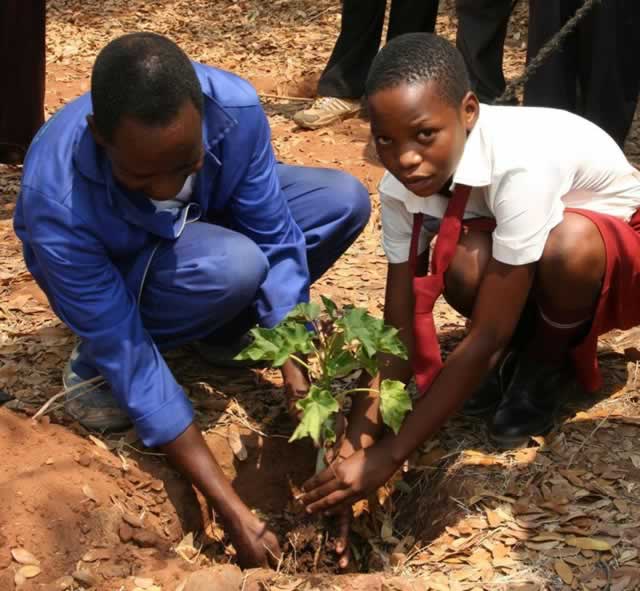
Jeffrey Gogo Climate Story
Zimbabwe succeeds in nurturing only 65 percent or 6,5 million trees of those planted in any one year under public programmes by the Forestry Commission, which is a far cry from what this country really needs.
The Forestry Commission said last week that at least 2,5 million trees put into the ground during the 2012/13 planting season died owing to factors such as veld fires, poor weather, animal damage, poor planting techniques and pests. That’s an average US$7,5 million gone down the drain if those trees were of indigenous extract, sold by the Commission for US$3 per plant.
Some trees experienced better chances of survival in a different region than the other while mortality was high in the next, said Ms Violet Makoto, the Forestry Commission’s spokesperson.
This rate of survival is disappointing and Ms Mokoto knows it. In a written response to questions by this paper last week she said that “tree planting can never be enough especially in light of the growing demand for firewood and timber”.
“We admit there is a deficit or a wide discrepancy between loss and replacement. Tree planting alone cannot address this challenge . . .” Trees are only truly beneficial when they mature, when they withstand early hazards, which makes post-planting care and maintenance crucial.
The Forestry Commission has for a very long time now consistently targeted the planting of millions of trees each year, mostly of indigenous origin, as part of its reforestation and afforestation programmes.
Over the past 30 years, nearly 50 million trees have been planted countrywide under the National Tree Planting Day initiative. For 2010 the target was 5 million and this was exceeded by 300 000 trees. In 2011, at least 9,2 million trees were planted out of a targeted 10 million. Early in the 1980s, the yearly target of one million trees was consistently beaten
For the current tree planting season, usually commemorated in December, the target is 10 million.
The contrast is striking, however. Tobacco production alone decimates 7,5 million trees every year here. Yet, a whole country, Zimbabwe, matches not even a bad standard from one economic sector in doing the positive opposite – planting, caring and growing life-supporting trees to maturity.
Thirty-five million more trees destroyed yearly in other areas of the economy including agriculture and infrastructure development will also be awaiting replacement.
Reforestation figures from the private sector are not included in the Commission’s data, but there has been increasing activity from this quarter with strong tree planting campaigns coming from organisations such as the Friends of the Environment (FOTE).
This coaltion of private businesses has been planting millions of trees every year since 2010 when it launched its Walkathon, an environmental solidarity march across targeted cities, along the way, planting trees.
FOTE has an ambitious target of planting 500 million trees by 2026, translating to about 41,6 million trees per year from now. Government aims for 50 million trees in five to 10 years, the same number of trees we are losing each year.
Though of limited capacity, the Forestry Commission had mechanisms in place to follow up on trees planted during the planting season to assess progress.
The Commission realised the inadequacies of Zimbabwe’s tree planting acts. For that reason it has expanded complimentary responses to include conservation strategies targeted mostly at communities and farmers, some of the biggest drivers of deforestation.
Ms Makoto said: “ . . . this (deficit) is why the Forestry Commission also promotes woodland management programmes that involve rehabilitation of deforested areas, allowing trees to coppice and ensuring the conservation of indigenous forests and makes way for their natural regeneration.
“Fire awareness campaigns and other woodland management programmes all complement tree planting activities but cannot really be quantified yet they are important ways of growing forests.”
The Forestry Commission also trains and educates communities on agroforestry practices that encourage the co-existence of trees and crops, she said, as well as “promote forest-based enterprises which make sure that a farmer can get livelihood without destroying the trees”. Examples are beekeeping, seedling production, growing woodlots to sell poles, etc.
However, the effectiveness of such projects remain in question given the country continues to experience unsustainably high rates of forests loss. The Commission puts the level of deforestation at 333 000 hectares per year or 50 million trees, an average rate for the 16 years since 1992.
That figure has now been overtaken by events, as deforestation in Zimbabwe widens everyday due to rising agriculture and infrastructure development, veld fires and energy needs among others. Fuelwood still remains the single largest source of energy here accounting for 53 percent in the national energy mix.
Obsolete data inhibits proper planning, fans speculation and usually gives rise to inadequate response strategies.
However, the Forestry Commission was currently updating its forests inventory to reflect current changes. This is done through surveys, including the use of satellite imaging, based on the years 2008-2012. These type of surveys are usually performed every 10 years.
“The Forestry Commission is not in a position to estimate the current rate (of deforestation) even with the different factors pointing to an increase we need specific figures based on an in inventory which cannot be done overnight. We appreciate that people want actual figures but the process of getting the figures is long and cannot be done on a daily basis,” said Ms Mokoto.
Now as December, the symbolic month for tree planting activities, wraps up taking stock of past successes is not important because that success does not exist. There is, as a matter of fact, increasing need to raise awareness and concretise actions on slowing down the rate of deforestation at a much faster pace than is currently the case.
Stiffer penalties should be meted out against those destroying forests or actively fuelling the destruction of such through illegal downstream industrial activities that feed on timber. Alternative energy sources must be explored and brought on board to curb the reliance on fuel-wood. This will be a mountain to climb in view of the country’s limited power generating capacity, which in the absence of adequate investments, is guaranteed to last for a long time to come.
To replenish forests as quickly as possible, people should plant “fast growing species of trees that can be harvested after five years”, as encouraged by the Commission. Such tree types include eucalyptus/gum trees, Beefwood, Senna Simea, Gravillia (which belongs to the oak family) or Cidrella which are exotics and some acacias (e.g. Apple ring) that are indigenous.
God is faithful.



 Online Reporter