admin
admin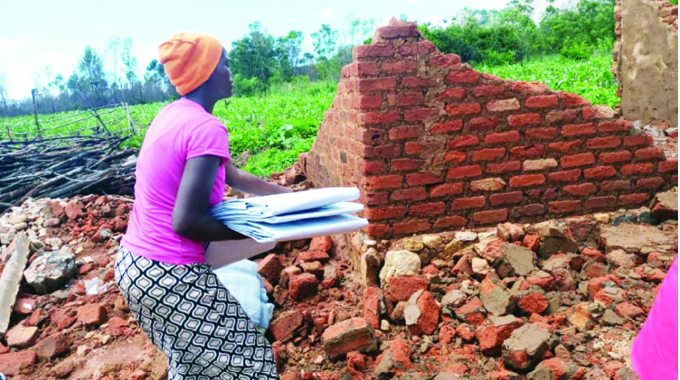
Phyllis Kachere Deputy News Editor (Convergence)
While overland tropical depression Ana seems to have dissipated, communities in Mutasa and Nyanga districts in Manicaland are counting their losses.
For seven-months pregnant mother of four, Ms Grace Chimbadzwa and her 43-year-old husband Mr Costain Mangunda of Ward 20 in Chida Zembe area in Mutasa, it’s back to the drawing board.
“Our four-roomed house collapsed on January 26, following heavy rains that pounded our area.
“We had been listening to the warnings of a cyclone from the radio and our village volunteers on disaster risk reduction about the impending disaster,” said Ms Chimbadzwa.
She narrated that while they had prepared for the impending disaster, the collapse of the house traumatised their children.
“My four children are now scared to stay home. After the collapse of the house, we tried to salvage the remainder of our belongings.
“Our food stocks were destroyed. Clothing and blankets are all wet, and we cannot dry them because of the incessant rains.
“I am pregnant, and most of the baby stuff that I have been accumulating in preparation for the arrival of the new baby has been lost,” she said, with tears running down her cheek.
She said her children spend the day with her in their only remaining house, but have to go to their paternal grandmother’s house for the night, about 300 metres away.
“The oldest child is turning 15, while the second is 11, another one is seven and the last is 4. They are all traumatised. They can’t sleep here,” she said.
After receiving a donation of blankets, tents, mosquito nets, hygiene kits and jerry cans from the Zimbabwe Red Cross Society Manicaland provincial manager Mr Munyaradzi Chikukwa, she said she has to raise funds to buy cement and bricks to build a new home.
“It is now clear that we have to construct a stronger house with cement and other components. The challenge for me and my husband is how to raise that kind of money,” she said.
Headman Victor Nyakurima said due to climate change, they were experiencing heavy and unprecedented rains.
“This means we must start building stronger houses that can withstand heavy winds and rains. We are used to building without cement. We must change. We have to use building components that make stronger houses,” said Headman Nyakurima.
For co-wives Ms Pauline Padzuwa (23) and Ms Polite Mukariri (19) from the same village, they had to go and squat at their father-in-law’s homestead after their three-roomed cottage and kitchen collapsed due to the heavy winds and rain.
“We were sleeping with my three children when we heard the heavy thud, a result of the collapsing bricks of our cottage.
“Our husband is away, so we moved to his father’s homestead.
“There isn’t enough room for the two of us and our children. But we have no choice. We have become homeless,” she said.
The Mutasa district development co-ordinator Ms Caroline Mudaringo said: “We continue to encourage our communities to build durable structures.
“Due to climate change issues, we will continue to have more cyclones characterised by heavy rains and strong winds.
“This means we have to change the way we used to build our homes. In the olden days, it was okay to build structures without cement, but nowadays, it is getting dangerous to continue like that. Things may be difficult, but let us try to use cement in our structures.”



 Online Reporter