admin
admin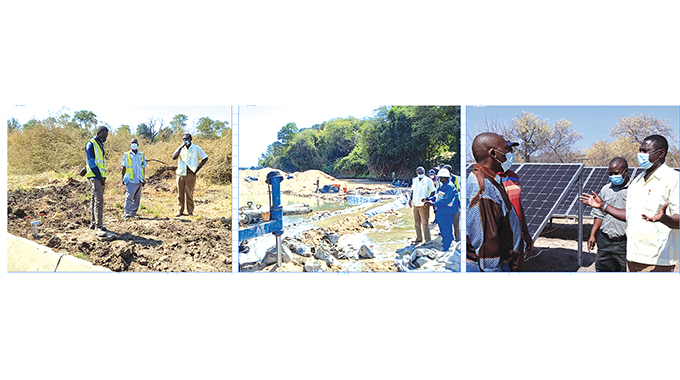
Thupeyo Muleya
Beitbridge Bureau
For the first time, in more than a decade and half, the 65-hectare Tshikwalakwala irrigation scheme in Beitbridge East is being rehabilitated bringing a glimmer of hope to the local community and investors alike.
This glimmer of hope is a result of efforts by the Second Republic to rehabilitate all irrigation schemes dotted around the country which had been neglected for years, affecting all efforts to improve food security and water availability.
This irrigation scheme, which has 130 potholders, was once a horticulture hub in the southern part of the country.
Lack of maintenance and antiquated irrigation infrastructure had complicated life for the locals, forcing them to rely heavily on food handouts.
This is despite the fact that this scheme, which was started around 1965, lies within a kilometre from the mighty Limpopo River.
But now things are changing. The Second Republic is turning the tide and taking bold steps to revamp the irrigation scheme.
Things started taking a turn in 2019 when the Government in partnership with the International Fund for Agricultural Development (IFAD) invested US$1 million for the revitalisation of the project.
This has brought hope to the local community which also showed its commitment by offering labour and pooling funds to buy fencing material.
Community members are excited about the rehabilitation of the scheme. It’s a dream come true for them.
The project is now nearing completion with the potholders and the contractor having started land preparations.
The potholders expect to plant maize on 32 hectares under phase one of the project that has been made possible under the seven-year Smallholder Irrigation Revitalisation Programme (SIRP).
SIRP national project coordinator, Mr Odreck Mukorera said the initiative is being implemented in four provinces.
“In Matabeleland South, our focus is at Tshikwalakwala irrigation scheme which is being rehabilitated,” he said.
“This communal irrigation has been grounded for a very long time, due to a number of challenges. One of the major challenges at the project has been the use of diesel pumps which was not sustainable in terms of ever-increasing operations costs”.
Mr Mukorera said they had drilled eight more boreholes in the Limpopo River using modern technology, and also converted the existing three to use solar.
The official said they had constructed two ground-mounted solar plants with an output capacity of 75 kilowatts and 54 kilowatts respectively.
So far, the solar plants and the pump units have been installed and now the farmers are busy with land clearance so that they may start planting.
“We are looking at the first crop to be planted before the end of August on the first 32 hectares which are ready for planting,” he said.
Matabeleland South’s provincial irrigation engineer, Shepherd Mupotegwa said the new solar system and the water infrastructure had the capacity to irrigate 1 000 hectares.
He said there was a proposal to extend the current 65 hectares to 90 hectares in a setup where 25 hectares will be put under citrus.
Beitbridge agronomist Ms Eve Kuzwa said they expect each farmer to get a minimum of R30 000 from selling green mealies from their plots, translating to a collective R4 million per season for all the 130 potholders.
She said they had come up with a planting calendar for the project after carrying out feasibility studies with other technocrats and the farmers.
“By August 30, the farmers should have planted maize under phase one and by February they will plant sugar beans and winter wheat in May next year.
We are going to use the block system, which entails planting the same crop at the same time, so that we have a good quality yield,” said Ms Kuzwa.
The Irrigation Management Committee chairman, Mr John Kibi Muleya said: “We thank the Government for coming to our rescue, we have been encountering challenges in reviving this project.
Procuring diesel to power the three pumps has been a headache for many years and some plotholders were considering pulling out because of the state of affairs here”.
He said to show commitment to the project, they had contributed their own funds to buy fencing material.
“Our wish is to have an electric fence to deter wild and domestic animals.
“When this venture is fully operational, it will reduce food and nutrition challenges at the household level,” said Mr Muleya.
Tshikwalakwala senior village head, Mr Never Zava said the community was delighted at the prospects of a thriving irrigation project.
He said the area had 273 homesteads and that they expected to do away with issues of food handouts in the near future.
“We have all agreed that we must work as a team, in consultation with agriculture technocrats. This project was long overdue.
The market for the products is plentiful and it includes Chiredzi and Beitbridge towns and other adjacent towns in South Africa,” said the traditional leader.
Beitbridge East Member of Parliament, Cde Albert Nguluvhe who also visited the place said he would help the farmers reserve one plot which will contribute food to the Isiphala seNkosi/Zunde raMambo.
He said the SIRP project would result in improved food and nutrition security, and the attainment of the envisaged Vision 2030.
“I want to thank the President and his Cabinet for giving this place the attention it deserves.
“Now it’s a dream come true for the community. The irrigation scheme has not been working for over 10 years,” said Cde Nguluvhe.
He said the communities should work hard to increase crop productivity and that they had no reason to fail considering the level of investment in the area by the Government.
The Government is on a drive to resuscitate irrigation schemes in the country with the aim to rehabilitate and modernise them under the Accelerated Irrigation Rehabilitation and Development Plan.
According to the National Development Strategy 1, the country is targeting to put 350 000 hectares under irrigation by 2025.
Government has so far invested $693 million under the National Accelerated Irrigation Rehabilitation and Development Programme, which seeks to exploit irrigable potential in every district as part of its drought proofing strategy.



 Online Reporter