Online Reporter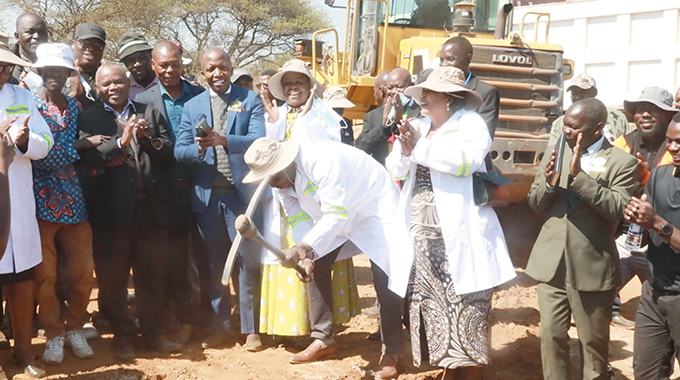
Sikhumbuzo Moyo, Senior Reporter
THE community-driven initiative to rehabilitate the Bulawayo-Tsholotsho Road has received a fresh boost, with Government officials, community leaders and stakeholders putting resources on the table to accelerate works on the 65-kilometre stretch.
The latest commitments include US$2 000 from Minister of State for Matabeleland North
Provincial Affairs and Devolution Richard Moyo, another US$2 000 from Landa John Nkomo Trust chairperson Mr Jabulani Nkomo and 1 000 litres of diesel from Tsholotsho South legislator Cde Musa Ncube.
The pledges, announced during the recent official launch of the Tsholotsho Road Rehabilitation
Initiative (TRRI) at Nyamandlovu Business Centre, come on top of 5 000 litres of diesel donated by the Zimbabwe National Road Administration (Zinara) under its Community Social Responsibility programme.
The initiative seeks to mobilise communities and other stakeholders to complement Government efforts to rehabilitate the 65km road, which is a critical link between Bulawayo and Tsholotsho.
The road carries commuters, traders, farmers and transport operators and has deteriorated over the years, increasing travelling times, vehicle maintenance costs and the cost of doing business along the route.
The latest support is expected to help increase the pace of works, with the community initiative operating under a 60-day completion target for the sections it is undertaking.
Speaking at the launch, Minister Moyo said the initiative demonstrated the power of communities
taking responsibility for development in their areas.
“This initiative strongly supports President Mnangagwa’s development philosophy that ilizwe lakhiwa ngabanikazi balo. This initiative clearly illustrates that national development is everyone’s responsibility,” he said.
“Government creates an enabling environment, institutions provide technical and financial support, local authorities mobilise resources, and communities become active participants in shaping their own future.”
Minister Moyo said reliable road infrastructure was essential to economic development, as it reduced transport costs, facilitated movement of goods and people and opened rural communities to markets and investment.
“Our roads are not merely strips of tar or gravel linking one point to another. They facilitate tourism, attract investment, reduce transport costs and improve the efficiency of public service delivery,” he said.
“This initiative therefore contributes directly to the realisation of Vision 2030, whose objective is to transform Zimbabwe into an empowered and prosperous upper-middle-income economy.”
The community initiative comes as Government moves to complement the project with formal road works.
Government has awarded tenders to two contractors to rehabilitate a 15km section, which will extend the tarred portion of the road to 35km.
The broader community project involves Tsholotsho and Umguza rural district councils, with rehabilitation works divided into manageable 23km sections.
Operations will commence simultaneously from the Bulawayo and Tsholotsho ends, with at least two independent teams deployed to work on either half of the targeted stretch.
The approach is aimed at shortening the rehabilitation period and ensuring that work progresses from both ends rather than relying on a single work front.
To prevent interruptions, gravel will be stockpiled before grading begins, ensuring that sufficient material is available throughout the project.
The rehabilitation will include spot dumping, where gravel or crushed stone is placed on severely damaged sections such as deep potholes, depressions, edge breaks and ruts.
Shoulder grading will also be undertaken to reshape and compact the road edges, improve drainage and reduce further deterioration.
The road rehabilitation programme has attracted growing support from communities and stakeholders, who have been urged to contribute financial resources, fuel, equipment and other forms of assistance.
The initiative is rooted in the belief that communities can complement Government-funded infrastructure programmes by contributing directly towards projects that affect their livelihoods.
The road also connects farmers to markets, enables traders to move goods, links communities to schools and health facilities and provides transport operators with a vital commercial corridor.