Chronicle Editor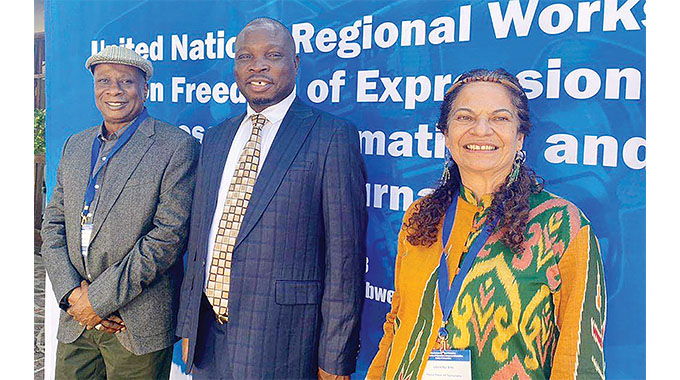
Leonard Ncube – [email protected]
THE media play a key role in the socio-economic transformation and implementation of national development agenda and attainment of Sustainable Development Goals (SDGs), United Nations resident and humanitarian co-ordinator for Zimbabwe, Mr Edward Kallon has said.
Speaking during the UN regional workshop to upscale UN-wide understanding of the rights to freedom of expression, access to information, and safety of journalists in sub-Saharan Africa in Victoria Falls yesterday, Mr Kallon said the meeting comes at an opportune time when the UN has rolled out a year-long campaign on human rights along with the 75th Anniversary of the Universal Declaration of Human Rights, viewed as a solution to all contemporary challenges — political, social, economic, and cultural.
“As we deliberate and exchange over the next two days, it is my sincere hope that as a regional grouping in the spirit of human rights at 75 initiative, we will leave this workshop with the commitment to a set of pledges to advance the rights to freedom of expression, freedom of information and safety of journalists in sub-Saharan Africa,” he said.
“The freedom of expression cannot be seen in isolation from social, economic, and democratic processes of a country or the context we all work in. Without journalists, it is not easy to achieve SDG Target 16.10, which ensures public access to information and protects fundamental freedoms, in accordance with national legislation and international agreements.”
The workshop seeks to strengthen the common resolve to the promotion of freedom of expression, freedom of information, and the safety of journalists and media workers in Africa.
The UN has expressed concern over a free-fall of the freedom of expression with the number of media workers killed around the world last year rising by 50 percent.
In July, UN will launch a new Agenda for Protection, an initiative to strengthen support from across its system to member States to protect people and their rights, both in times of peace and conflict.
Mr Kallon assured media practitioners that the UN recognises their tireless commitment to fact-checking stories and social media posts.
Freedom of expression was given international legal status enshrined under Article 19 of the Universal Declaration of Human Rights in 1948 and has been reflected in several regional human rights instruments, including the African Charter on Human and Peoples’ Rights.
Mr Kallon said freedom of expression calls for an open yet responsible information-sharing regime, guaranteed by law, and is an essential characteristic of people-centred democracy and development.
Zimbabwe also crafted the new Constitution in 2013, guaranteeing media freedom in Section 61.
Mr Kallon challenged member States to adhere to the spirit and letter of freedom of expression including adopting the UDHR in their national laws and information disclosure policy.
He said the responsible two-way flow of information helps citizens to articulate and exercise their rights and to make informed political and economic choices, and for a state to dialogue, receive feedback, and provide a response.
“So, as we deliberate on the issues for freedom of expression/information and safety of journalists, there shouldn’t be any dispute that a well-trained and judicious media plays a key role in social, economic, and democratic transformation,” said M Kallon.
“As such building media capacity is critical. Freedom of information provides better and timely access to reliable information, facilitates fact checks, and encourages investigative reporting. This enables the media and civil society organisations to perform their roles as vigilant watchdogs, with credibility, objectivity, and professionalism.”
Mr Kallon said the lives of the poor, and particularly women and girls in poor households, can be transformed by ensuring their access to information that protects their rights, ensures redress when wronged, and opens doors to development resources such as land, markets, and credit.
Government and political leaders also rely on social media to market their policies.
Speaking during the same event, Matabeleland North Provincial Affairs and Devolution Minister Richard Moyo said free media fosters and drives the existence of a sound environment.
He challenged citizens to play a responsible role guided by principles enshrined in the Constitution.
“Freedom of expression is priceless. The Second Republic under President Mnangagwa continues to be seized with efforts to improve the welfare of its citizens including media practitioners, “he said.
Unesco regional director for Southern Africa and representative to Sadc and Zimbabwe Professor Lidia Arthur Brito said there is a need to mobilise all stakeholders in Sub-Saharan Africa to scale up systems aimed at promoting media freedoms.
Information, Publicity and Broadcasting Services Minister Monica Mutsvangwa is expected to officiate at the workshop today.-@ncubeleon


 Online Reporter