

 Online Reporter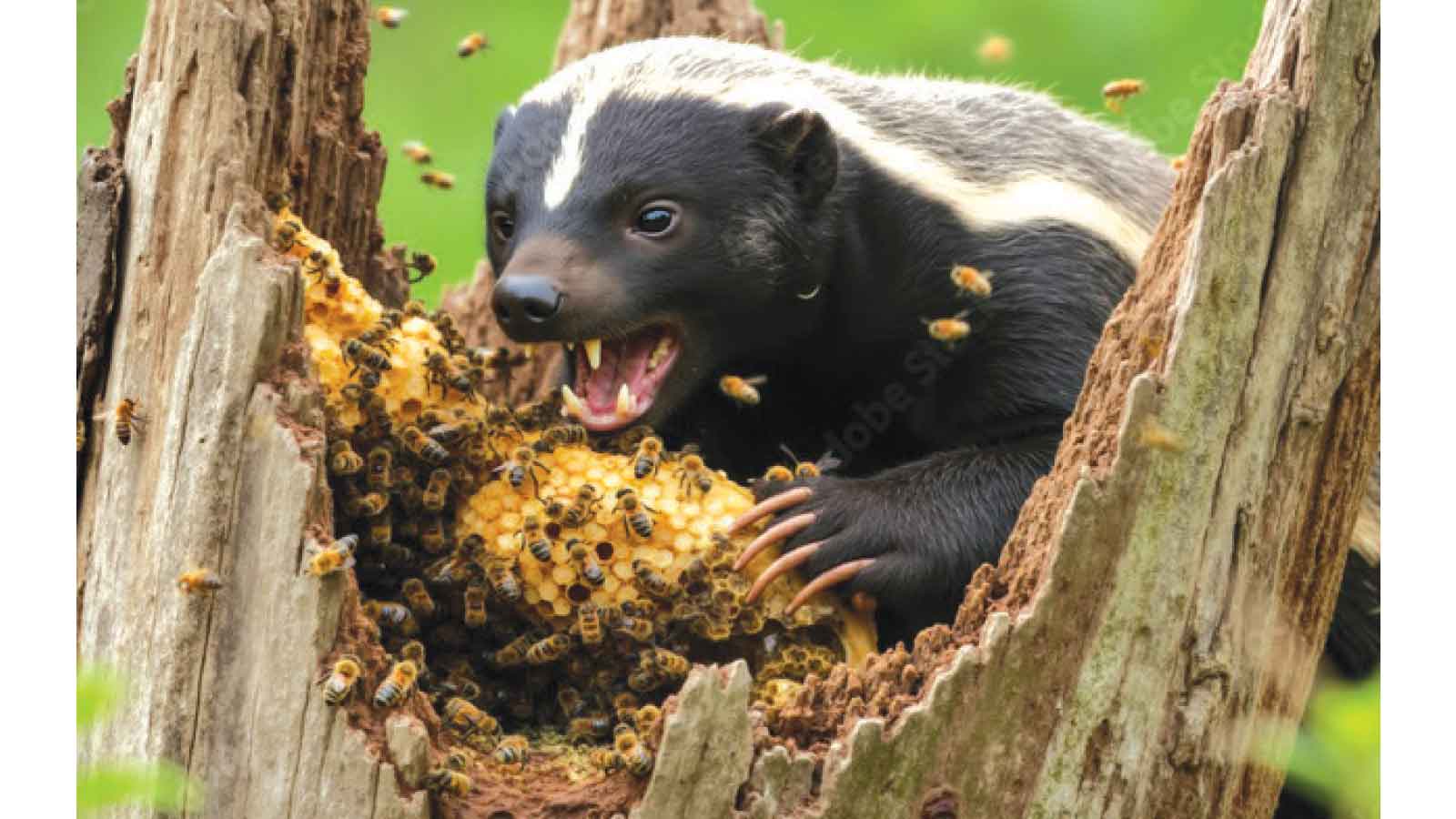
Arthur Marara-Point Blank
In the wilderness of the African savannah, where survival is a daily contest decided by tooth and claw, a small creature commands a respect that lions and elephants cannot claim.
The honey badger, standing barely a foot tall and weighing no more than 10kg, has been crowned by the Guinness Book of World Records as “the world’s most fearless animal”.
This is not hyperbole; it is a biological reality. When confronted by a leopard, a pride of lions, or a venomous cobra, the honey badger does not flee, does not negotiate, does not calculate the odds. It attacks. It fights. It persists. And remarkably, it often wins.
There is a profound leadership lesson in this small creature’s defiance of every natural law that says size determines outcomes. In an era of corporate giants, disruptive Goliaths, and market volatility that would overwhelm lesser organisations, the honey badger offers a blueprint for uncompromising tenacity — the disciplined, fearless pursuit of mission regardless of obstacles. Its success is built on a trinity of primal instincts: fearless tenacity, strategic resourcefulness, and resilient immunity. Together, they form a masterclass in leading through adversity.
I. Fearless Tenacity: The Will to Engage the Impossible
The honey badger does not calculate the size of its adversary before deciding whether to fight. Its default setting is engagement. Documented accounts describe honey badgers fearlessly attacking lions, savagely defending themselves against leopards, and confronting venomous snakes as a source of food rather than a threat to avoid. This is not recklessness; it is a profound confidence in its own capabilities, rooted in the knowledge that its ferocity, sharp claws, and thick skin make it a formidable opponent regardless of the size mismatch.
In one remarkable account, a honey badger named Stoffle repeatedly escaped from what his caretaker believed was an impenetrable enclosure. When confined, Stoffle didn’t accept his fate. He studied the environment, recruited a female companion as an accomplice, and devised elaborate escape plans — opening gates with two bolts through coordinated effort, piling rocks and mud to scale walls, and using tools like rakes to overcome barriers. Each time his keeper sealed one escape route, Stoffle found another. He simply refused to accept “no” as an answer.
The Business Translation: Cultivate the Will to Engage the Impossible. In organisations, the greatest limitations are rarely external. They are internal — the learned helplessness that accepts market dominance of larger competitors, the risk aversion that avoids bold moves, the cultural conditioning that says “this is how it’s always been done.” The honey badger teaches that fearlessness is a cultural choice, not a genetic accident.
Leaders who embody this principle refuse to be intimidated by industry giants. They understand, as Malcolm Gladwell articulated in David and Goliath, that the underdog’s perceived weakness can be transformed into strategic advantage when they refuse to play by the incumbent’s rules. They attack problems with the honey badger’s ferocity, not because they are reckless, but because they have cultivated an organisational confidence that says: “We may be smaller, but we are more determined, more agile, and more creative. And that is enough.”
This fearlessness must be institutionalized. It means rewarding teams who tackle seemingly impossible challenges, celebrating those who persist through repeated rejection, and creating a culture where the question is never “Can we?”, but “How will we?” The honey badger doesn’t ask if it can defeat the lion; it simply begins the fight, trusting its claws, its skin, and its relentless spirit.
II. Strategic Resourcefulness: Turning Constraints into Weapons
The honey badger’s fearlessness would be suicidal without its equally developed capacity for strategic resourcefulness. It is one of the few non-primate species documented using tools to solve problems — employing sticks, rocks, and mud to achieve objectives that brute force alone could not accomplish. In captivity, honey badgers have been observed rolling stones to create climbing platforms, using rakes to manipulate their environment, and even coordinating escapes with partners in elaborate, multi-step plans.
This resourcefulness extends to its hunting strategy. The honey badger is an omnivore and an opportunist, capable of surviving in diverse habitats from savannahs to forests. It doesn’t rely on a single food source or a single technique. It adapts. It experiments. It learns. When it scents prey beneath solid ground, it digs relentlessly until it reaches its goal — not through brute force alone, but through sustained, intelligent effort.
The Business Translation: Resourcefulness is the Ultimate Competitive Advantage. In resource-constrained environments — and for most organisations, resources are always constrained — the ability to do more with less separates the survivors from the casualties. The honey badger teaches that constraints are not barriers; they are invitations to innovation.
This means cultivating what the honey badger instinctively knows: that every obstacle contains within it the seed of a solution, if only we have the creativity and persistence to find it. When market conditions shift, the resourceful organisation doesn’t lament the loss of old advantages; it pivots, experiments, and discovers new paths to its goals. When competitors erect barriers, the resourceful leader studies those barriers, finds the cracks, and designs an elegant circumvention — just as Stoffle the honey badger studied the gate’s two bolts and recruited a partner to open them in coordinated sequence.
Leaders must institutionalise this resourcefulness by creating environments where creative problem-solving is celebrated, where failure in the service of learning is protected, and where the question “What else could we use?” is asked constantly.
The honey badger doesn’t wait for perfect tools; it fashions solutions from what’s at hand. Organisations that master this principle can thrive in environments where better-funded competitors starve.
III. Resilient Immunity: The Capacity to Absorb and Overcome
Perhaps the honey badger’s most astonishing adaptation is its biological and behavioural immunity to threats that would destroy other creatures. Its thick, loose skin is almost impossible for predators to penetrate, allowing it to twist and fight back even when caught in an enemy’s jaws. More remarkably, the honey badger possesses a natural resistance to venom. It can survive the bites of cobras and other venomous snakes, sometimes deliberately seeking them out as prey. When stung by bees in its pursuit of honey, it endures the pain, learns from the experience, and returns again and again — because the reward is worth the punishment .
This is not invulnerability; it is adaptive resilience. The honey badger doesn’t avoid pain — it accepts it as the cost of achieving its objectives and has evolved the physical and psychological capacity to absorb it.
The Business Translation: Build Organisational Immunity to Setbacks. Every organisation will face its “venomous bites” — market downturns, regulatory shocks, competitive assaults, product failures. The difference between those that collapse and those that persist lies in their organisational immune system.
Building this immunity requires three elements. First, develop a “thick skin” as an organisation — a culture that doesn’t take criticism personally but learns from it, that doesn’t crumble under pressure but adapts. This means cultivating psychological safety where setbacks are analysed dispassionately, not used as weapons of blame.
Second, build true resilience through exposure to manageable challenges. Just as the honey badger’s venom resistance is honed through repeated exposure, organisations strengthen their immune systems by navigating controlled crises, running stress tests, and learning from small failures before they become catastrophic ones.
Third, cultivate the mindset that pain is part of the path. The honey badger pursuing honey accepts that stings are the price of sweetness. Leaders must help their teams understand that meaningful objectives come with inevitable setbacks — and that persistence through those setbacks is not optional but essential. As one observer noted of the honey badger: “It has the right motivation not to give up in any hunting expedition”.
Arthur Marara is a corporate law attorney, keynote speaker, peak performance and corporate strategy speaker. With his delightful humour, raw energy, and wealth of life experiences, he captivates audiences and inspires them to unlock their full potential. Marara is the author of “Toys for Adults” a thought-provoking book on entrepreneurship, and “No One is Coming” a book that seeks to equip leaders to take charge. Send your feedback to [email protected] visit his website www.arthurmarara.com or contact him at +263772467255.



