Vusumuzi Dube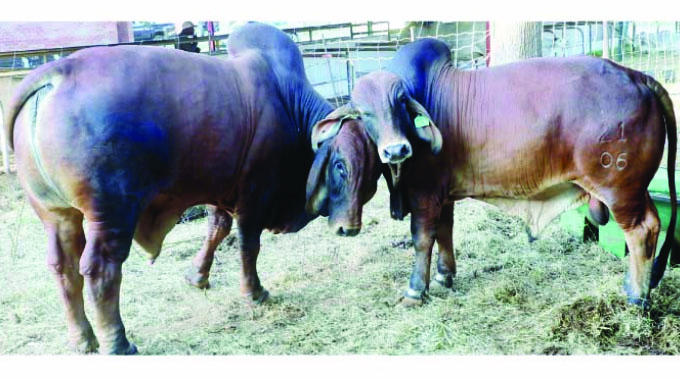
Mhlupheki Dube
This week, we discuss an important disease with regards to bull maintenance.
We again remind farmers and readers that a bull is half your herd because it contributes half of the genetics in your herd, especially in controlled breeding environment where you are sure it is the sire.
In other words, if you have twenty cows and they are all serviced by your bull, all their offspring will have the genetics from the bull and they will inherit the characteristics of that bull.
This is the level of influence and impact your bull has on the herd. Therefore, any disease that affect your bull and impair its ability to produce, is important.
One such disease is orchitis, which is an inflammation of the testicles. This is caused by either bacterial or viral infection. It can also be caused by physical injury to the testicles.

The affected bull will have swollen testicles with pain experienced on both testicles. Usually, the area becomes very hard and lose that general pliability that is known for the testicles.
Normal bull testicles are pliable, which means you can easily press, feel and see movement of the testicles with the scrotum. This may not happen when your bull has orchitis because of the swelling.
There is also redness and heat in the scrotal area, with pus discharge from the prepuce in some cases due to the inflammation. As a result of the pain due to the inflammation, your bull will exhibit general lethargy and loss of appetite. In fact, it will not go out to forage preferring lying down and resting instead.
As a result of orchitis, your bull may experience decreased fertility and eventual sterility in severe cases. In simple terms, your bull becomes non functional and not fit for purpose. What use is a bull when it is now infertile? It reduces to mere meat for the butcheries!
This is a huge loss to the farmer as you will have an impotent bull, which you probably bought at an exorbitant price. As a farmer, you therefore need to be careful and purposeful with regards to where you buy your bulls from.
You need to buy from herds that are free of this disease so that you do not buy a potential candidate for orchitis and import the disease into your herd.
This is why it is always very important to buy bulls from registered and regulated producers who can provide lineage records of their bulls because this is an animal, which comes to you after parting with a very significant amount, usually not less than two thousand five hundred dollars.

While orchitis is easily noticeable by physical inspection of the testicular area, it is good to carry-out laboratory tests to ascertain the cause so as to prescribe the correct medication. Treatment is generally by administration of antibiotics or anti- inflammatory medication supported by care such as provision of drinking water and feed in the pen. The disease can be prevented by adopting proper hygiene and general cleanliness to avoid infections.
However, vaccination is the principle prevention against orchitis. Farmers need to vaccinate their bulls and veterinary officers can advice on the proper vaccines to use especially against brucella. Since we are on the subject of a bull, we can as well talk about its management during this dry season. Usually, bulls are huge framed animals requiring huge quantities of feed intake daily.
The feed is obviously in short supply as we are not at the peak of the dry season. Be that as it may, it remains important for livestock farmers to prioritise supplementary feeding of bulls as well. If you allow your bull to excessively lose condition, it will take time to regain that condition following the onset of rains.
An emaciated bull will not service cows when they come on heat. It simply does not have energy for conjugal luxuries and hence your cows and heifers may miss an opportunity to be serviced simply because your bull is still too weak to indulge in such.
It is thus prudent to keep your bull in a fair condition, which will allow it to quickly reclaim its normal condition after the onset of the rain season. Uyabonga umntaka MaKhumalo.
Mhlupheki Dube is a livestock specialist and farmer. He writes in his own capacity. Feedback [email protected]. Cell 0772851275


 Online Reporter