dyton mupawaenda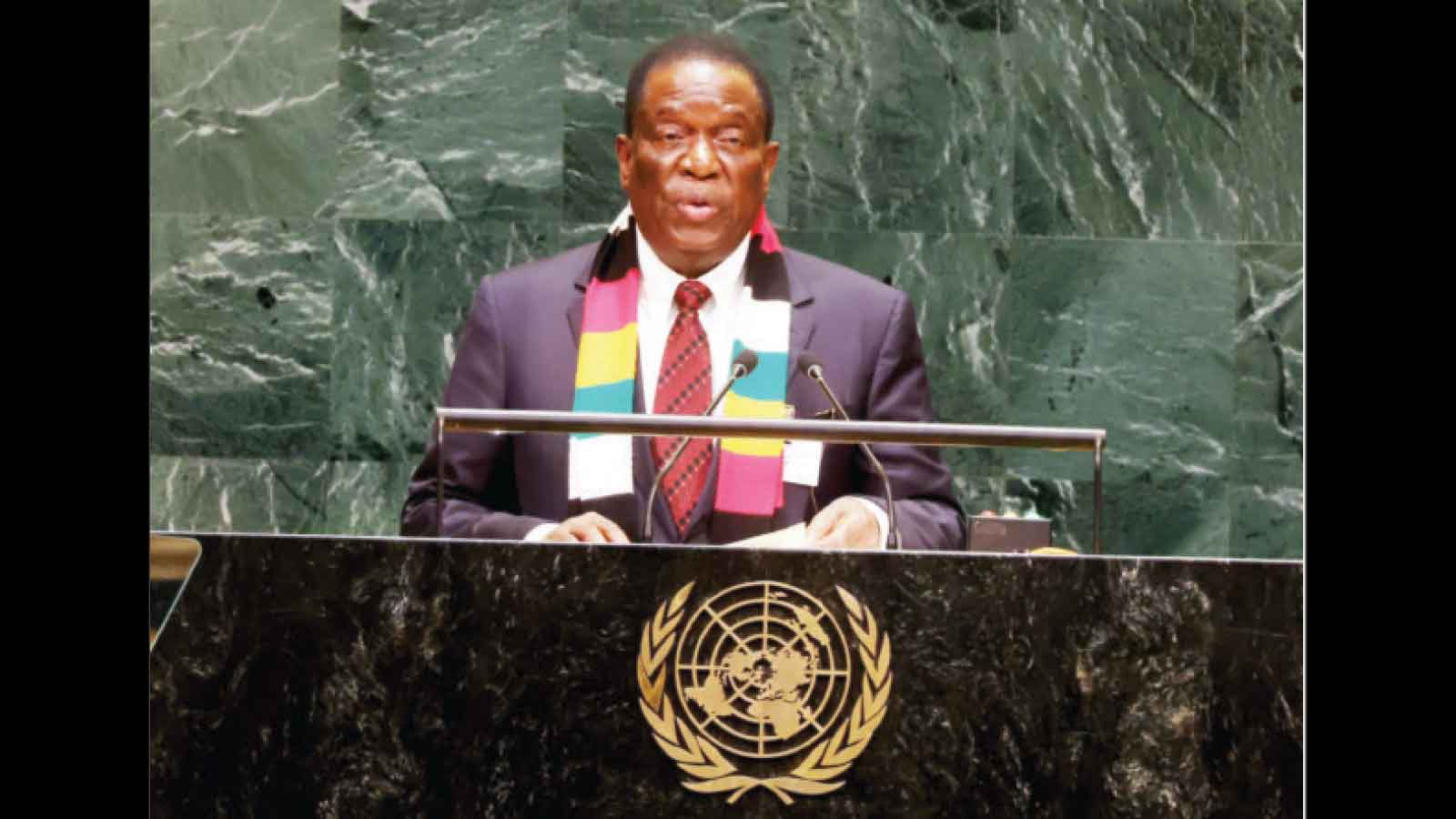
Wallace Ruzvidzo in New York, USA
There was a discernible shift in the way Zimbabwe approached the 81st Session of the United Nations General Assembly (UNGA81).
Yes, President Mnangagwa delivered the expected foreign policy message: calling for a more representative international system, defending multilateralism, advancing African interests and outlining Zimbabwe’s priorities ahead of its assumption of a non-permanent seat on the United Nations Security Council (UNSC).
But that was only one part of the New York story.
Perhaps more significantly, Zimbabwe used UNGA81 as a diplomatic, economic and technological marketplace, placing investment, critical minerals, beneficiation, artificial intelligence (AI), trade, tourism and Diaspora participation alongside the traditional issues of peace and international relations.
That distinction matters.
For years, high-level international gatherings have often been judged by the speeches delivered from the podium.
Zimbabwe’s participation this year suggests a broader calculation: the value of diplomatic visibility ultimately lies in what it can unlock beyond the conference hall.
The evidence was visible from the beginning of the President’s programme.
On the sidelines of the General Assembly, Zimbabwe hosted a Business Forum that brought together investors, financiers, international buyers, development partners and Zimbabweans based in the United States.
The event was specifically designed to showcase opportunities across mining, agriculture, tourism, energy and other sectors.
This was not incidental programming.
It represented an attempt to connect Zimbabwe’s political presence in New York with the practical question of capital.
And that perhaps provides the clearest lens through which to understand the country’s UNGA81 participation.
From diplomacy to economic diplomacy
Zimbabwe’s foreign policy mantra of being “a friend to all and an enemy to none” has traditionally been presented primarily as a statement of international relations.
In New York, however, it was increasingly deployed as an economic proposition.
President Mnangagwa told American investors that Zimbabwe was open to capital, technology, expertise, innovation, skills and international markets, while emphasising the country’s natural resources, agricultural potential, skilled workforce and strategic position in Southern Africa.
That is important because the global competition for investment has changed.
Countries are no longer simply selling tax incentives or cheap labour.
They are selling access to minerals, markets, energy, technology, infrastructure and strategic supply chains.
Zimbabwe possesses several of those assets.
Its challenge is converting possession into production.
That is why the President’s emphasis on beneficiation was arguably more consequential economically than simply reiterating Zimbabwe’s mineral wealth.
Zimbabwe can point to lithium, platinum-group metals, chrome, nickel, gold, diamonds and rare-earth elements.
But the real economic question is not how many minerals the country has.
It is how much value Zimbabwe captures before those minerals leave its borders.
The President’s UNGA address, therefore, fitted neatly with his Business Forum pitch.
The message was essentially that Zimbabwe wants to move further up the value chain, from extraction towards processing, refining, manufacturing and participation in regional value chains.
The reported dispatch of the country’s first locally produced lithium sulphate during the second quarter provided a tangible example of that ambition.
That is where UNGA diplomacy intersects with domestic economic policy.
The international message is about investment. The domestic objective is industrialisation.
The bridge between the two is value addition.
The lithium question is bigger than lithium
The critical minerals discussion also reveals why Zimbabwe’s economic diplomacy increasingly intersects with geopolitics.
The global energy transition is creating enormous demand for minerals needed in batteries, electric vehicles, renewable energy systems and other technologies.
At UNGA81, critical minerals and the question of who captures their value featured prominently in broader African economic discussions.
For Zimbabwe, this presents both an opportunity and a strategic dilemma.
The opportunity is obvious: mineral demand can bring investment, foreign currency earnings, technology, infrastructure and industrial capacity.
The dilemma is that a country can possess enormous mineral deposits while capturing relatively little of the final value.
Hence the repeated emphasis by President Mnangagwa on beneficiation at source.
If successful, that approach would mean a different economic relationship with international investors, one in which investors bring capital and technology while Zimbabwe seeks to retain a larger share of the value generated from its resources.
That is the logic behind the President’s “win-win” formulation.
However, the wider investment environment must make beneficiation commercially viable.
That is why the Business Forum, meetings with investors and engagements with international companies matter.
They form part of the search for the capital and technology required to translate policy into physical plants, production lines and export earnings.
AI adds a new dimension
Perhaps the most forward-looking component of Zimbabwe’s UNGA81 participation was the emphasis on artificial intelligence.
President Mnangagwa presented Zimbabwe’s National Artificial Intelligence Strategy 2026-2030 as part of the country’s industrialisation programme, while arguing that AI should narrow development gaps rather than deepen them.
That positioning is significant because AI is increasingly becoming an economic infrastructure issue rather than simply a technology issue.
At UNGA81, technology discussions were closely tied to questions of economic competitiveness, security, workforce transformation, digital infrastructure and global governance.
For Zimbabwe, the opportunity is potentially transformative.
A country does not necessarily need to replicate the enormous physical infrastructure of established industrial economies to benefit from some aspects of the digital economy.
AI can potentially improve agriculture, financial services, public administration, education, manufacturing, mining and healthcare.
But there is an important condition.
AI cannot compensate for weak foundations.
Reliable electricity, broadband connectivity, data infrastructure, digital skills, research capacity and appropriate regulation will determine how much value Zimbabwe can actually derive from the technological revolution.
The President’s engagement with technology companies during UNGA week, therefore, assumes even greater significance when viewed alongside the country’s AI strategy.
The Diaspora becomes part of the equation
The President’s engagement with Zimbabweans living in the United States provided another important piece of the same puzzle.
The Diaspora has traditionally been viewed largely through the prism of remittances.
President Mnangagwa’s message in New York was broader: Zimbabweans abroad can potentially contribute capital, professional expertise, technology, networks, markets and mentorship.
That represents a conceptual shift from seeing the Diaspora primarily as a source of household financial support to viewing it as part of the country’s wider development ecosystem.
There is also an obvious connection with the investment strategy.
An investor does not necessarily arrive in Zimbabwe with only money.
They may bring supply-chain relationships, technical expertise, international market access or industry-specific knowledge.
That makes the Diaspora potentially valuable not only as a financial constituency but also as a bridge to knowledge, markets and investment.
Again, however, the success of that strategy will ultimately depend on whether the opportunities presented in New York are converted into tangible projects in Zimbabwe.
The UNSC seat adds another layer
This is where Zimbabwe’s forthcoming Security Council membership becomes important, though not necessarily as the lead story.
The country’s election to the Council for the 2027-2028 term gives Zimbabwe an additional diplomatic platform from which to advocate for African interests, preventive diplomacy, peacebuilding and stronger co-operation between the UN and regional organisations.
President Mnangagwa outlined four priorities for the tenure: preventive diplomacy, stronger UN-AU co-operation, ensuring that Africa’s natural resources advance industrialisation rather than conflict, and greater participation by women and young people in peacebuilding.
The significance of the seat, therefore, extends beyond prestige.
Zimbabwe will enter the Council at a time when security, energy, minerals, climate, development finance and technology are becoming increasingly interconnected.
A conflict in a mineral-producing region can affect global supply chains. Climate shocks can undermine food security and trigger instability.
Energy transitions are reshaping demand for critical minerals. Technology is changing warfare and economic competition.
Development finance influences the ability of countries to build resilience.
In that environment, Zimbabwe’s economic and diplomatic messages are not separate tracks. Rather, they intersect.
The real measure begins after New York
This may ultimately be the most important conclusion from Zimbabwe’s UNGA81 participation.
New York has provided the platform.
The President has made the pitch.
Investors have been engaged.
The Diaspora has been addressed.
Critical minerals have been showcased.
AI has been incorporated into the industrialisation narrative.
Zimbabwe’s incoming Security Council role has been defined.
The harder part began when the delegation returned home.
The success of the New York mission will not ultimately be measured by the number of meetings held, speeches delivered or headlines generated.
It will be measured by outcomes.
Does an investor who listened to the President establish a project?
Does a mineral-processing discussion result in a new plant?
Does a technology engagement produce a partnership?
Does a Diaspora meeting result in capital, expertise or market access flowing back home?
Does the AI strategy translate into practical applications that improve productivity?
Does Zimbabwe’s diplomatic influence help create conditions for greater development finance, trade and investment?
Those are the questions that will determine whether UNGA81 becomes another successful diplomatic appearance or something more consequential.
There is reason to view Zimbabwe’s approach in New York as deliberately constructed around that broader objective.
The General Assembly supplied the global political stage.
The Business Forum supplied the investment platform.
Diaspora engagements added the human-capital and network dimension.
Technology meetings opened the digital-economy conversation.
Critical minerals discussions addressed the resource-to-industry question.
And the Security Council election supplied Zimbabwe with a new diplomatic platform from which to advance African and developing-country interests.
Taken together, these were not disconnected engagements.
They formed a coherent proposition: Zimbabwe wants its international relationships to generate economic relationships, and it wants those economic relationships to contribute to domestic transformation.
That is perhaps the most significant story to emerge from Zimbabwe’s UNGA81 participation.
The speeches in the General Assembly chamber mattered.
But the larger test of Zimbabwe’s New York mission will be what happens after the lights of UNGA go out.
That is when diplomacy must become investment, investment must become production, production must become jobs and exports, and international visibility must become measurable development at home.


 Online Reporter