admin
admin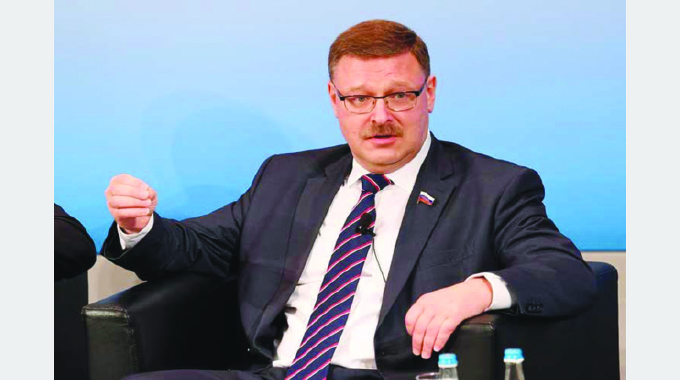
The neo-colonial agenda of the West is threatening the sovereignty of African states. However, Russia says it will not allow a unipolar system led by the United States to dominate the world. Deputy Speaker of the Russian Federal Council Konstantin Kosachev (KK) in an interview during his visit to Harare told Herald Correspondent Gibson Nyikadzino (GN) that Russia will not stop fighting for Africa against Western neo-imperial agenda. Below are the excerpts:
GN: Russia has been present in Africa to help the continent from colonialism. Today, colonialism has taken a new form (technological, cultural, and informational) with the Western narrative domineering. Do you think you can also help Africa win this new and modern colonialism?
KK. It is impossible to build a sustainable multipolar world order without eliminating the latter form of colonialism in all its current forms – technological, financial, institutional, cultural, informational. For Russia, a unipolar world is categorically unacceptable.
The West is putting unprecedented pressure on every country in the world without exception to obediently follow the policy dictated by the US and its allies. Therefore, Russia is existentially interested in the existence of the largest possible number of truly independent states in the world.
That we have enough determination, if necessary, to use military force, I believe, there is no longer any doubt after the Russian military operations in Syria and Ukraine.
I am sure that the new, just world order will put everything in its place. Both Russia and Africa have something to fight for together. Therefore, our African friends can count on our support, as they did in the 20th century.
GN: The USA has passed the Countering Malign Russian Activities in Africa Act, a law that punishes states that back Russia’s activities in Africa. What measures have you put in place to protect or cushion Africa from the impending socio-economic and political consequences from the US?
KK: The draft law on counteracting Russia’s “hostile activity” in Africa, which has already passed hearings in the House of Representatives of the US Congress, in my opinion, is the quintessence of colonial thinking and an attempt by Washington to transfer geopolitical conflicts to African soil. As one of the main supporters of the document, a member of the US House of Representatives Committee on Foreign Policy, quite frankly said, “Russian activity on the (African) continent is growing, and this is a real threat to our interests.”
According to the politician, Washington should force African governments and officials to choose with whom to do business.
In this case we are not talking about supporting Africa, but about purely American interests promoted in the rudest ways. The document, in particular, involves holding accountable the governments of African countries and their officials who support the Russian “hostile influence and activities”.
Let me remind you that all this is said by people who passionately supported the freedom of each state to choose its partners when it came to Ukraine. But, as we see, they do not provide for such freedom for African countries.
I believe that in full accordance with the Declaration of the first Russia-Africa summit of October 24, 2019, in which we emphasised our desire “to jointly oppose political diktat and currency blackmail in the implementation of international trade and economic cooperation, to stop the desire of individual countries to appropriate the exclusive right to determine expediency and acceptable parameters of legitimate interaction between other countries, as well as to avoid manipulating the requirements of the global non-proliferation regime in order to put pressure on objectionable countries and unfair competition.”
There, at the summit, the mechanisms for further interaction were formed, ambitious goals for its development were set.
As far as Russian principles of cooperation with Africa, I would recall the words of Russian President Vladimir Putin, who in an interview on the eve of the Russia-Africa Summit said: “We do not condition our support for proposed joint development projects with political or other conditions, so-called exclusive, but in fact enslaving economic and trade preferences, we do not impose our position, but respect the proposed by the Africans themselves the principle of ‘African problems – African solutions’”
This is an important point: unlike its Western opponents Russia does not offer to be friends against someone. We are ready for fair and open competition for influence in Africa, but it seems that those who are used to commanding and imposing their will on other countries are not ready for this.
GN: Since the February 24 Special Military Operation by Russia in Ukraine, there have been serious issues regards Africa’s position in this conflict. Here, the EU Ambassador has expressed concern that Africa has failed to condemn Russia’s military operation. How do you locate Africa in this conflict and how is it caught up in a USA/NATO/European-Russia conflict?
KK: You rightly mention the conflict between the US/NATO/EU and Russia. Many in the world see this and are well aware that they are being drawn into the confrontation between the West and Russia.
It seems that the balanced and objective position of African countries in this situation is dictated by their national interests, their own experience of dealing with both the West and our country, and the desire to refrain from participating in the conflict. There are, of course, nuances in the positions, but in general this position is quite understandable and traditional.
Another thing is that this position does not suit America and its allies. The West almost daily sends ultimatums to every capital, uses all possible levers of blackmail and pressure, even directly threatens the governments of sovereign states that they will be punished if they do not join the sanctions against Russia.
They begin to remember about Africa when African votes are needed against those whom the West today has appointed as its adversary. Yesterday it was Iran or Venezuela, today it is Russia, tomorrow it will be China.
But the essence is the same: this is absolutely colonial thinking, and not the desire to sincerely help African countries to solve their most serious problems, which just largely begin from their colonial past.
The fact that Africa is trying to resist blackmailing and bribery confirms the increased geopolitical maturity of the continent, its awareness of its interests and its desire to become a full-fledged independent centre along with all others countries in the democratic multipolar system. This fully meets Russian interests. The world should not be divided into “chosen”, “privileged”, “exclusive” countries and peoples – and into all the rest.
In addition, the world also sees the blatant hypocrisy of the West, calling for the condemnation of the Russian special military operation in Ukraine as something “unheard-of.” As if everyone had forgotten NATO’s military aggression against Yugoslavia in 1999 without a mandate from the UN Security Council, as a result of which part of its historical territory was taken from a sovereign state against its will by force. Or the 2003 war in Iraq, which was started on the blatantly false ground that Saddam Hussein was developing weapons of mass destruction. And then there was the 2011 Western invasion of Libya outside the framework of a UN Security Council resolution, which resulted in the destruction of Libyan statehood, civil war and the growth of terrorism throughout North Africa.
And even in the presentation of information, outright racism comes through: they say that the victims in Africa or Afghanistan cannot be compared with those who die in Ukraine. It is useless for West to believe their politicians and media that these double standards and hypocrisy are not seen beyond their own audience.
GN: The USA and its Western allies have built socio-economic, political and cultural institutions like IMF and World Bank to which Russia is part of since 1992. How has joining the two organisations undermined your sovereignty and civilisation considering the two institutions have provided financial assistance to Ukraine since the February 24 Special Military Operation?
KK: I think the future belongs to those organisations that will work in the interests of all members of the international community without exception. But we see no harm in the existence of universal institutions that could serve as tools to support the development of individual states. To the extent that the World Bank and the IMF fulfil this mission, they have enjoyed the support of Russia and many of its partners, including, for example, China.
Concern is caused by the conditions that sometimes imposed on the assistance offered to needy states, in particular, the requirements for certain reforms, the formation of certain institutions, and so on. Behind this is often not the immediate economic needs of the recipient countries, but the political interests of the states that dominate the financial structures.
The politicisation of the actions of financial institutions is also noticeable against the backdrop of the Ukrainian conflict. When they try to reduce the negative effects of conflict, support health systems and refugees, this is their usual mission. But when the leaders of the IMF and the World Bank officially declare that their task is to “support Ukraine on the financial and political fronts”, this is already something else. “Front” logic is contraindicated for institutions that claim the status of universal and independent.
Full interview on www.herald.co.zw
GN: China has said it wants to propose an expanded BRICS membership involving emerging economies. As a BRICS founding member, do you consider that a workable and noble move which however may be detriment to Africa considering its close proximity to Russia?
KK: As for BRICS, a number of other important world players are showing interest in this format, for example, Saudi Arabia. And the Minister of Foreign Affairs of Argentina, S. Cafiero, also announced his country’s desire to become a full member of the BRICS. This speaks of the viability of the association and its growing role as a platform for discussing world problems between very different states from different continents.
I think the secret of the attractiveness of BRICS lies in its democratic nature, in which no one dominates and does not impose their will. The next summit of this “five” is being prepared. Within its framework, an outreach format will be created, in which a dozen developing states will take part. And this is only for the benefit of the association. On May 20, within the framework of the virtual meeting of the BRICS foreign ministers, organized by China, a separate session was held in the BRICS+ format. Argentina, Egypt, Indonesia, Kazakhstan, Nigeria, UAE, Saudi Arabia, Senegal and Thailand were represented at the meeting.
However, this irritates the West, which sees a threat to itself in any organization not under its control. The paradox is that the stronger the opposition of the West to the development of global structures with a truly democratic order, the more the world and regional powers desire to create and strengthen them. So, I think that the pressure of the USA and the West in general. BRICS will only strengthen this format and increase its attractiveness for many states of the planet.
GN: How will the expanded BRICS organisation remain relevant considering we once had the Non-Aligned Movement (NAM) which is still there but has not changed in form and character to address new demands. How will you keep it alive?
KK: Russia really supports China’s initiative to expand the membership of the BRICS group. Although for now I would refrain from mentioning potential candidates – this is a subject of discussion both with the members of the organisation and with each of the candidates.
The procedure for accepting new BRICS members should be developed, which requires a consensus of its current members on standards, criteria and other organisational issues, as was said in a joint statement following the meeting of the BRICS Foreign Ministers. As for cooperation with the Non-Aligned Movement, I do not see any formal obstacles on this way. In 2016, when the Non-Aligned Movement was chaired by Venezuela, the Caracas summit approved the final declaration, which stated: “It is necessary to raise the flags of a new international economic order, based on a powerful alliance with the BRICS as an emerging economic force.”
The BRICS format as a non-military and non-bloc association does not prevent this in any way, and, in my opinion, both global institutions can complement each other’s efforts.
Another thing is that it would be reasonable to formalise this interaction by adopting a certain strategy and, possibly, certain principles and ideas of cooperation. As I understand it, the next Conference of Heads of State and Government of Non-Aligned Countries is to be held in Uganda next year. Perhaps it makes sense to come to this summit with ready-made proposals for interaction with the BRICS. Russia will definitely support it.


 Online Reporter