Online Reporter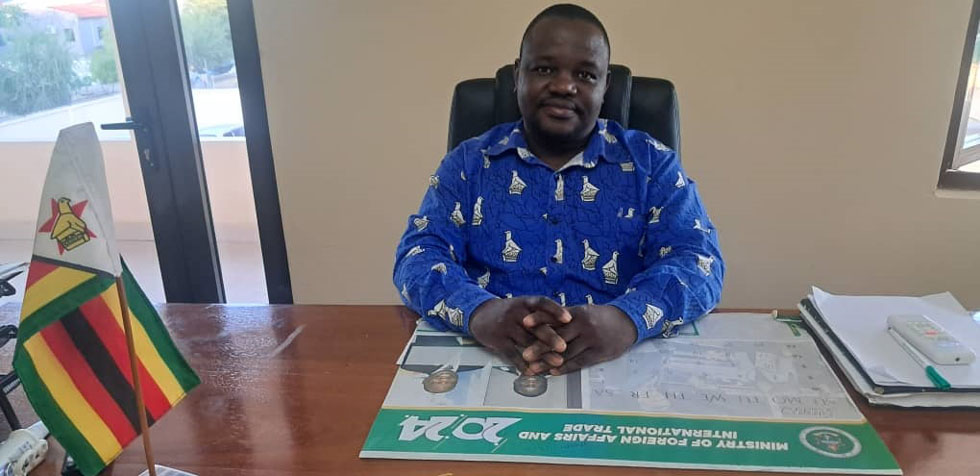
Cletus Mushanawani
Editor
IN a bid to foster stronger diplomatic and economic relations between Mozambique and Zimbabwe, Zimbabwe Consulate General in Mozambique plays a vital role in promoting trade, cultural exchange, and providing essential consular services to citizens of both nations.
At the helm of this critical diplomatic mission is Mr Munetsi Malvern Bere (MMB), the esteemed Consul General of Zimbabwe in Beira, Mozambique.
Our Editor, Cletus Mushanawani (CM) was in Beira, Sofala Province, Mozambique last week for the ZimTrade Outward Seller Mission where he had a chance to rope in the youthful Consul General for an exclusive interview.
In this insightful interview, Mr Bere shares his vision for enhancing bilateral cooperation, discusses the range of activities superintended by his office, and highlights the opportunities and challenges that come with nurturing a robust relationship between the two neighbouring countries.
From trade and investment to cultural exchange and consular services, Mr Bere provided a comprehensive overview of the Consulate’s work and its commitment to serving the interests of both Zimbabwe and Mozambique.
This interview offers a unique glimpse into the inner workings of the Zimbabwean Consulate General, and sheds light on the important role it plays in strengthening ties between two nations:
CM: What consular services are available to Zimbabweans living in this part of Mozambique (Beira, Chimoio and Tete among other provinces), and how can they access these services?
MMB: We have a number of Zimbabweans living here in Mozambique. Most of them have actually secured local documents.
They have Mozambican particulars, while others are still using Zimbabwean particulars, but we are encouraging everyone to visit the Embassy so that we can document them.
So these people are coming to our offices to regularise their stay.
Initially when I came to this office, we used to have one visitor per month, but nowadays, almost everyday we have Zimbabweans who are coming in to seek consular services.
So in terms of consular services, I mean things like birth certificates, passports, identification cards, Temporary Travel Documents (TTDs), authentication of documents, and driver’s licences.
To assist in replacing these documents, we have to call our head office in Harare or Central Vehicle Registry Department directly or the actual department that deals with these documents.
There is so much that we do here, almost everyday we receive such requests, and we think we have done fairly well in terms of consular service assistance.
Then we have bereavements, and funerals are another challenge.
The biggest challenge being that there are some people who come here and do not renew their documents.
Some of them will lose everything to an extent that you cannot even identify whether the person is Zimbabwean or not, and we are only told by others that he is Zimbabwean.
Sometimes we are forced to request the family members in Zimbabwe for the particulars of that person.
It is not easy. Recently, we had a similar case of a Zimbabwean who also had Mozambican particulars, but he wanted to be buried in Zimbabwe.
So it presents some challenges for us to identify whether you are a Zimbabwean or not.
And also there is a challenge on post-mortem.
There are huge amounts that are attached to it, I would say more than US$500 just to do the post-mortem.
But if you are a local it is free.
So our people are complaining saying the money is too much for them, and most of them do not have the funds.
We have engaged the authorities here, and we hope to get a remedy, God willing.
These are some of the consular duties that we do.
On top of that, we also man the Beira Corridor, that is our responsibility.
I am sure when you were coming you saw trucks, many of them.
Nowadays the corridor clears about 1 500 trucks on a daily basis which is quite significant, and have actually surpassed Beitbridge Border Post in terms of trucks that are processed showing that it is now a busy route.
But there is a challenge at Munene Bridge at the no man’s land at the border which is creating some traffic congestion there.
I happy to say that the Government has noted that, and that they are going to develop the border.
So we hope it will be fast-tracked.
CM: Thank you for the insight on the consular services being offered by your office, but from your explanation, it shows that there is a challenge in cargo movement.
How are you working to ensure a smooth flow and avoid unnecessary delays in the movement of goods between the two sister nations?
MMB: They used to be very serious challenges in cargo movements in that past. However, we are working flat out to address this.
First of all, we have what we call Revimo, the company that was contracted to superintend the Machipanda to Beira Road.
This road was constructed by a Chinese company, so they are responsible for repairs to the damages, but they charge for that service.
In the event of a truck breakdown, they only give our truckers three hours to remove their trucks.
After three hours, they send some tow trucks which are very expensive.
They charge between US$1 500 to US$3 000, sometimes for a very short distance even for 100 metres, you have to pay that amount.
But, however, I am happy to announce that this has been rectified, so now they are entitled to 24 hours.
At the border, our trucks are given 24 hours after they leave the port to exit, but now if you drive to the border there is a 20km queue.
You are forced to stay there for the next two days, and when you are exiting you are charged for exceeding the time you are expected to leave the border.
Is that the fault of the driver?
So we have engaged the authorities in Mozambique, and they have promised to look into the matter.
We hope it will be rectified as soon as possible.
There is also the issue of thefts being reported. Of course here and there some petty thefts, petty crimes are recorded and it is normal.
It is everywhere.
Even at the port (Sea Port of Beira) there used to be some unnecessary delays, but now that has been resolved.
We have engaged the company that is managing the port, Cornelder de Mozambique, and we raised these issues that the drivers had brought to us.
So now I can safely say that they have installed some cameras, and they have now a 24-hour hotline which we have given to all the drivers.
Moreso, we as a Consulate, we have a 24-hour functional WhatsApp account which we have also shared with all the drivers. If they experience any problems, they can call us.
We also have the contact details of the police commanders for Manica and Sofala provinces, so for any corrupt activities involving the local police, drivers are free to call us and we will call the commanders.
They have been very supportive. I can say right now we are on track, but our call is for improvements at the border.
CM: You mentioned that there are exciting developments at the Sea Port of Beira aimed at improving cargo handling to and from Zimbabwe, may you shed more light on the developments there?
MMB: Cornelder de Mozambique are doing a great job to develop the port.
In the past they were processing an average of 4 500 tonnes of cargo, but now they are processing over 500 000 tonnes, and they are hoping to process 700 000 per annum.
But now the challenge is that it will create bottlenecks if they develop here and do not develop the border.
They would not have done much.
There is need for mutual development here and at the border, both at Machipanda and Forbes.
But one of the biggest solutions is a one-stop border post.
This is the panacea to everything.
CM: Taking a leaf from the developments happening at the Sea Port of Beira, how can Zimbabwe and Mozambique cooperate on economic development projects, such as infrastructure development and agriculture?
MMB: Following ZimTrade’s highly successful trade missions to Mozambique over the past few years, we are now inundated with calls from our businesspersons and Mozambican businesses who want to source products from Zimbabwe.
The ZimTrade Tete Trade Mission in 2023 and 2024 was a success, and we are now replicating it here in Beira. We are happy that we had more than 30 companies participating, in Tete there were 15 companies.
This year’s Trade Mission was oversubscribed, and we had to limit the number of companies that wanted to come.
Most of them that are already functional are into supplying irrigation equipment, belts and PPEs.
These are being manufactured in Zimbabwe, and they are being send here.
For most companies especially in Tete, they are buying from Zimbabwe, so we hope after this Trade Mission the same will happen here in Beira, but already as a Consulate we are approaching these companies as well giving them contacts.
So this mission was mainly about just marrying those buyers and suppliers.
I think we need to have more of these especially in all the provinces.
This time we are in Sofala, last year we were in Tete, probably next year we will be in Chimoio. We want to maximise trade between these two countries.
There are huge opportunities for Zimbabwean products, and most people prefer Zimbabwean products because of their organic nature, especially Mozambicans.
We are one people.
I think our desires are almost similar.
So what we want at home is also basically what they want here as well.
I do not think we have to scout for markets far, let us exhaust local ones, and also look at the distance.
Mozambique is just a stone throw away, and most of the products that are in their shelves are from Zimbabwe.
We are pushing, this has been our thrust.
Politically we are ok, now there is also need to solidify politics with trade. Ukama igasva hwunizadziswa nekudya.
So this is what we are doing now, for countries to develop they need to trade.
This is what we are doing.
We now have Intra-African Trade, Continental Free Trade Area (CFTA), let us live on that.
There are so many instruments we can capitalise on.
CM: What are the major challenges facing Zimbabwean businesses and investors in Mozambique, and how can they be addressed?
MMB: Before, there was an issue of security of investments.
I am happy to announce that the Mozambican authorities have addressed that after it had been raised to them.
Now you can actually invest 100 percent, with 100 percent shareholding.
You do not need to share your company with anyone because that was the challenge.
Now it is 100 percent ownership.
You are now allowed to invest 100 percent in the business of your choice.
Investment opportunities are available in manufacturing, agriculture, logistics especially at the port, and transport.
But the biggest investment is in agriculture because there are vast lands here which are under-utilised.
Among some of the challenges is foreign currency, of late they have been experiencing some foreign currency shortages, but it is slowly improving.
The has been an issue of political unrest in the past year which has been put to rest and there is now only the treat of kidnapping.
People are being kidnapped and it is a serious threat especially in Cabo Delgado.
CM: How can the consulate facilitate more people-to-people diplomacy between Zimbabwe and Mozambique?
MMB: We have musical cultural groups that have been coming here for some of these cultural activities.
We also have Mozambicans who have also been sending artistes to Zimbabwe, and we are now conducting some cultural gala and exchange programmes.
We had one last year, and we are planning one this year where we will have several artistes from Zimbabwe participating.
Last year there was about 26 groups from Zimbabwe that came here, and we hope this year they are going to Zimbabwe as well.
Last year they also went to Courtauld Theatre in Mutare.
Not only that, we also have schools, as part of the cultural exchange programmes.
Beira International School has been visiting Hillcrest Group of Schools in Mutare, and several schools are coming to Mozambique like Sheni Primary School which visited last year.
In the event of disasters, we facilitate the evacuation of our nationals.
We put up bulletins and notices, and we have a WhatsApp group where we put notices.
These are some of the ways we assist. Moreso, as a country through our ZimAid, we have donated maize to Mozambique after it was affected by a cyclone.
So we have been doing a lot as a Consulate and as a country.
Sometimes we hire buses if there is need, we facilitate with documents for those who do not have documents on top of providing transport.
CM: Consul General Bere, thank you for sparing your time for this interview, what is your parting shot?
MMB: Mozambique and Zimbabwe have excellent political relations, and we should work together to promote these relations.
We do not only want political relations; we also want economic relations.
If Mozambicans also want to invest in Zimbabwe, let them come and invest freely, and if Zimbabweans want to invest in Mozambique, they should be allowed because we are one people.
Remember the Munhumutapa Empire used to stretch to Mozambique, so we are one people.
We have similarities, same cultures, and everything. Let us continue to work as one people.
Only trade development can push us out of poverty.
Nyika inovakwa nevene wayo. We are the people, let us build our countries together.
There will never come a Messiah to help our countries.
Let us build on what our President is saying and doing.
Let us also contribute in a small way we can, if everybody contributes in a small way we can, we can take our country far.
This is all we want, a happy people.