Vusumuzi Dube
Wallace Musakanyi
The government of Zimbabwe under the Second Republic has managed to unlock invaluable economic partnerships and deals by harnessing diplomatic relations it has with other sovereign republics the world over.
Diplomacy is an art that the New Dispensation mastered with passion, in fact, it has a visionary, solution-oriented and forward-looking agenda that transcends beyond East and West but a mandate that is ensconced on addressing the socio-economic plights of the ordinary populace while making Zimbabwe a meaningful destination for massive as well as game-changing investments.
The symbiotic relationship between politics and economics is pinned on economic diplomacy and this has allowed the government to unlock critical bi and multilateral deals out of the political relations it shares with other countries making Zimbabwe’s economic turnaround imminent and inevitable.
Foreign policy shift
Zimbabwe’s foreign policy goals under the leadership of the New Dispensation are anchored on positioning Zimbabwe at a strategic place in global politicking.
As such, shrewd diplomacy is the vehicle that is driving Zimbabwe’s foreign policy which is pinned on re-engagement and engagement, promoting political and economic interests as well as image and influence of the republic, which is a momentous departure from the foreign policy trajectory in the First Republic. Likewise, the, ‘an enemy to none and friend to all’ mantra which is a prologue of Zimbabwe’s foreign policy set the tone of Zimbabwe’s commitment to be accommodated in the international community by all states, taking cognisance of the significance of inter-dependency in global politics.

An attractive destination for Foreign Direct Investment
One of the key attributes of President Mnangagwa is to make Zimbabwe an attractive destination for foreign direct investment through a deliberate economic bias in the implementation of Zimbabwe’s foreign policy.
The intersection and relationship between foreign and domestic policy is one of the truisms of international relations, in this regard, foreign direct investment is crucial in promoting and complementing the efforts which are being made by the government in the development of the republic.
Making Zimbabwe Open for Business
“Zimbabwe is Open for Business” started as a “mere rhetoric” but it has become a critical foreign policy pronouncement and a warm invite to investors that has interesting consequences. After the successful launch of that mantra cum policy pronouncement, there has been a euphoric moment in Zimbabwe which has seen investors from all the four corners of the world expressing their interest to invest in Zimbabwe.
Some of these investors are from countries that include China, United Arab Emirates, Russia and Qatar, among others. The investments are worth billions of United States dollars and play a central role in Zimbabwe’s economic turnaround. This is owed to the Zimbabwe is Open for Business policy pronouncement coupled with a domestic environment which has been created in order to improve the ease of doing business.
Zida Act a foreign policy tool and short in the arm for investors
The government enacted the Zimbabwe Investment and Development Agency Act which is aimed at providing the promotion of entry, protection and facilitation of investment as well as to provide for the establishment of one stop investment services centres in Zimbabwe.
The Act also established the Zimbabwe Investment and Development Agency which levelled the investment grounds and liberalised the economy in a bid to lure and protect investors by improving the ease of doing business in Zimbabwe.
All these efforts are concentrated on the overarching goal of curating and harnessing FDIs who are inextricably lured by the reformative path that the New Dispensation took since its inception in 2017.
AFCTA, a dream come true
African Continental Free Trade Area, a free trade pact which is aimed at creating a single market for goods and services of almost 1,3 billion people across Africa is taking shape and becoming a reality, premised on the strategic and development oriented ethos of the Second Republic.


This can be exemplified by frantic efforts that have been initiated by the government in pursuing economic integration under the ideals of the AFCTA which include the desire to deepen and broaden economic integration, boost trade, alleviate poverty and increase shared prosperity in Africa.
Last year, Harare hosted the Zimbabwe-Rwanda Trade and Investment Conference where several agreements were signed in education, energy, agriculture, mineral resources, ICT and tourism.
Likewise, Zimbabwe opened the year by signing eight crucial memorandum of understanding in areas such as tourism, mining and agriculture. All these trade pacts are the means that are meant to archive the ends, that is the economic interconnectedness under the auspices of the AFCTA.

Withstanding sanctions
Sanctions, which have check-mated Zimbabwe’s economic development for nearly two decades, can be over-powered by harnessing strategic alliances. This is the case between Zimbabwe and Iran, both countries have been under the Western imposed sanctions, Iran as a result of undertaking the successful Iranian Revolution which led to the demise of the US puppet, the Pahlavi Dynasty and Zimbabwe as a result of its successful Land Reform exercise.
As such, the relations between these two Republics are shaped by ideological solidarity with the ultimate goal being to ease the pain and damage which is caused by sanctions. This manifested with the conduction of the ninth meeting of the Joint Permanent Commission on Cooperation between Zimbabwe and Iran held in Tehran on the 5 February this year.
Tehran agreed to foster relation with Harare in areas including gas and petroleum trade, renewable energy, trade and commerce, mining as well as industrial cooperation.
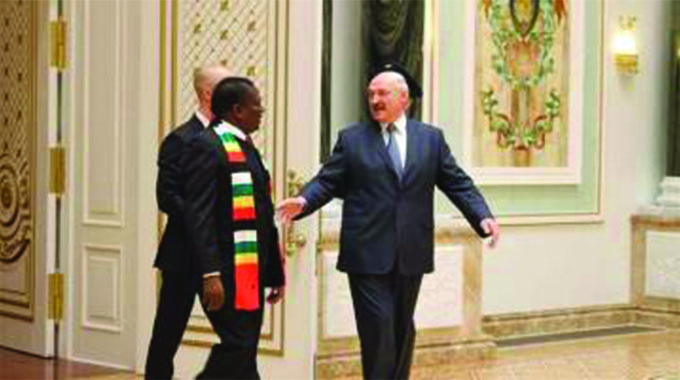
Zimbabwe – Belarus Relations stronger than before
The water-tight relations that exist between Zimbabwe and Belarus serves as an indicator as to how the Zimbabwe’s foreign policy is a continuation of its fight to have an Upper Middle Income by the year 2030, as pronounced in the Vision 2030 economic blue print.
The recent three-day State visit by the Belarusian President Alexander Lukashenko was revealing. Eight deals were signed between these two countries in the areas of education, agriculture, economic cooperation and tourism, to mention just a few. Relations with Belarus will facilitate the enhancement of Zimbabwe’s innovation and industrialisation
The way forward
Diplomacy is promiscuous in nature and scope, as such some countries use it as a war-mongering platform, others as a means to exert their influence in the global affairs but Zimbabwe has used it as a platform to unlock economic deals which feed into the developmental grid.
n Wallace Musakanyi can be contacted on [email protected]



 Online Reporter