


 Online Reporter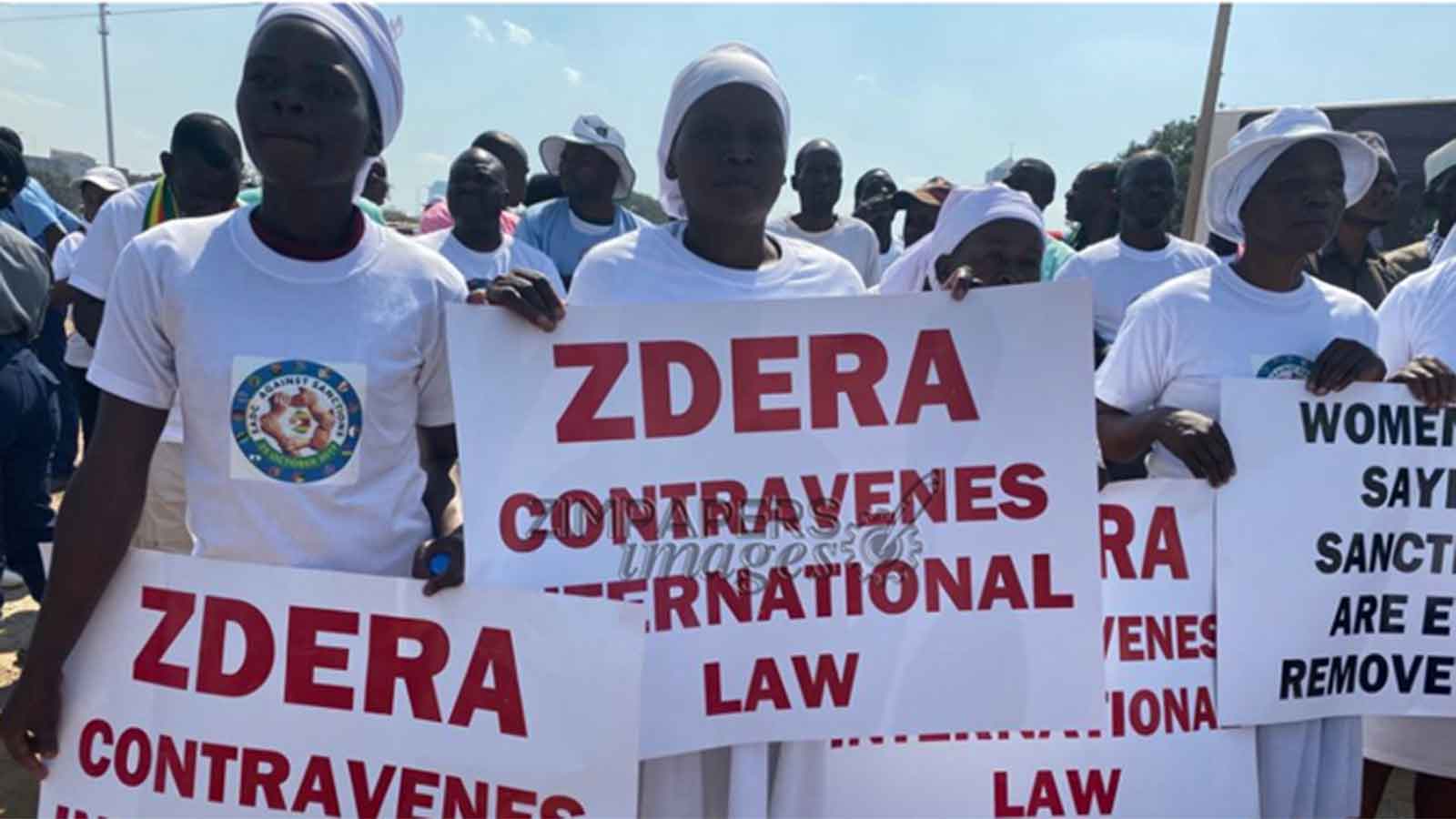
Debra Matabvu-Senior Reporter
THE United States has formally initiated legislative processes leading to the repeal of the Zimbabwe Democracy and Economic Recovery Act (ZDERA), the nearly 25-year-old sanctions law that has sought to isolate Harare and restrict the country’s access to international financial support since 2001.
The proposed repeal has now been officially tabled before the House of Representatives — the lower chamber of the US Congress — marking a major step towards potential debate, amendment and eventual voting on the matter.
The ZDERA repeal provision is contained in the Department of State Policy Provisions Act, a broad foreign policy and national security legislative package, that is being sponsored by Representative Mr Brian Mast (Republican) of Florida.
The Bill seeks to dismantle ZDERA, the law that has empowered Washington to block Zimbabwe from receiving loans, debt relief or financial assistance from institutions such as the International Monetary Fund (IMF) and the World Bank, a position that effectively locked the country out of key development financing for more than two decades.
Political analyst and Bindura University of Science Education peace and governance lecturer Dr David Makwerere said the development was welcome.
“I think these processes have been happening over the past few months and could potentially be significant if they materialise,” he said.
“Repealing ZDERA will significantly improve our association, particularly with the Western bloc, meaning our relations would significantly improve.
“This development would be a significant achievement in our international relations goals in that it means we would have mended relations and enhanced cooperation with the United States of America.
“But more importantly, it must also be seen in the context of what our own Government has been doing, including paying compensation to some white former farmers who were affected by the Land Reform Programme.”
According to the official US Congress Bill Tracker, the legislation reached the full House after the House Committee on Foreign Affairs approved it on September 18, 2025.
The committee endorsed the Bill, designated H.R. 5300, by a narrow 27-24 vote, after applying technical amendments.
Its tabling before the House signifies that the Bill has successfully passed the committee stage and is now eligible to proceed towards full House debate.
Executive director of Citizens Against Economic Sanctions Mr Martin Zharare said the process was welcome and should be carried out without any conditions.
“By moving to repeal the sanctions, they have realised that the embargoes have failed to accomplish the intended results,” he said.
“Zimbabweans have stood with their Government and the will of the people has outlived the sanctions. So, the move is welcome.
“However, they have attached conditions to the removal of the sanctions, and we are saying the sanctions should be removed without any conditions. The sanctions are illegal; therefore, there is no reason to impose conditions for their removal.”
Significance
The formal introduction of the Bill in the House is significant, because it moves the repeal effort into a decisive stage of the congressional law-making process.
A Bill cannot be debated or voted on by the full chamber until it has been formally introduced following committee approval, making this step an important milestone that officially places the ZDERA repeal on the legislative agenda of the House of Representatives.
The development also represents the clearest signal in decades that the US may be prepared to revisit and possibly revise its sanctions framework on Zimbabwe.
Since 2001, ZDERA has shaped US policy towards Zimbabwe, influenced the position of international lenders such as the IMF and the World Bank, and guided broader Western engagement with the country.
Legislative process
With the legislative process now formally underway, the Bill will proceed through several stages before it can become law.
It will first be scheduled for debate before the full House of Representatives, where lawmakers will have an opportunity to propose changes, including altering or removing some provisions.
After the debate, the House will vote on the Bill, and a simple majority will be required for it to pass.
If the Bill is approved by the House, it will be sent to the US Senate.
There, it may be referred to the Senate Foreign Relations Committee, which can conduct hearings, propose amendments or rewrite entire sections of the Bill.
The full Senate must then debate and vote on the legislation.
Should the House and Senate pass different versions of the Bill, negotiators from both chambers will convene a conference committee to produce a single, unified version.
This compromise text must then be approved again by both the House and Senate.
Once both chambers agree on the final version, the Bill will be sent to President Donald Trump.
The US president may sign it into law or choose to veto it.
If a veto occurs, Congress can still enact the Bill by overriding the veto with a two-thirds majority vote in both chambers.
Conditions
While the proposed repeal will dismantle these restrictions, the Bill also introduces new conditions tied to the country’s land reform legacy.
It stipulates that Washington will not support any fresh IMF or World Bank funding for Zimbabwe unless the Government commits to fully compensate white former commercial farmers, in line with the Global Compensation Deed.
Over US$20 million has already been paid to the farmers so far.
Reads the Bill in part: “In general — The Zimbabwe Democracy and Economic Recovery Act of 2001 (ZDERA), as amended, Public Law 107-99 (115 Statute 962) is hereby repealed.
“Condition on further funding for Zimbabwe — The United States shall not support any new or expanded funding from the International Monetary Fund or the International Bank for Reconstruction and Development (commonly known as the World Bank) for the Government of Zimbabwe unless the Government of Zimbabwe shall commit, within 12 months of the approval of such new or expanded funding, to remit all outstanding arrears owed under the Global Compensation Deed, inflation adjusted to the date of enactment, and compensation shall not be in the form of Zimbabwe issued securities.
“Failure to comply with this provision shall result in an immediate cessation of all United States support for any further funding from these institutions.”
The expansive Bill, introduced by Mr Mast, is a wide-ranging authorisation and policy blueprint for the US State Department.
Its provisions cover everything from countering China and managing artificial intelligence to embassy security and public diplomacy.




We shouldn’t get too excited about the goings on in the US government corridors in as far as the proposed removal of ZDERA is concerned. There will be no physical changes even if the Act is repealed. We must understand that with or without the ZDERA act in existence, the USA will still exercise its veto rights in the same financial institutions and that will sideline Zimbabwe. So repealing ZDERA won’t change the situation for us in Zimbabwe. Secondly, we are dealing with Donald Trump here, not the USA. Until DJT leaves office, it will virtually be impossible to trust what the US regime does. Ask South Africa! Third, Zimbabwe tied itself into a corner by promising to compensate white farmers. It was the biggest mistake the government did since independence. This promise will be used by the Western World to make it impossible for Zimbabwe to access the much needed finances from world institutions. The fact that the USA is putting impossible conditions for the repealing of ZDERA must simply show us that nothing is about to change for some forseeable future. So the hope and excitement shown by some people indicates serious naivety.
Dear Editor,
This development regarding the proposed repeal of ZDERA is undoubtedly significant and marks an important moment in Zimbabwe–US relations. Any move that promises to restore access to international finance and normalise engagement deserves to be welcomed with cautious optimism.
However, Zimbabweans have learned through hard experience that legislative intent does not always translate into real-world relief. The introduction of new conditions tied to the Global Compensation Deed suggests that while the law may change in form, pressure mechanisms may simply mutate rather than disappear. True economic recovery requires genuine partnership, not permanent conditionality dressed up as reform.
If Zimbabwe has begun compensating former farmers, it is doing so as a gesture of reconciliation and closure — not submission. Reconciliation should be met halfway, not turned into a bargaining chip. Sanctions that harm ordinary citizens cannot be morally defended, regardless of the language used to justify them.
What the Zimbabwean people desire is not favour, but fairness — not charity, but a level field. Repeal must mean repeal in practice, not replacement by another set of barriers.
This moment must therefore be used to push for honest engagement, mutual respect and the complete removal of economic weaponry masquerading as diplomacy. The wellbeing of ordinary people must finally take centre stage.
Yours faithfully,
Equally concerned Son of the Soil,
Reverence Zimunya.