

 Online Reporter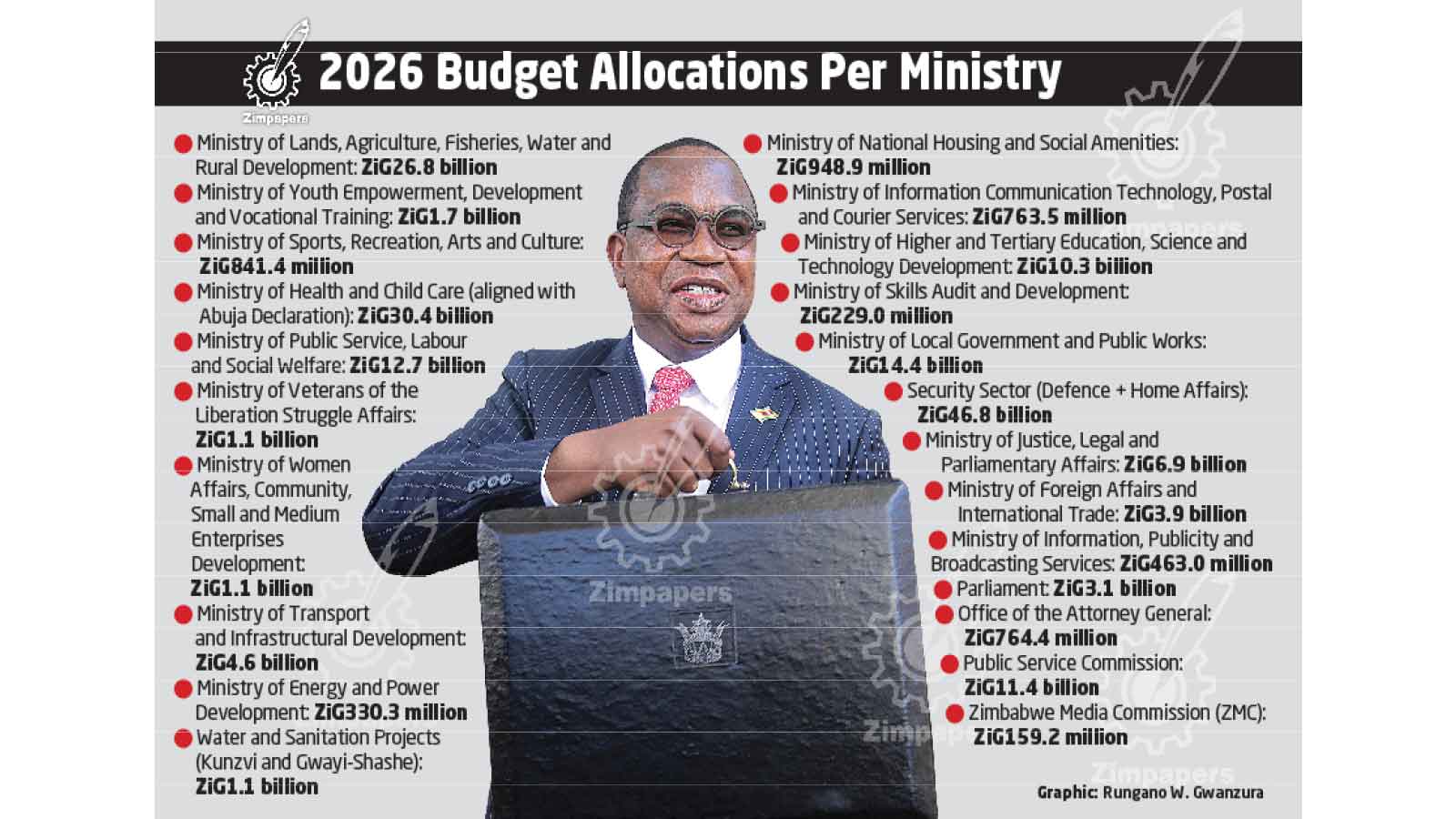
Nelson Gahadza
FINANCE, Economic Development and Investment Promotion Minister Professor Mthuli Ncube has expressed concern over the sharp increase in US dollar cash withdrawals, warning that the trend heightens the risk of informality, tax evasion, corruption, and administrative inefficiencies.
Presenting the 2026 National Budget at the new Parliament Building in Harare on Thursday, Prof Ncube said the emerging sector continued to account for a substantial share of economic activity, with foreign currency dominating over 90 percent of physical cash transactions across both formal and informal markets.
“On average, ATM withdrawals amounted to approximately US$265,8 million per month between April 2024 and June 2025, of which over 90 percent were in United States dollars. Banks currently maintain nearly US$1 billion in cash and Nostro balances to meet withdrawal demand. The continued increase in cash withdrawals reached US$353 million in June 2025.
“In light of these challenges, it is imperative to introduce measures that discourage excessive cash withdrawals, enhance transparency, strengthen tax compliance and gradually shift economic activity towards formal and digital payment platforms,” he said.
For individuals, there will be no levy (0 percent) on monthly US dollar withdrawals between US$1 and US$500.
A 2 percent tax rate will be applied to withdrawals between US$501 and US$1 000.
Any amounts withdrawn above US$1 001 will be subject to a 3 percent levy.
Corporations will also pay no levy on monthly US dollar withdrawals up to US$5 000.
A 2 percent tax rate will apply to withdrawals ranging from US$5 001 to US$10 000. Any corporate withdrawals exceeding US$10 000 per month will be taxed at the highest rate of 3 percent.
These new measures are with effect from 1 January 2026.
Analysts believe that if successful, the policy could cajole individuals and businesses towards electronic and traceable payment platforms, strengthening revenue collection and financial sector stability.
But they also warned that the cash-withdrawal tax can unintentionally push economic actors further into informality, as past experiences show that when formal channels become too costly or restrictive, the public pivots quickly to alternatives such as cash or unregulated mobile-money dealers.
Investment analyst Mr Enock Rukarwa said the policy was crucial as it directly enhanced the “stickiness” of deposits within the formal banking system.
“By imposing a tangible cost on converting digital bank balances into physical cash, the policy incentivises both individuals and corporations to leave their funds deposited. This reduces the velocity of cash withdrawals and the associated operational costs for banks (ATM refills, cash handling, security),” he said.
Mr Rukarwa added that more stable and sticky deposits provide banks with a more predictable and lower-cost funding base, strengthening their balance sheets and enhancing their capacity for longer-term lending to the productive sectors.
“This measure, therefore, acts as a fiscal tool to deepen financial intermediation and
improve monetary policy effectiveness by anchoring more liquidity within the controllable, formal financial system,” said Mr Rukarwa.
Prof Ncube highlighted that the surge in cash withdrawals was linked directly to the size and growth of the shadow economy.
He said the tax would enable authorities to better monitor economic activities.
Mr Tinevimbo Shava, an economist, said the new cash withdrawal levy could play a constructive role in pushing the economy towards greater digital adoption.
“The levy sends a clear signal that the country is moving towards a modern, cash-lite economy. For years, the high preference for physical cash has fuelled thriving informal activities, weakened the tax base and created unnecessary pressure on financial institutions.
“Through gently disincentivising large cash withdrawals, the Government is encouraging individuals and firms to embrace electronic payments, which are safer, more efficient and easier to trace.”
He added that the measure could also help curb cash hoarding.
“A lot of value has been sitting outside the formal system in the form of hoarded cash. When money doesn’t circulate, it limits liquidity within the banking sector and slows down economic activity. This levy nudges people to keep their funds within the formal channels, which is ultimately positive for financial stability and long-term monetary discipline.”
Another economist, Mr Walter Mapfumo, said the Government aimed to reduce the high volume of physical cash circulating in the economy, which stood at $353 million in June 2025, hoping to enhance transparency, strengthen tax compliance and shift economic activity towards formal and digital payment platforms.
“The tax could encourage individuals and businesses to adopt digital payment methods, potentially increasing financial inclusion and reducing transaction costs.
“By making cash withdrawals more expensive, the government may be able to reduce the amount of cash in circulation, which could help curb tax evasion and corruption,” he said.
Mr Mapfumo added that the tax is expected to generate significant revenue for the government, which could be used to fund public services and infrastructure projects.
However, he noted that the tax could push more economic activity into the informal sector, potentially reducing government revenue and increasing the complexity of tax administration.
“The tax could disproportionately affect low-income individuals who rely heavily on cash transactions, potentially increasing their financial burden.
“But the effectiveness of the tax in achieving its objectives remains to be seen, and the Government may need to consider complementary measures to promote digital payments and reduce cash usage,” said Mr Mapfumo.
The 2026 national budget hinges on stabilising inflation, easing business costs through tax adjustments, strengthening fiscal controls, and leveraging high mineral prices to fund public programmes, all while pursuing the targeted 5 percent economic growth.



As long as artisanal miners, farmers and other players are paid in cash US dollars, this new tax on people who have chosen to follow the legal way of doing business through formal banking will drive more people back into cash street business that had almost disappeared.