Online Reporter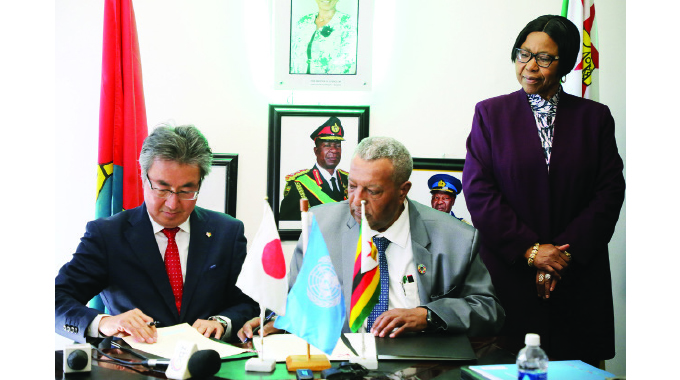
Columbus Mabika-Herald Reporter
ZIMBABWE yesterday signed a US$3,4 million partnership agreement with Japan and the United Nations Development Programme (UNDP) to speed up the clearance of anti-personnel landmines and empower communities living in affected areas.
The funding will target the remaining 12 kilometres of mine-contaminated land in Rushinga and Mudzi districts along the country’s borders, creating safer conditions and releasing land for farming and other economic activities.
Themed, “Enhancing Resilience of Communities through Mine Clearance and the Improvement of Agricultural Infrastructure”, the initiative, comes after Zimbabwe missed its 2025 deadline to become landmine-free, largely due to financial constraints following the withdrawal of support from traditional donors.
The project is designed to meet Zimbabwe’s obligations under the Anti-Personnel Mine Ban Convention (APMBC) while supporting national development goals.
Speaking at the signing ceremony in Harare, Defence Minister Oppah Muchinguri-Kashiri hailed the agreement as a milestone in Zimbabwe’s quest to eliminate the deadly remnants of war.
“Today’s signing ceremony between the Government of Japan, the United Nations Development Programme (UNDP) and the Government of Zimbabwe bears testament to the power of partnership, solidarity and shared commitment to peace and human security,” she said.
“Allow me to acknowledge the sterling work being undertaken by the United Nations Development Programme team in Zimbabwe contributing to the country’s developmental agenda in particular, assistance being rendered to our vulnerable people throughout the country.
“Your coming on board to mobilise funding for mine action is most commendable for it will go a long way in enhancing safety and security which is instrumental in improving livelihoods, building resilience and strengthening social cohesion in affected areas.”
She commended Japan’s unwavering commitment to the global campaign for a landmine-free world, noting its persistent support for mine action worldwide, including in Zimbabwe.
“They have also persistently and constantly provided funding to mine action around the world of which Zimbabwe has been a beneficiary,” she added.
“On behalf of the people and Government of Zimbabwe, I take this opportunity to extend my gratitude for the support we continue to receive from the people and Government of Japan as we strive towards a mine free Zimbabwe.”
Japan’s Ambassador to Zimbabwe, Mr Shinichi Yamanaka, said his country remained committed to promoting peace and human security globally, particularly in its role as this year’s President of the APMBC.
“We are proud to support Zimbabwe in its journey to become a landmine-free nation,” he said.
“Furthermore, this project contributes to the rehabilitation of mine-cleared land as farmland and to the improvement of livelihoods of smallholder farmers through the smallholder horticulture empowerment and promotion approach.”
UNDP Deputy Resident Representative in Zimbabwe, Mr Lealem Berhanu Dinku, said the project aligned with the principle of leaving no one and no place behind, by tackling a long-standing barrier to development in border communities.
“The legacy of conflict has for too long held back the potential of Zimbabwe’s borderlands,” he said.
“This vital project generously funded by the people of Japan allows us to address the fundamental issue of human security integrating mine clearance with sustainable development climate action and social cohesion creates pathways for communities to recover and thrive.”
Following the signing, International Federation of Red Cross and Red Crescent Societies Regional Director for Africa, Mr Charles Businge, paid a courtesy call on Minister Muchinguri-Kashiri, also emphasising the importance of safe communities through mine clearance.
Zimbabwe’s minefields were laid by the Rhodesian colonial regime between 1976 and 1979 to restrict the movement of liberation fighters along the borders with Mozambique and Zambia.