

 admin
admin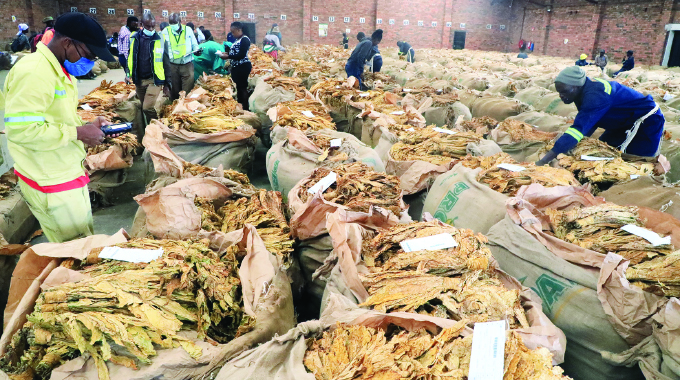
Elita Chikwati
Features Editor
The 2023 tobacco deliveries have surpassed last year’s volumes, setting a new record in the industry, thanks to the land reform which saw many smallholder farmers successfully producing the crop that was once perceived to be a preserve for white farmers.
By day 67, farmers had sold 266,8 million kilogrammes of tobacco valued at US$806,6 million compared to the same period last year’s volume of 173,2 million kilogrammes worth US$525,1 million.
This year’s output surpasses the 261 million kilogrammes of tobacco that were sold by farmers during the 2019 marketing season.
At the advent of the land reform in 2000, 236 million kilogrammes were produced.
Zimbabwe is among the top five major producers of flue cured tobacco globally and the leaf is popular because of its flavour.
Tobacco provides the best economic return per hectare among all major crops.
This income is used as a springboard to develop other farming activities and development of farm infrastructure.
The tobacco value chain employs more than 1,2 million people with up to six million dependants.
The evidence is there for everyone to see how tobacco production has benefitted farmers since the land reform.
Livelihoods have improved, with some farmers boasting of acquiring farm machinery such as tractors, building better houses and sending children to decent schools and universities, among other things.
Others have used proceeds from tobacco production to invest in other projects to maximise profits. There have been some challenges, especially with the contract system where some unscrupulous contractors have continued to fleece farmers.
Other farmers feel the situation could improve if there was an independent fund to support growers instead of having private companies who are only interested in making huge profits at the expense of the producer.
The Tobacco Industry and Marketing Board (TIMB) is working with other stakeholders to perfect the contract system.
The board, together with Government and other stakeholders, has been working hard to improve the viability of growers, ensuring 100 percent compliance to regulations and ensuring sustainable tobacco production and good agricultural labour practices.
Now that the industry is getting to the targeted 300 million kilogrammes in terms of tobacco, this is an excellent achievement.
The quality of the crop is also improving as many farmers gather the requisite knowledge and skills to grow, cure and handle the leaf.
The tobacco industry has implemented several initiatives to increase tobacco yield, including training farmers.
Growers are being trained to improve their knowledge and follow best practices through all stages of production.
This helps them reduce inefficiencies and improve productivity and leaf quality.
TIMB licensed new contractors as well to increase the number of tobacco financiers and enacted the Contractors Compliance Administration Framework that stipulates the standard minimum inputs package.
This move ensures growers get enough inputs, and this guarantees a quality crop and increased yield.
More investment is also being made into irrigation, climate proofing tobacco farming.
The tobacco sector has also introduced several initiatives to reduce harvest and post-harvest losses, including the Natural Air Curing Systems (Chigafas) and barn door grading.
The portfolio of tobacco is also expanding with the recent introduction of shisha and jutty to augment cigar wrappers and Virginia.
Despite all the efforts to increase yields, more still needs to be done to promote value addition.
This is because the country is still exporting the bulk of the leaf as either unprocessed or semi processed.
Tobacco rakes more than US$1 billion per year in terms of revenue, but the earnings could be more if the country processed the crop and exported finished products.
Improved production methods and enhanced value addition and beneficiation are the stepping stones towards the attainment of the targeted US$5 billion industry.
Currently, seven cigarette manufacturers operate in Zimbabwe, with a combined production capacity of around 5 billion cigarette sticks per annum.
Efforts are being made to increase value addition and beneficiation from the current 3 percent to 30 percent by 2025.
For example, Cutrag Processors Pvt Ltd, is in the process of constructing a new manufacturing facility in Harare and when completed it is expected to double its processing capacity from the current 1,6 billion sticks per year.
Haltrade Pvt Ltd, the manufacturer of ZARK cigarettes, is also expanding its brand portfolio by introducing tobacco one can roll on their own.
TIMB has also licensed Cavendish Lloyd Tobacco to support the production of shisha and process it locally.
Zimbabwe can only realise the full value in tobacco production if more companies are licenced to process the crop before exporting.
The global tobacco market was valued at US$849,09 billion in 2019 and grew to US$878,35 billion in 2020 and is projected to reach US$1,08 trillion by 2027.
While Zimbabwe is the fifth largest producer of flue cured tobacco in the world, the country earns a fraction of the global tobacco market value.
Zimbabwe still earns a paltry 0,17 percent of global tobacco value when it produces 7 percent of world production instead of earning 7 percent of US$878,35 billion (global tobacco value) which translate to US$61,48 billion.
Value addition of tobacco presents an opportunity since less than 2 percent of total tobacco produced is manufactured into cigarettes.
The Zimbabwe tobacco industry has a potential value of US$15 billion from cigarettes export, yet currently, US$0,9 billion is realised from leaf exports.
There is need for funding to promote expansion of tobacco production and processing.
The industry will require state-of-the-art machinery to improve processing of the crop while there is also need to create an enabling environment for value addition through the establishment of an export fund for exporters.
Authorities may also offer export incentives and favourable foreign currency retention thresholds.
The Tobacco Value Chain Transformation Plan which was approved by Cabinet in 2021 is also expected to boost value addition in the tobacco industry.
The plan is aimed at transforming the tobacco value chain as a strategic way of creating opportunities that will benefit the whole value chain.
Tobacco Value Chain Transformation plan is targeted at growing the industry to US$5 billion by 2025 through localisation of tobacco financing, increased production and productivity, value addition and beneficiation, and exports of cigarettes.
The initiatives are expected to contribute significantly to the Gross Domestic Product, foreign currency generation and employment creation, thereby raising household incomes in pursuit of Vision 2030.
The plan will also create an enabling environment that incentivises investors to set up shop in the country instead of exporting raw or semi-processed tobacco.
To fully enjoy the benefits of tobacco production, there is need to boost value addition and beneficiation.



 leeroy
 Online Reporter