admin
admin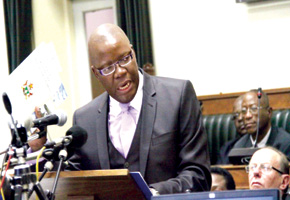
Speaking at the 2013 National Budget Stakeholder Consultative Meeting last week, representatives of various sectors said they were saddled by a number of challenges that were hampering growth and threatening the very survival of local industry largely due to the heavy tax regime prevailing in the country.
They appealed to Finance Minister Tendai Biti and his team to come up with measures that help turn around the economy by offering support to key sectors of the economy.
Local farmer Mr Trevor Shaw said the budget should reflect that Zimbabwe’s economy was agro-based.
He said the agricultural sector needed Government support for it to tick.
“We are an agro-economy. The agriculture sector needs Government support. If you support agriculture, you support the ordinary person in the street,” said Mr Shaw.
Gweru businessman Mr Chrispen Tomu said retailers were facing challenges in modernising their shops because of VAT levied on capital equipment.
He said the 2013 national budget should address the prohibitive VAT and duty charges as they were stifling the sector’s growth.
“Our shops need to modernise. A modern shop should have state-of-the art refrigerators and ice-cream making machines. A well equipped and clean shop plays a key role in boosting tourism and this is especially important towards the build-up of our co-hosting of the UNWTO General Assembly meeting in 2013. It is imperative that Government remove VAT on capital equipment like fridges. VAT is prohibitive to the growth of the sector. Also, if we reduce duty to zero rate, we reduce the Dubai/South Africa trek.
“Zimbabweans go to South Africa and Dubai to buy consumer goods like TVs and microwaves, yet some of these things can be brought here by our business people and they assemble or make them here before selling at affordable prices on the local market. There will be job creation through assembling or manufacturing the gadgets,” he said.
Mr Tomu also appealed for a grace period on paying duty on imported equipment and machinery.
He said this would help sustain the few industries that are still operational.
“As retailers we consider ourselves as partners of the Finance ministry. Most goods we sell in our shops have a 15 percent VAT that we pay to the Government. So let’s improve the ambiance of our shops to world class standards and help bring up the image of our country, which in turn, helps bring tourists to our country,” said Mr Tomu.
Zimbabwe National Chamber of Commerce Midlands chapter representative, Mr Michael Phiri, said Government needed to take on board the informal sector to boost its tax revenue base.
He said the informal sector constituted about 75 percent of the economy and ignoring it was detrimental to economic growth.
“Seventy-five percent of our economy is now in the informal sector. At the moment, most of the Government revenue is coming from penalising the few manufacturing companies that are still operating. Increased revenue from penalties does not translate to increased production. Bring on board the informal sector so that they also pay tax. This will help expand the tax base,” said Mr Phiri.
He said while it was not feasible for Government to totally scrap tax and VAT, the model of heavily taxing the few businesses that were still operational to boost revenue was punitive.
“Reducing tax levels would not produce the desired results. It will deny you (the ministry) the tools to implement the budget . . . trade deficit of more than $1 billion and there are high levels of unemployment in the country. We have to move away from this model where we rely on imports. This is not sustainable. Beneficiation would help create jobs. Government should push for the consumption of locally made goods. It should take a leading role and spearhead the Buy-Zimbabwe Campaign,” said Mr Phiri.
Women in Business in the Midlands said the 2013 budget should be gender-sensitive and take on board women’s interests in empowerment programmes as well as loan applications.
“We want gender equity in the budget. Emphasis should be placed on the girl child who has been marginalised. Even most students who benefit from scholarships are males. There are fewer girls. Funds should be availed through the SMEs ministry to empower women. There should be loans for our rural-based colleagues as well.
“Some of us are into cross-border trading. Duty is prohibitive. We appeal to the ministry to reduce duty for us to remain viable. The Beitbridge road is in a bad shape, causing road carnage. Government should dualise the road to reduce accidents,” said the Women in Business representative.
The health sector, represented by Gweru Provincial Hospital Superintendent, Dr Fabian Mashingaidze, wanted the budgetary allocation for health to be released timeously.
He said there was also need to decentralise the health delivery system by equipping all provincial hospitals with critical life-saving machinery.
“Failing to release the funds on time is failing the health delivery system. It is imperativeto sustain standards at our hospitals before they relapse to the deplorable state of the years in the past.
“We need to decentralise our services. For example, at the moment it’s only Parirenyatwa Hospital in Harare that is doing the screening of cancer yet in Matabeleland there are also women who suffer from cancer.
“The Government needs to buy equipment to facilitate such programmes at all health centres,” said Dr Mashingaidze.
Minister Biti said there was no need to scrap duty on equipment like fridges when Zimbabwe had two refrigerator making companies.
On agriculture he said Government had always been supportive of the sector.
He said there was need to protect sectors like the textile industry which were facing unfair competition from cheap imports from the East.
“While we work on measures to sustain these key sectors, we also should look at how we can value add our minerals and materials before exporting. That way, we create employment as well,” said Minister Biti.



 Online Reporter