

 admin
admin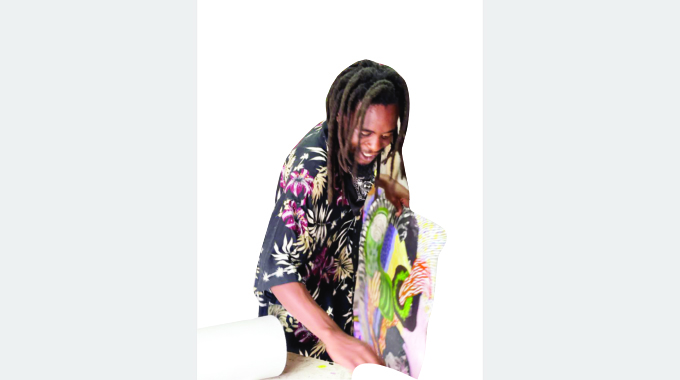
Kundai Marunya Arts Correspondent
In one of the rarest creative moments, visual artist Option Nyahunzvi poked his brush to ink compelling pieces on seating “paKadoma.”
“Kadoma” is a moniker of a very uncomfortable makeshift seat behind the driver’s seat of a commuter omnibus (or kombi as they are widely regarded).
This is where those falling short of the fare are forced to sit usually at half price.
At this position, one seats facing all passengers thus reading into everyone’s facial expression.
When Nyahunzvi recently visited Nigeria for the inaugural Pacers Gallery artist residency programme, this was the experience he shared through his work, in an exhibition dubbed “Face The Nation”.
In the exhibition, Nyahunzvi employs his usual exuding colour, densely populated collages that are an amalgam of figurative and abstract paintings, printing and drawing elements, and etchings on the surfaces of Fabriano paper glued onto the canvas and marked by carefully cut and inked lines.
A strong advocate for identity, he adheres to his signature black and white zebra elements, an ode to his totem.
In an interview with Herald Arts, Nyahunzvi said his residency was educative of different cultures and their imminent similarities.
“My stay in Nigeria was very pleasant and insightful,” he said. “I got to learn from different people and a very new environment, which though different had many similarities with Harare, the city I have lived in for many years.
“The differences like in the transport system inspired my exhibition, and had me interrogating how as a nation we can develop and improve on various socio-economic issues.”
The title of the exhibition has been taken as a call for politicians to deliver on election promises and develop their communities, an issue topical in both Lagos and Harare.
Just as one can read into people’s lives while looking at their faces, politicians ought to look into the faces of the electorate to understand their pains, worries and needs.
Writing in the exhibition’s catalogue Barnabas Ticha Muvhuti, a PhD in Art History candidate at Rhodes University, saluted Nyahunzvi for his ever expanding scope thus including an installation as part of the exhibition.
“A surprise component of this show is an installation of the property and clothing items the artist was using in the duration of his stay in Lagos, alongside the collages,” said Muvhuti.
“It is the bed, table, kitchen utensils, studio table, chairs, and his clothes. These materials enabled him to accomplish his mission.
“As such, exhibiting them is an act of acknowledging their energy, spirit, and soul. Most importantly it is the artist’s recognition of the crucial role they played in helping shape the work.
“They bore witness to the evolution of the works, from the incubation phase to completion. Incorporating them in the show is an affirmation of Nyahunzvi’s Shona spiritual beliefs which are central to his practice.”
Pacers Gallery founder and director Wunika Mukan said the residency programme opens up opportunities for artists.
“It’s a wonderful opportunity for the artist, gallery and community to participate in this cultural exchange,” said Mukan.



 Online Reporter