Online Reporter
Ivan Zhakata
Features Correspondent
BEFORE the policy documents, the speeches and the official declarations, there were human stories of pain, exclusion, resilience and survival that set the tone for Zimbabwe’s inaugural National Disability Symposium in Harare.
These were not abstract discussions about inclusion.
They were lived realities, told by people who have navigated a world often not built with them in mind.
For Paralympic legend Elliot Mujaji, it all began in 1998 with a devastating accident that left him in a coma for four months and changed his life forever.
When he finally regained consciousness, the world around him had shifted into something unfamiliar – a space filled with barriers most people never notice.
“Buildings without ramps, schools without accessible facilities, environments where participation seemed impossible,” he said, recently at the National Disability Symposium that was held in Harare recently.
For Mujaji, recovery was not just medical – it was social, emotional and deeply personal.
Everyday tasks became challenges, and participation in ordinary life felt like a distant goal.
But in that struggle, a turning point emerged.
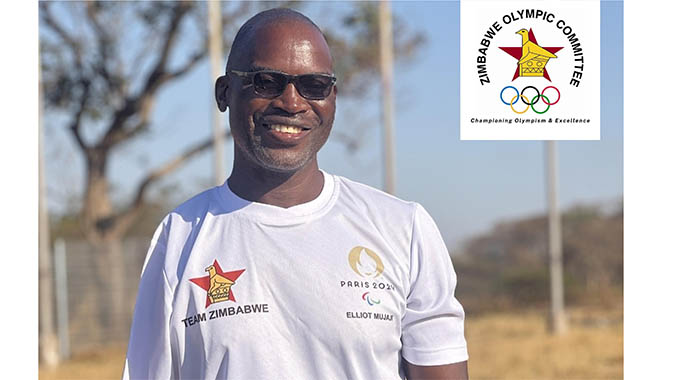
A chance encounter with a social work programme introduced him to inclusive sport systems abroad, where disability was not treated as a limitation but as a potential.
“I experienced a society that saw my potential, not my disability,” he said.
“I trained, competed and proudly represented Zimbabwe, winning our first Paralympic gold medal.”
That moment, he said, was not just about sport — it was about dignity.
“That victory was more than a medal. It was an affirmation of belonging,” he said.
“It proved that persons with disabilities are not burdens, but contributors.”
Today, Mujaji has become a mentor and coach, working with both able-bodied athletes and persons with disabilities, using sport as a platform for inclusion and transformation.
But beyond his success lies a message that echoed throughout the symposium — that inclusion must move from policy to practice.
“Inclusion is not merely a policy or a word in a document. It is a fundamental human right,” he said.
“Government policies are the foundation, but policies alone are not sufficient. They must be translated into concrete action.”
His words reflected a broader sentiment shared by many delegates — that progress depends not only on legislation, but on implementation in classrooms, workplaces, hospitals and communities.
That reality was also reflected in the voice of Ruwa Ward Councillor Ms Masline Hwiza, who shared her journey from education into public service while living with a disability.
“I went to tertiary, I did my designing there, then after that I started working,” she said.
“In 2023, I had the opportunity to learn politics under our President, and I really applaud and thank you for recognising us as persons with disabilities and women with disabilities in our country.”
For Hwiza, inclusion is not theoretical — it is personal.
She spoke of perseverance, determination and the importance of opening doors for others like her.
“We are having challenges, but we must work on them,” she said.
Her story reflects a growing presence of persons with disabilities in leadership spaces — but also the ongoing need for meaningful participation beyond symbolism.
For Mr Lincoln Matongo, the challenge lies in the implementation of laws that already exist.
“There are many laws that support disabled people,” he said.
“But if we are implementing the laws of disability, actually, we are all potentially disabled.”
His message was simple but urgent — that disability inclusion is not a specialised issue, but a universal one.
“If you don’t make the laws set today, tomorrow you are just like me, then you are going to start again to face what should have been done before,” he said.
Mr Matongo also highlighted barriers faced by deaf persons, particularly in education, where a lack of sign language inclusion and trained educators continues to exclude learners.
“If deaf children are not taught in their language, they are excluded,” he said.
His concerns pointed to a wider issue raised at the symposium — that inclusion must account for different types of disabilities, not just physical access.
That reality was further illustrated by Mr Taurai Kadzviti, who lives with epilepsy and spoke candidly about stigma, misunderstanding and isolation.
“Epilepsy can affect anyone at any age, any race, rich or poor,” he said.
Yet for years, he said, misconceptions defined how people treated him.
“For a long time, people thought I had been bewitched,” he said.
He recalled experiences of exclusion at school and discrimination in workplaces, as well as periods of institutionalisation that were poorly explained to him.
“I was in a psychiatric ward for two weeks when it was supposed to be one night observation,” he said.
Mr Kadzviti said such experiences show the hidden cost of ignorance and stigma surrounding invisible disabilities.
Despite this, he has turned his lived experience into advocacy, calling for better awareness, workplace accommodation and understanding of epilepsy.
“I did not fully understand my condition. One doctor finally told me I had epilepsy,” he said.
These personal testimonies, among others, transformed the symposium from a formal gathering into a space of reflection — where policy met lived experience.
Public Service, Labour and Social Welfare Minister Edgar Moyo said the country was now shifting towards measurable implementation of disability inclusion policies.
“It is a technical checkpoint, a governance instrument and a national mirror,” he said.
“We meet to take stock, interrogate policy design, test implementation fidelity and fine-tune our systems so that inclusion is not an aspiration, but an operational reality.”
National Council of Persons with Disabilities president Annah Shiri said inclusion must be anchored in participation.
“Nothing for us without us is not just a mantra. It is a prerequisite for democracy,” she said.
Representing the United Nations Resident Coordinator’s Office, Dr Abdul Rahman said success must be measured by real-life impact rather than policy frameworks alone.
“Progress cannot be measured only by the number of policies adopted or structures established,” he said.
“It must be measured by real outcomes in people’s lives.”
As the symposium continued, the message from those who live with disability remained clear — inclusion is not an act of charity, but a matter of rights, dignity and national development.