Vusumuzi Dube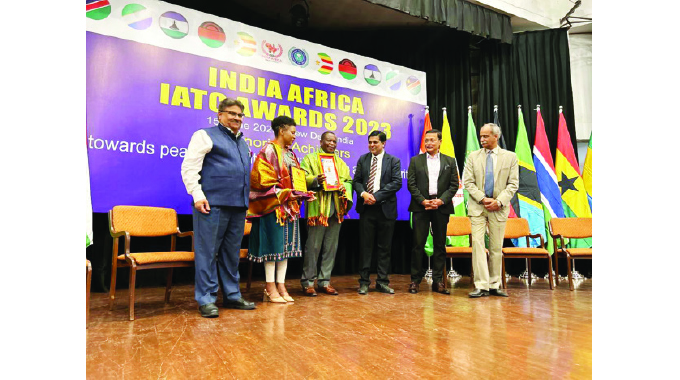
Africa Moyo in NEW DELHI, India
It was probably Vice President Dr Constantino Chiwenga’s busiest day yesterday on his visit to India, as he participated in three critical engagements headlined by a successful interactive meeting with Indian Vice President Jagdeep Dhankhar and later addressing a highly subscribed session specific to Zimbabwe attended by investors mainly from India and other regions.
VP Chiwenga had earlier in the morning taken a short drive from Taj Palace, the venue of the 18th Confederation of Indian Industry-Exim Bank Conclave on India-Africa Growth Partnership, to the Indian International Centre where he was honoured with the India-Africa Achievers Award.
The award, which was presented to him by India-Africa Trade Council chairman Dr Asif Iqbal, was in recognition of his long-standing contribution for enhanced India-Africa cooperation and specifically with Zimbabwe.
VP Chiwenga, who was accompanied to the awards ceremony by his wife Colonel Miniyothabo Chiwenga, said the occasion was a culmination of “mutually beneficial endeavours to promote and foster India-Africa relations”.
“As I accept this award, I am mindful that it is not only a personal achievement but a recognition of my being a representative of the Government of Zimbabwe and the people of Zimbabwe,” he said.
“I am, therefore, glad to be here to accept this iconic award. I take this opportunity to heartily congratulate my fellow awardees.”
Seven other representatives from African countries including Lesotho, Ghana, Tanzania and Congo, were honoured.
After that ceremony, VP Chiwenga drove back to his hotel at the main venue, and immediately went to a lunch meeting with the Indian Vice President, with only a photocall for the media.
VP Chiwenga said afterwards that he had “a very friendly” engagement with VP Dhankhar, in which the host leader spelt out the areas that the two leaders could collaborate.
“We discussed where we would want the input of India at the government level,” he said.
“You are aware that we have had assistance in the repowering of our energy plants in Hwange and they will assist. As I meet with the Exim Bank tomorrow, that thing would be looked up.
“We discussed our railway system and there is something that will be happening to our railways because it is important that it be revamped if our economy is to grow. As you know, the mining industry has gone up, the agriculture industry has gone up, the manufacturing is going up and we can’t continue to use the road.”
Heavy trucks damage the roads regularly, and experts say goods transported by road are 40 percent more expensive than those moved by rail, hence the desire to have the National Railways of Zimbabwe capacitated.
After the engagement with VP Dhankar, VP Chiwenga had little rest, before walking into a room that was filled to capacity by investors mainly from India and some from across the world, who wanted to know more about investment opportunities in Zimbabwe and why they should choose Harare ahead of the 192 other countries in the world and two recognised States – Palestine and the Vatican City.
In his address, VP Chiwenga said Zimbabwe’s aspirational goals are anchored on Vision 2030, a roadmap to achieving an upper middle-income status by that year.
The initial step to attaining Vision 2030 was adequately rehearsed in the National Development Strategy 1 (NDS 1), a five-year economic blueprint targeting an annual Gross Domestic Product growth rate of over 5 percent and the creation of about 760 000 formal jobs.
VP Chiwenga said NDS1 objectives are aimed at strengthening macroeconomic stability, achieving and sustaining inclusive and equitable real GDP growth, promoting new enterprise development, employment and job creation, strengthening social infrastructure and social safety nets, promoting good governance, modernising the economy through ICTs and ensuring sustainable environmental protection.
“The stance taken by Zimbabwe towards growing its economy presents a host of trade and business opportunities with India.
“In order to facilitate the ease of doing business and streamline investment regulations, the Government of Zimbabwe established the Zimbabwe Investment and Development Agency (ZIDA),” said VP Chiwenga.
ZIDA is a one-stop investment centre whose operations are guided by the Zimbabwe Investment Development Agency Act, which has clear provisions on non-discriminatory business climate, company ownership, repatriation of funds and other key areas.
In terms of starting a business, ZIDA facilitates all investors’ business registration process through the one-stop investment services centre, with the aim of reducing the lead time and creating convenience for investors.
Zimbabwe had repealed the Indigenisation and Economic Empowerment Act and foreigners can now have 100 percent shareholding in their companies.
Investors are also offered various incentives such as duty rebates on raw materials, capital goods and equipment in all sectors, all in an effort to promote local industrial production and import substitution, particularly on targeted value chains. Exporting companies also enjoy lower corporate tax rates.
Many Indian companies such as Varun Beverages and Surface Wilmar have already taken advantage of the incentives and set up plants in Zimbabwe.
VP Chiwenga said the pharmaceutical sector, in which India is a strong global player, has low entry barriers.
“Therefore, companies are encouraged to set up manufacturing plants and distribute their products to the Southern African Development Community and the African Continental Free Trade Area and take advantage of Africa’s population of 1,3 billion,” he said.
Turning to diamond mining, VP Chiwenga said India has some of the best technology, especially in cutting and polishing, and invited businesspeople to invest in Zimbabwe.
“Come, we discuss, we mine together, we cut together, polish together, sell together and it’s a win-win situation. We want cooperation with India.”
Information, Publicity and Broadcasting Services Minister, Monica Mutsvangwa, said investors should feel free to invest in Zimbabwe since the country religiously follows its constitution.
In the next two months, Zimbabweans go to the vote in keeping with the dictates of the people driven constitution.
Minister Mutsvangwa said the Government was working to ensure the polls would be free, fair and credible, adding that invitations were being sent out to foreign observers.
Deputy Minister of Foreign Affairs and International Trade Dr David Musabayana said Zimbabwe walks the talk on reforms and is now ever so close to rejoining the Commonwealth.
Industry and Commerce Deputy Minister Raj Modi said investors should decide what they want and should “not worry about your investment (since) they can own 100 percent”.
“If you come to Victoria Falls (a declared Special Economic Zone), you have a market from three more countries; Zambia, Botswana and Namibia,” said Deputy Minister Modi.
“For everything you need, you come to talk to me. Some have asked me, ‘is it safe to live in Zimbabwe?’ I have lived there for 42 years,” he said.
After Government officials spoke, there was an interactive debate with many potential investors, some already running big businesses across the world, seeking clarity on some issues while others promised to come soon.
By the end of the session, ZIDA chief executive Mr Tafadzwa Chinamo was the busiest person as he was surrounded by investors who needed more information.



 Online Reporter