Online Reporter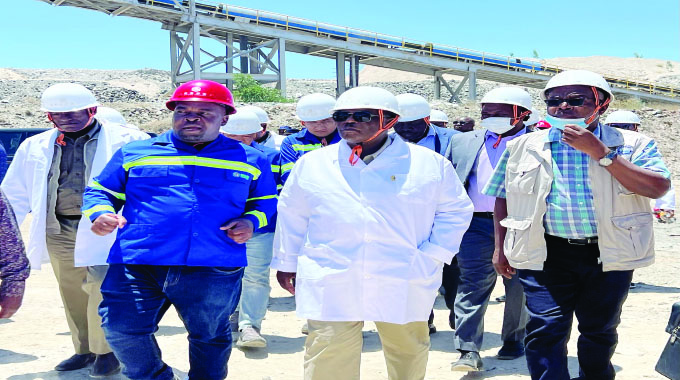
Gibson Mhaka, Zimpapers Politics Hub
The ushering in of the Second Republic has altered the development narrative of the Matabeleland region as several state-of-the-art infrastructure projects are taking a foothold — signalling a shift towards modernity and inspiring confidence across the provinces.
Guided by President Mnangagwa’s philosophy of ensuring “No one and no place is left behind,” numerous development projects have since been undertaken across the region.
In a powerful demonstration of the Government’s ongoing commitment to inclusive economic growth and regional development, Vice President Dr Constantino Chiwenga recently led a high-profile delegation that toured key, high-impact development projects in Matabeleland North and South provinces.
In Matabeleland North, VP Chiwenga toured several strategic sites, each representing a facet of the Government’s development agenda.
The tour included the Bulawayo Kraal Irrigation Scheme in Binga District, a project deemed critical for ensuring national food security and unlocking wider economic opportunities for local communities.
Further demonstrating the nation’s drive to leverage its mineral wealth, the delegation visited the Kamativi Lithium Mine.
This project underscored Zimbabwe’s commitment to unlocking the full potential of its natural resources under the Second Republic’s transformative vision.
A major infrastructure highlight was the Lake Gwayi-Shangani Construction Project, a flagship national undertaking that has reached 73 percent completion following renewed Government funding.
The dam wall, which has reached 43 metres, will stand at 72 meters upon full completion, promising significant water supply benefits for the region.
VP Chiwenga also visited the historic Hwange Colliery Mine, a cornerstone of Zimbabwe’s mining industry.
The mine is undergoing significant revitalisation, with recent investments aimed at increasing coal production and enhancing operational efficiency.
He also toured Zhong Jing Heli Energy Power Station, a crucial project that represents a major step in addressing the nation’s energy deficit through foreign investment and modern technology, thereby boosting Zimbabwe’s overall electricity generation capacity.
In Matabeleland South province, the delegation toured several infrastructure and agricultural projects, including the Gwanda Lithium Mine, Tuli Manyange Dam, and the Garanyemba Drought Mitigation Centre.
This leg of the tour further underscored the Government’s commitment to engaging with and strengthening strategic enterprises vital for national economic growth.
The visit was also part of a broader national effort to monitor progress on strategic projects aligned with the National Development Strategy 1 (NDS1) and Vision 2030, which seeks to propel Zimbabwe into an upper-middle-income economy.
After assessing the strategic farming project at Bulawayo Kraal Irrigation Scheme, which has the potential to provide adequate food through crop and fish farming, and create job opportunities for the youth, VP Chiwenga stressed the need for a “Whole of Government and Society Approach” to ensure its full operationalisation.
He noted it was unacceptable that the project remained non-operational, given its proximity to the abundant water supplies of the Zambezi River.
“Today, I came to assure you of the Government’s commitment to see to it that this scheme is successful and that it operates perfectly,” he stated, reiterating the commitment to the Zimbabwe Agriculture Food Systems and Rural Transformation Strategy.
At Kamativi, the VP Chiwenga was briefed on the progress of exploration, extraction, and processing operations being spearheaded through a joint venture between the Zimbabwe Mining Development Corporation (ZMDC) and private investors.
This project is expected to produce significant volumes of lithium concentrate, contributing substantially to Zimbabwe’s foreign currency earnings and industrialisation drive.
Regarding the Lake Gwayi-Shangani project, VP Chiwenga described it as an “emotional” issue that the Second Republic holds close to its heart, stressing the need to increase the pace to ensure completion well ahead of the revised November 2026 target.
“This project is for the betterment of the Matabeleland region because once the water gets to Bulawayo the dams that have been feeding water to the city will be released and they will start providing water to Matabeleland South and that is a very fertile agricultural area,” he noted.
Along the pipeline to Bulawayo, five pumping stations will be created, each irrigating 200 hectares for a total of 1,000 hectares of new agricultural land.
In Matabeleland South, VP Chiwenga was impressed by the province’s progress in implementing the rural industrialisation drive.
He said the project he had visited testified to the region’s unwavering support for the Government’s development and rural industrialisation agenda. He pledged that the Government would prioritise the construction of Tuli Manyange Dam, which has stalled for decades, to provide water for irrigating 1,600 hectares of land and supply water to Gwanda Town and Gwanda Lithium Mine.
Commending the farmers at the Garanyemba Drought Mitigation Centre, he said the vision is for the centre to serve as the heart of food security, nutrition, and value addition and be a national example, emphasising the goal to navigate development from grassroots to national level, empowering people at the household level through improved income and livelihoods.
These comprehensive tours by VP Chiwenga were much more than mere inspections.
They serve as a tangible and high-profile affirmation that the ushering in of the Second Republic has fundamentally changed the development narrative in Matabeleland.
By showcasing massive, active investments in areas like water infrastructure, mining, energy and agriculture, these projects demonstrate a decisive break from the historical era of neglect.
This practical display of resource commitment proves that the philosophy of “No one and no place is left behind” is being implemented, translating political intent into accelerated, state-of-the-art infrastructure projects that are set to redefine the economic landscape and significantly reduce the pervasive feelings of marginalisation in the region and setting it on a path of unprecedented economic opportunity and full integration into the national development agenda towards Vision 2030.