admin
admin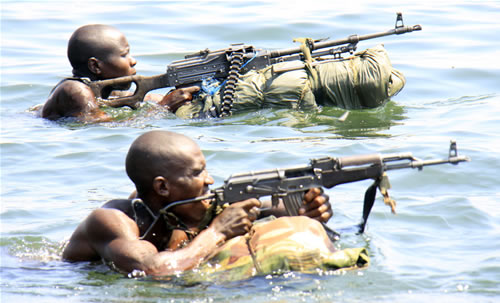
came out alive.
While recovering from their injuries, they still volunteer to operate in the area where they nearly lost their lives. The two commandos were operating in Wafa Wafa training area exclusively chosen for Special Forces Training.
A seasoned commando and war veteran, Sergeant Moses Madondo, who was on a routine training exercise with two colleagues, found himself at the mess and mercy of three elephants.
“I still cannot believe how I survived on that day, it seemed like a bad dream. While on our routine training exercise around midday, suddenly we saw a female elephant within a stone’s throw away. I temporarily froze and when I came back to my senses my colleagues had escaped. I squared off with the jumbo after having stared at each other momentarily. The elephant cow had a calf.
“It charged at me and before I could even react, it hit me with its trunk and I fell down and slid under it. The animal was infuriated and while I was underneath it, the animal tried to drag me from beneath using its trunk but I continued to evade.
“During the scuffle, the elephant stepped on my leg and the pain was excruciating. I did not scream because doing so would have invited more trouble.
“I did not know that an elephant had front breasts like a woman. The two breasts dangled between its front legs and I momentarily forgot my predicament in amusement. Two other elephants emerged but they just became spectators to the party. When I saw them I thought that was the end of my life. I still cannot recall how exactly I escaped. I just found myself at the camp and by then, word had already circulated that I had died. I got into my vehicle and drove to Harare. When I got to Harare my leg was swollen, it was later discovered that it was broken during the scuffle and I am still recovering as you can see.”
Sgt Madondo, who joined the commando regiment at its formation at independence in 1980, said commando skills helped him to remain calm, cool and and fought for his life. Unlike others who after such an experience, would refuse to go back to where they nearly lost their lives, he still voluntarily insists on staying at Wafa Wafa, while his leg is still recovering.
Still in his 20s, Lance Corporal Phineas Mupfururi, a survivor of a buffalo attack at dawn while on commando skills training at the same camp said his stick (commando unit) did not realise that close to them was a snare-injured buffalo since it was still dark.
“When the buffalo saw us it probably thought we were the wire snare owners. Upon seeing us, it charged and we split running in different directions. I just ran without having mapped a safe direction and I found myself in a valley. I looked for my colleagues but there was none in sight. I then tripped and fell and when I woke up the buffalo was just a metre away from where I was.
“I could not stand up and just stared at my fate, the animal charged with its head down and it narrowly missed my leg with its big and sharp horns. It went past me, turned and charged back towards me again. After a running and evading battle with the beast, I managed to climb a tree and to my shock, the bull waited for me for more than 30 minutes before it disappeared into the jungle,” he said.
The two managed to escape with injuries but one volunteer sadly lost his life in that jungle while on training but still his colleagues, who graduated recently were not deterred or drawn back, instead they were more determined as a way of honouring their comrade.
Commanding Officer of Commando Regiment, Lieutenant-Colonel Hwami Vengesai, who presided over the graduation ceremony, paid tribute to the volunteer who lost his life while on training and said it was possible to have a training session without casualties in the future.
Major Vengai Musanga, who is officer commanding commando training at Wafa Wafa, said the place as depicted by its name, is hostile and has dangerous animals like lions, elephants, leopards, crocodiles, hippos and poisonous snakes roaming around the bushes surrounding the training camp.
“This terrain is the worst but best for specialised military training since war can never be fought in a safe terrain. The skills we equip the commandos with are crucial for their survival during wartime,” he said.
Commando Regiment second-in-command Major Fanuel Muzerengwa said the commando survived because of the complex and tough training that moulds and totally transforms soldier’s character, behaviour and attitude in the face of adversary.
“Our motto sums it all as it says; ‘No mission is impossible until one drops dead’. As a commando, you do not surrender to challenges,” he said.
During their training sessions commando volunteers navigate the rugged bone-dry Kariba for 48 hours non-stop day and night while carrying 20kg weights on empty stomachs and with limited water supplies as a way of enhancing their mental strength.
It is during this phase of endurance that many volunteers drop out as they fail to measure up to the challenge. One volunteer vividly recalls when he was so drained and wanted to drop out, the instructor said to him: “If you cannot run anymore, walk and if you can’t walk then crawl. If you can’t crawl then roll and the most important thing here is to keep moving until you reach the final destination.” In the skills phase, commando volunteers are then exposed to more daring challenges where they are expected to live on virtually everything that is edible just to test how they will survive in a real battle situation. It is during phase that they do mountaineering, cross crocodile-infested Lake Kariba on watermanship skills, long- range reconnaissance patrols, rangework, firemaking using traditional ways of a stick and elephant dung, traditional drug making among many other skills.
The final day of graduation is really a day of jubilation for the commandos who would have made it. The recent passout parade saw 125 out of an initial enrolment of 212 volunteers graduating. Wafa Wafa is surely a place for the brave, courageous, dedicated, skilled and physically fit.



 Online Reporter