Online Reporter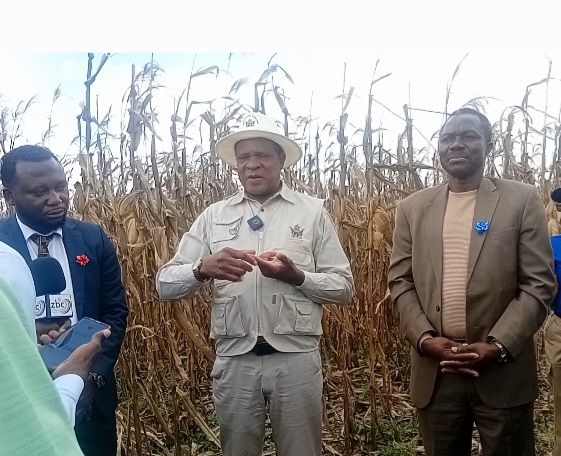
Gibson Mhaka [email protected]
THE commissioning of the Wanezi Dam, Irrigation Scheme and Solarised Piped Water System marks another major milestone in Government’s drive to climate-proof agriculture, enhance rural livelihoods and transform dams into engines of economic development, Agriculture, Mechanisation and Water Resources Development Minister Dr Anxious Masuka has said.
Officially commissioning the project in Insiza District, Matabeleland South province, on Friday, Dr Masuka said the integrated water infrastructure project demonstrates the Second Republic’s commitment to building resilient communities capable of withstanding the effects of climate change while improving food security and household incomes.
“The project is part of the Government’s broader strategy to climate-proof agriculture and ensure that no community is left behind. Climate change is real and Zimbabwe is predicted to become drier in the decades ahead, but we must continue to produce food,” said Dr Masuka.
The project is part of the Government of Zimbabwe’s partnership with the United Nations Development Programme (UNDP)-led Climate Adaptation Water and Energy Programme (CAWEP), with funding from the United Kingdom’s Foreign, Commonwealth and Development Office (FCDO).
Besides Wanezi, similar projects are being implemented in Binga, Chipinge and Chivi under the US$17,1 million programme.
“I want at the outset to thank the United Kingdom for partnering with the United Nations Development Programme and the Government of Zimbabwe. In a few weeks’ time, we will also be commissioning a similar project in Binga, while another has already been completed in Chivi. The total amount that the United Kingdom has provided through UNDP is US$17,1 million,” said Dr Masuka.
The Wanezi project comprises a 30-hectare solar-powered irrigation scheme, a solarised piped water system, a water treatment plant and an automated weather station that supports climate-smart agriculture and early warning systems.
The upgraded Wanezi Dam now has a storage capacity of 1,7 million cubic metres and has been engineered to withstand a one-in-250-year flood event.
The project directly benefits 76 households through irrigation, while thousands of residents are expected to benefit from improved access to safe drinking water, climate information services and expanded economic opportunities.
Dr Masuka said the project fits squarely within President Mnangagwa’s “Dam is an Economy” philosophy, which seeks to ensure that water infrastructure drives rural industrialisation and economic transformation.
“In the past, we built dams simply to store water for livestock, fishing and domestic use. Today, under the Second Republic, water must become an economic enabler. Water in a dam is idle capital until it is utilised to transform people’s lives,” he said.
He said the Government’s response to climate change is anchored on two key interventions — promoting climate-smart agriculture through the Pfumvudza/Intwasa programme and accelerating dam construction and irrigation development.
“We climate-proof agriculture through two ways. The first is adopting sustainable intensive conservation agriculture, Pfumvudza/Intwasa, which is a modern scientific method of precision farming.
“The second is accelerated dam construction, utilisation of the dams and accelerated irrigation development. It is in this context that the President came up with the revolutionary intervention called ‘The Dam is an Economy’,” he said.
Dr Masuka encouraged communities in natural regions three, four and five to embrace traditional grains, which are better suited to low rainfall conditions.
“If you are in Region Four like this, you must focus on traditional grains such as sorghum, pearl millet and finger millet because they are climate resilient,” he said.
He also directed Government technical teams to establish drip irrigation at Tsotsi Village near Wanezi Mission to ensure villagers derive maximum economic benefit from the newly commissioned water infrastructure.
“We will put drip irrigation at Tsotsi Village so that people here can work, earn an income and improve their livelihoods. Vision 2030 is not about going to Bulawayo to look for work. Vision 2030 is beneath our feet, in our soils. We must use our minds and hands to achieve it,” said Dr Masuka.
He challenged communities to embrace commercial fish production at Wanezi Dam, saying the Government would provide technical support to establish cage fish farming.
“I want you to go beyond ordinary fishing. We will assist you to establish commercial cage fishing in Wanezi Dam so that the dam creates more economic opportunities,” he said.
Dr Masuka said the Government aims to expand Zimbabwe’s irrigated land from the current 258 000 hectares to 496 000 hectares by 2030, with every new irrigation scheme contributing towards national food security.
“This 30-hectare irrigation scheme adds to our national target. Every hectare is important because agriculture is now a business,” he said.
During the ceremony, Dr Masuka handed over the certificate of incorporation for the Wanezi Agricultural Society Cooperative, saying formalising farmers into business entities would improve productivity, strengthen market access and enhance rural economic development.
He said the Second Republic remains committed to ensuring that rural communities have access to modern infrastructure capable of transforming livelihoods while building resilience against the increasing impacts of climate change.
The commissioning was attended by senior Government officials, representatives from UNDP, the British Embassy, traditional leaders and members of the local community.