Chronicle Editor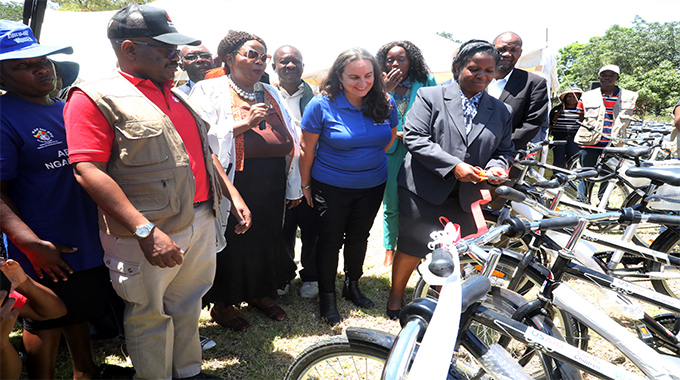
Nqobile Tshili, [email protected]
WITH a baby strapped on her back, Ms Mavis Ndanda from the Zimnyama area in Mangwe District, Matabeleland South Province, comfortably rides her new bicycle after it was handed over to her on Tuesday in Plumtree Town.
She was part of the 207 community childcare workers from Bulilima and Mangwe districts who received the bicycles as part of the Government’s initiative to improve their mobility.
Community childcare workers (CCWs) are the community’s first port of call in responding to child rights protection issues.
The elated granny was full of smiles as she rode the bicycle while strapping her grandchild, drawing the attention of the large crowd that witnessed the event.
“I always move with my grandchild, so here I’m just demonstrating what I will be doing as I do my childcare duties,” she said.
“I used to walk long distances with my grandchild to respond to cases. So, I’m happy to have received the bicycle. It will improve my mobility.”

Save the Children, an organisation that advocates children’s rights partnered with the Government in donating the bicycles with support from the United States Agency for International Development (Usaid) and the Organisation of Rural Associations for Progress (Orap) as an implementing partner
The development partners are working with the Ministry of Public Service, Labour and Social Welfare through the Department of Social Development in reaching out to victims when community childcare workers report cases.
The Government described as a milestone the provision of bicycles to community childcare workers saying their mobility is key in mitigating against child abuse in communities.
Public Service, Labour and Social Welfare Deputy Minister Cde Mercy Dinha said the donation will enable community childcare workers to effectively attend to children’s rights that are violated within their communities.
“Enhancement of community childcare workers’ mobility strengthens their capacity to effectively address critical child protection concerns within their respective communities, thus contributing to the nation’s aspiration for communities that are safe for all children,” she said. “The establishment of community-level child protection structures through the work of CCWs helps to facilitate cross-border case management, and family tracing and reunification (FTR) particularly in the two districts, which grapple with cases of children on the move,” said Deputy Minister Dinha.
She said community childcare workers were foot soldiers, frontline and extension workers of the Department of Social Development at the community level.

Through the partnership with development partners, the ministry fulfills its National Case Management System mandate of the protection of children through collaboration.
“These cadres need to be capacitated with adequate tools of trade, which enable them to effectively serve their communities. This support from development partners, save the children in particular, hugely builds community capacity to prevent and respond to all forms of violence against children through linking them with key prevention and response services,” said Deputy Minister Dinha.
She said the bicycle donation was part of the integrated approach to address integrated nutrition, water sanitation, and hygiene as well as protection projects.
Deputy Minister Dinha said the project also aims to reduce child and maternal mortality rates, thereby enhancing the overall well-being of the vulnerable members of the community.
“The project is targeting to reach out to 68 474 people within the two districts and these are vulnerable children, pregnant women, and lactating mothers. It seeks to holistically address nutrition, water, sanitation, and hygiene practices, as well as strengthen the child protection system to ensure a healthier and safer environment for all,” said Deputy Minister Dinha.
Save the Children country director Mr Bhekimpilo Khanye said the handover of bicycles was a significant milestone in the efforts to protect children’s rights.
He said his organisation was shifting from its previous approach where it would implement its projects but will now work with the Government through local communities.
“This is to empower them with improved mobility to effectively address critical child protection issues within their communities,” he said.
“Save the Children has embraced a new approach to delivering change for children in Zimbabwe through its localisation agenda, which aims to shift power to local and national actors, communities, and children. Supporting childcare workers in fulfilling their responsibilities is a crucial step towards localization.”
Mr Khanye said his organisation cherishes the long-standing relationship with the Government and would complement it as it journeys towards Vision 2030.
“Looking ahead to 2030, our vision to create a world where all children survive, learn, and are protected aligns with the efforts of the Government of Zimbabwe towards improving the lives of children,” he said.
“Government has ratified various instruments to promote and protect children’s rights, which include the United Nations Convention on the Rights of Children (UNCRC) and African Charter on the Rights and Welfare of Children (ACRWC).”
Mr Khanye said it was worthwhile that the Government remains committed to upholding children’s rights through legislature and actionable policies. He said the Government supports cross-border initiatives with Botswana, South Africa, and Mozambique to protect the rights of children and curb their illegal transportation.
“This has resulted in the establishment of Standard Operating Procedures for safe handling of unaccompanied migrant children between countries. Our work in advancing policy and legislation has resulted in the amendment of the Children’s Act, which now includes unaccompanied minors as children in need,” said Mr Khanye.
He expressed gratitude for the support they get from Usaid’s Bureau for Humanitarian Assistance in Matabeleland South province. Matabeleland South Provincial Affairs and Devolution Permanent Secretary Mrs Latiso Dlamini Maseko commended the partnership between the Government and the private sector.
She said the involvement of development partners in communities shows the importance of maintaining good working relationships among stakeholders.
“Save the Children is on the ground because the Government approves of its work. We don’t want development partners to work alone. They need to collaborate with the Government’s departments at local level, meaning the district development coordinators have to be aware of your work,” she said.–@nqotshili



 Online Reporter