Online Reporter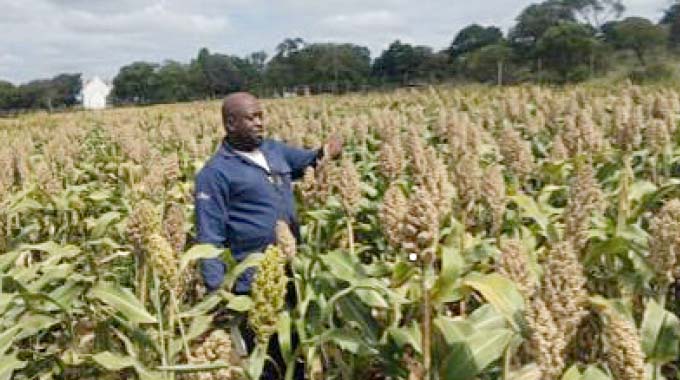
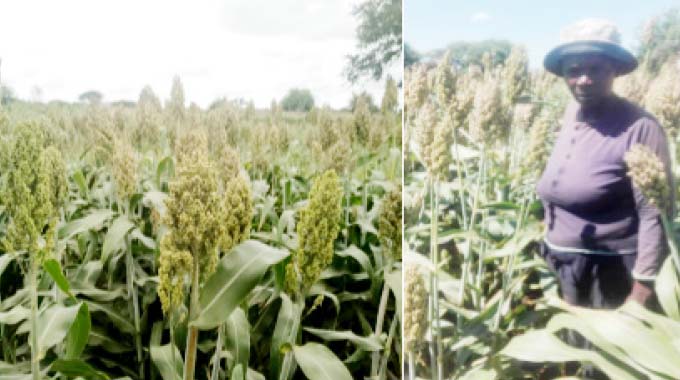
Insiza District – In Siyabalandela village, Ward 6, farmer Cecilia Moyo stands proudly by her small field of sorghum. On just 0.2 hectares, she harvested 500 kilograms of the Macia sorghum variety, a drought-tolerant crop that has become a symbol of resilience in Zimbabwe’s drylands. For Moyo and many like her, the harvest is more than food; it is proof that farmer-driven research can translate into real food security and income under climate stress.
What makes this story different is how the sorghum variety, Macia, came to her farm. The variety was not simply delivered to farmers. Instead, it was developed and refined through years of collaborative research and farmer participation involving the Department of Research and Specialist Services (DRSS), ICRISAT and local extension teams. Through participatory varietal selection trials, farmers like Moyo tested different sorghum varieties, sharing feedback on taste, yield, fodder quality and marketability. Their voices guided researchers to promote farmer-centric and market-oriented seeds that are better suited to the realities of dryland farming.
A climate that demands innovation
Insiza District lies in Agro-Ecological Regions IV and V, zones defined by low, erratic rainfall often less than 650mm annually. These conditions make conventional maize-based farming highly risky, with frequent crop failures that fuel hunger and poverty. In response, communities and researchers are co-designing pathways towards more resilient farming systems anchored in traditional grains like sorghum, pearl millet and finger millet.
Beyond Seeds: Integrated farmer-centric technologies
The shift is not just about new varieties. Farmers are also engaged in testing and refining water and soil management technologies to complement resilient crops. With the support of Agritex, Iicrisat and the ACIAR-funded Circular Food Systems in Africa project, farmers are experimenting with circular production technologies:
In-field water harvesting (e.g., tied ridges, infiltration pits) to conserve every drop of rain.
Integrated soil fertility management, combining organic amendments (manure, compost from sorghum stover, crop residues) with efficient fertiliser use.
Livestock-crop linkages, where by-products like manure enrich soils and stover provides fodder, creating a circular, farmer-led system.
Farmer innovators are pioneering these practices in their fields, showing that blending traditional knowledge with research-driven technologies can generate practical solutions.
A future built together
This participatory approach is more than a technical fix. It is empowering farmers as co-researchers, ensuring that new varieties and technologies reflect their priorities be it yield, taste, storage quality, or market value. By aligning seed development, agronomic innovations and market access, projects in Insiza are laying the foundation for farmer-centric, climate-smart and market-oriented agriculture. As Cecilia Moyo’s bumper harvest shows, when research meets the farmer’s field through co-design, the result is not only grain in the granary but also hope, resilience and dignity in the face of climate uncertainty.
Businesses completing the circle
Beyond the farm, a new wave of enterprises is emerging around traditional grains, creating jobs and extending the value chain. Local millers are processing sorghum into flour, while threshing service providers and small food processors are tapping into new markets for healthier, climate-resilient foods.
As Dr. Angeline Mujeyi, the Business Development Theme Lead at Icrisat, explains:
“The sustainability of the grain revolution in places like Insiza depends on more than good harvests. It relies on vibrant local businesses from threshing to milling and processing that add value, create jobs and connect farmers to markets. When businesses thrive alongside farmers, the entire value chain becomes more resilient and self-sustaining.”