Online Reporter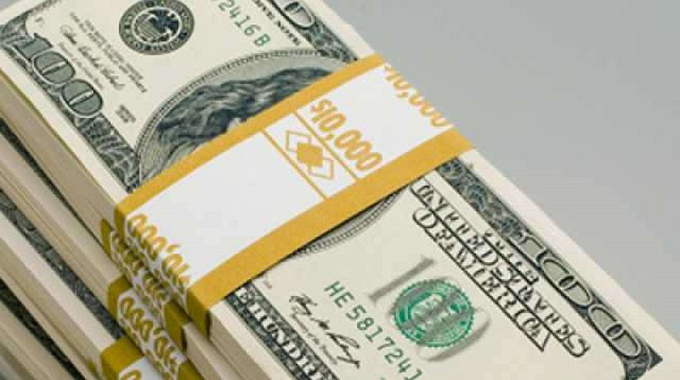
JACHYMOV. – The US dollar is the most widely used currency in the world.
It is both the primary de facto global tender and the world’s unofficial gold standard.
According to the US Federal Reserve, 58 percent of the planet’s financial reserves are held in US dollars – more than double the total foreign holdings of euros, yen and renminbi combined. Thirty-one nations have either adopted it as their official currency or named their money after it – 65 countries peg the value of their currencies to it and it’s now accepted in places as far-flung as North Korea, Siberia and research stations on the North Pole.
Yet, one place where the dollar is not accepted is in the tiny Czech town of Jáchymov – which is ironic, because it was here, tucked deep into the wooded folds of Bohemia’s Krušné hory mountains, where the dollar originated more than 500 years ago in 1520.
But as I pulled a George Washington one-dollar bill from my wallet in Jáchymov’s 16th-Century Royal Mint House museum, the very spot where the dollar’s earliest ancestors were coined, docent Jan Francovič smiled and stopped me.
“I haven’t seen one of these in a long time,” he said, calling over two colleagues.
“In Jáchymov, we only accept koruna, euros or sometimes Russian rubles. You’re the first American to come here in more than three years.”
Welcome to Jáchymov: a sleepy 2,300-person town near the Czech-German border that’s both the home of the dollar and the home of no dollars.
Chances are you’ve never heard of the place.
You probably didn’t know that it is part of a Unesco World Heritage site.
And you likely never realised that the currency that powers the free world originated in this one-road town still reeling from the collapse of communism that has more brothels than banks.
“There are no signs advertising it anywhere – most people living here don’t even know!” said Michal Urban, director of the non-profit development Mountain Region Krusne hory – Erzgebirge.
“No other mining town in the world has had such a big influence as Jáchymov, but we’ve forgotten our history.”
When vast quantities of silver were discovered in 1516, enterprising local nobleman Count Hieronymus Schlick christened the area Joachimsthal (“Joachim’s valley”) after Jesus’ grandfather, the local patron saint of miners.
“At the time, Europe was a continent of city-states with local rulers vying for power,” explained local historian Jaroslav Ochec. “With no standard monetary unit among them, one of the most effective ways rulers could assert their control was to mint their own currency, and that’s what Schlick did.”
The governing Bohemian Diet officially granted Schlick permission to mint his silver coins on 9 January 1520.
The count stamped an image of Joachim on the front, the Bohemian lion on the back, and named his new currency “Joachimsthalers” – which soon became shortened to “thalers”.
“For the next 300 years, many countries around the world modelled their money after the thaler,” Urban said.
“Soon, the thaler started to live a life of its own far from here.”
As rulers across Europe began remodelling their coins after the thaler, they also renamed them in their own languages.
In Denmark, Norway and Sweden, the thaler became known as the “daler”. In Iceland, it was the “dalur”. Italy had the “tallero”, not to be confused with the “talar” (Poland), the “tàliro” (Greece) or the “tallér” (Hungary).
The thaler soon spread to Africa where it was used in Ethiopia, Kenya, Mozambique and Tanzania as late as the 1940s – and across much of the Arab Peninsula and into India, where it was still in circulation through the 20th Century.
The official currency of Slovenia was the “tolar” until 2007.
The money in Samoa is still called “tālā”.
And the currencies in Romania (“leu”), Bulgaria (“lev”) and Moldovia (“leu”) today all take their names from the lion stamped on the first thaler 500 years ago.
But it was the Dutch leeuwendaler (“lion dollar”, or “daler” for short – pronounced nearly identically to the English “dollar”) that gave the US currency its name.
After first arriving in New Amsterdam in the 17th Century with Dutch colonists, the dalers quickly spread throughout the Thirteen Colonies and English-speaking settlers began calling them – and all similarly weighted silver coins, including the widely used Spanish real de a ocho (“piece-of-eight”) coin – “dollars”.
The dollar became the US’ official currency in 1792 (the same year the US minted its first penny) and ever since, the thaler-inspired dollar has continued its march across the globe to places like Australia, Namibia, Singapore and Fiji. – BBC