Chronicle Editor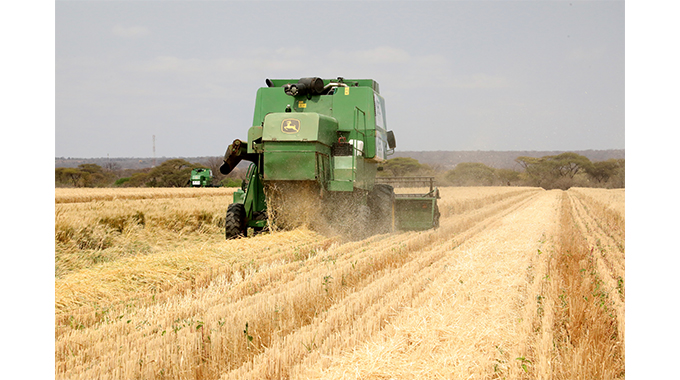
Raymond Jaravaza, [email protected]
DESPITE the crippling effects of the El Nino-induced drought and illegal sanctions, wheat farmers have defied the odds by increasing their output.
This increase has significantly contributed to the country’s food security and nutrition.
Research and economic experts have voiced their concerns about how the illegal sanctions have hindered the country’s access to external funding and potential investment, leading to weaker trade performance, low investment and unfair participation in the global economy.
According to the Agricultural Advisory and Rural Development Services acting chief director, Mr Leonard Munamati, Zimbabwe is expected to harvest 600 000 tonnes from this year’s winter wheat crop.
Harvesting has already begun, and this figure shows a significant increase compared to the same time last year when only 468 000 tonnes were harvested. This increase is attributed to a paradigm shift to irrigation farming by local farmers to beat the effects of drought.
The jump in domestic wheat production is a strong testament to the positive fruits of the Land Reform Programme, which empowered a majority of indigenous farmers, but angered former colonial masters leading to the imposition of illegal sanctions in protest.
Overall, Zimbabwean farmers hope that despite the challenges they face, they will continue to produce more and improve the country’s food security while defying external pressures.
“The country is on course to meet the 600 000 tonnes of wheat given that farmers are recording average harvests of 5,1 tonnes per hectare and we are hopeful the trend will continue as harvesting progresses,” said Mr Munamati.
“It’s important for wheat farmers to stay resilient and to keep coming up with innovations in the face of the drought and other external factors that hinder the growth of their farming enterprises.

“We have seen a huge shift to irrigated farming in the last few years and that’s good direction from our wheat farmers because we never know when the next drought is coming.”
A total of 121 000 hectares was put under winter wheat this year with projections of over 600 000 tonnes of the cereal compared to 360 000 tonnes of domestic consumption needs. Last year’s 468 000 tonnes was the highest ever recorded since wheat production started in the country in 1966.
“Wheat farmers must continue practising climate-smart agriculture as the importance of the cereal in the nation’s food basket cannot be taken for granted.
“Food security is guaranteed when our farmers continue being innovative and the nation doubles the current hectares put under wheat cropping,” said Mr Munamati.
In the last Cabinet meeting, Lands, Agriculture, Fisheries, Water and Rural Development Minister, Dr Anxious Masuka, said 237 710 metric tonnes of grains and oilseeds from the 2023/2024 summer season had been marketed with 48 334 metric tonnes delivered to the Grain Marketing (GMB).
The total grain and oilseeds marketed comprises 130 244 metric tonnes of maize, 28 748 metric tonnes of soya beans, and 8 156 metric tonnes of sorghum. The other cereals are 1 259 metric tonnes of sunflower, 51 299 metric tonnes of wheat and 18 004 metric tonnes of barley.
The Government has said the current stocks of maize, wheat and traditional grains in the Strategic Grain Reserve stand at 228 712 metric tonnes, which is sufficient to last until January next year.
“A total of 372 000 metric tonnes of grain is required to feed the rural people in need by March 2025 at 7,5 kilogrammes per person,” Information, Publicity and Broadcasting Services Minister, Dr Jenfan Muswere, said in a post-Cabinet media briefing on Tuesday.
In Matabeleland South province, new players in wheat production such as the Gwanda State University are also contributing to the national food basket. The university, which planted wheat for the first this year since its establishment in 2016, put 17,8ha under winter wheat and is expecting 88 tonnes, which translates to more than four tonnes per hectare.
At Redwood Irrigation Scheme in Umguza District, a group of villagers planted 17 hectares, down from 25 hectares, as a result of dwindling water levels caused by the drought but still expect a good harvest of 80 tonnes
Redwood Irrigation Scheme was rehabilitated by the Agricultural and Rural Authority (Arda) in 2022 and the villagers transformed it into a thriving venture that produces wheat, maize, butternuts and potatoes.


 Online Reporter