Online Reporter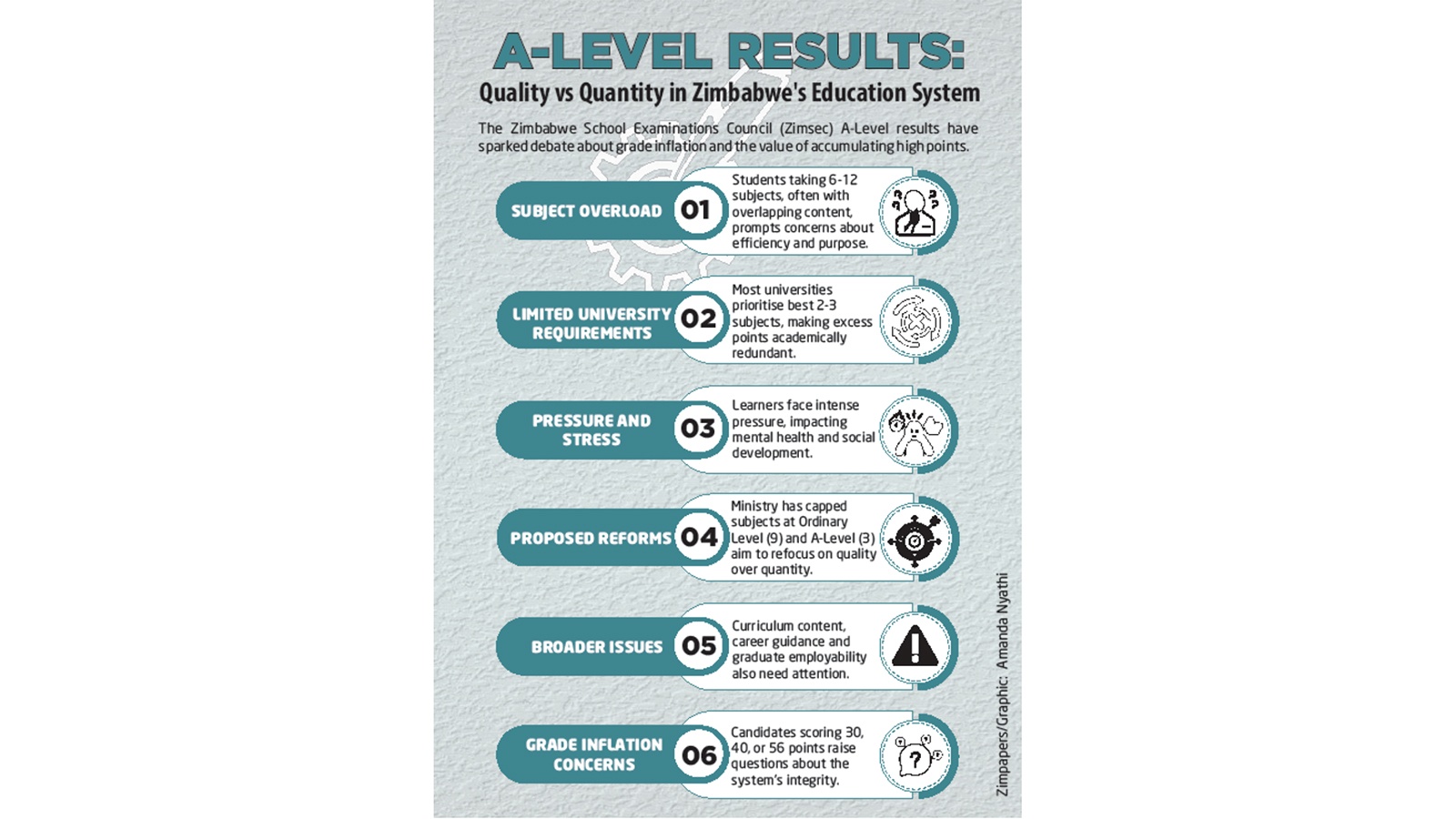
Emmanuel Kafe
CheckPoint Desk
It is that time of the year again, the examination results season when November outcomes redraw the emotional map of households across the country.
In some homes, there is gnashing of teeth and stunned silence; in others, ululation, thanksgiving and carefully cropped screenshots of results shared endlessly on social media platforms.
Social media, as ever, has coined its own vocabulary for the moment.
“Chikuru kufema” (being alive is the only important issue), has trended as a consolatory refrain for those whose results fell short of expectation, a gentle reminder that life, and learning, do not end with one set of grades.
Yet, beyond the humour, the coping mechanisms and the ritualised public celebrations, the latest Zimbabwe School Examinations Council (Zimsec) Advanced Level results have reignited a deeper, more unsettling national conversation: are A-Level results steadily losing their value?
At the centre of this debate are not the failures, but the spectacular successes.
Increasingly common are candidates boasting 30 points, 40 points and even 56 points — totals that, only a decade or two ago, would have sounded implausible, even absurd.
Where 15 points, three straight As, was once the preserve of the exceptionally gifted and academically disciplined, today the public gaze is drawn to candidates amassing towering point totals by sitting for six, eight or even 12 subjects at A Level.
Educationists, academics and policymakers are now asking, sometimes sotto voce and sometimes openly, whether this explosion of points represents a resurgence of academic excellence or a system quietly succumbing to a form of grade inflation.
On the surface, the November 2025 A-Level results appear impressive by any statistical measure.
ZIMSEC reports that the overall pass rate rose from 94,58 percent in 2024 to 95,75 percent.
A total of 36 635 candidates sat the examinations, up from 33 585 the previous year.
Of these, 34 740 obtained at least two passes at grade E or better. Among school candidates alone, the pass rate stood at an imposing 96,39 percent.
But as economists like to remind us, numbers do not speak for themselves, context gives them meaning.
For decades, the country’s A-Level system was deliberately narrow, demanding and sharply defined.
Rooted in the British advanced subsidiary model inherited at independence, it was designed to encourage early academic specialisation.
Three subjects were the norm, occasionally four, carefully selected to align with a learner’s intended field of study — sciences, humanities, commerce or technical disciplines.
Excellence was measured not by volume, but by depth.
Fifteen points was not merely a number; it was a powerful signal to universities and employers alike.
A powerful signal of intellectual rigour, discipline and focus.
It suggested that a learner could sustain high-level reasoning across demanding syllabi, not that they could simply accumulate passes.
That clarity, many argue, is now blurring.
Increasingly, A-Level resembles an expanded version of Ordinary Level, with candidates assembling large clusters of overlapping subjects in pursuit of ever-higher point totals.
The most cited example this season is that of 19-year-old Mukudzei Ziveyi of Pamushana High School in Bikita, Masvingo Province, who amassed 56 points after sitting for 12 subjects at A-Level.
His results include multiple mathematics-related subjects — Pure Mathematics, Additional Mathematics, Mechanical Mathematics and Statistics alongside Physics, Computer Science, Geography and others.
The achievement is undeniably remarkable and speaks to extraordinary discipline, stamina and intellectual ability.
But it also exposes the paradox at the heart of the current system.
Sitting for four or five closely related subjects that, as one veteran teacher Mr Michael Putsai put it, “essentially teach the same thing using different labels”, raises uncomfortable questions about efficiency, educational purpose and guidance.
Was this an act of intellectual curiosity, or a strategic accumulation of points?
More importantly, what tangible advantage does such an achievement confer in real terms?
“In practice, very little,” said Mr Putsai.
At Zimbabwean universities and indeed most regional and international institutions admission, decisions at A-Level hinge on the best three subjects, sometimes even two passes are enough.
An A remains worth five points.
The theoretical maximum for selection purposes is therefore still 15 points.
Everything beyond that threshold, many academics argue, is academically redundant.
Renowned educationist, Dr Tafirei Mandigo, is blunt in his assessment.
“Some of these results are a waste of time, children work themselves to death, but at the end of the day universities require a minimum of three subjects. Beyond that, the points do not matter,” he says.
Excellence was measured not by volume, but by depth. Fifteen points was not merely a number; it was a powerful signal to universities and employers alike. A powerful signal of intellectual rigour, discipline and focus. It suggested that a learner could sustain high-level reasoning across demanding syllabi, not that they could simply accumulate passes.
He cautions against equating examination scores with human potential.
“Examinations may tell us what a person is capable of academically, but they should also tell us who a person is.
“Intelligence is not the same as complete humanness,” says Dr Mandigo.
“We have seen students with excellent grades who go on to do very little, because they lack balance, creativity or resilience.”
Others take a more nuanced position.
Professor Admore Mbengwa argues that, in some cases, broader subject exposure can widen a learner’s intellectual horizons.
“Doing more than three subjects can strengthen theoretical competence and help students see important facets of life more clearly,” he says.
“Knowledge does not exist in silos.”
Yet Prof Mbengwa concedes that the points system itself is a blunt instrument.
“It is primarily a selection tool, not a definitive measure of ability or future success,” he says.
Former university lecturer, Professor Trymore Manda, is more sceptical.
He describes the belief that saturated A-Level results automatically translate into future achievement as “illusory”.
“Some students with flying colours struggle to complete a degree,” says Prof Manda.
“Meanwhile, those who came in with lower grades often outperform them and graduate with first-class degrees. A-Level results can be deceptive and sometimes they breed complacency.”
This is where the analogy of inflation becomes unavoidable.
Just as economic inflation erodes the purchasing power of money, grade inflation risks eroding the signalling value of results.
When high scores become commonplace, they cease to distinguish. Employers begin to doubt.
Universities quietly recalibrate their entry requirements.
International comparability, long one of Zimsec’s selling points, comes under increasing scrutiny.
There are also social and psychological costs to the current trajectory.
Teachers report learners under relentless pressure, juggling punishing workloads and overlapping syllabi.
Parents, sometimes driven by status anxiety and comparison, encourage excessive subject loads in pursuit of bragging rights rather than clarity of purpose.
Sociologists warn that such practices can leave children socially and emotionally bruised, their adolescence consumed by perpetual assessment and performance anxiety.
Some learners emerge academically decorated, but psychologically depleted.
It is against this backdrop that the Ministry of Primary and Secondary Education has announced plans to tighten subject capping.
Under proposed reforms linked to the Heritage-Based Curriculum, Ordinary Level candidates will be limited to a maximum of nine subjects, while A-Level learners will be expected to adhere to the standard three.
The policy signals an official recognition that the system may have drifted from its original intent.
Director of Communication and Advocacy in the Ministry, Mr Taungana Ndoro ,recently clarified the ministry’s position regarding students registering for more subjects than the stipulated number for public examinations.
“The ministry has a clear and revised policy on this matter,” he said.
“To ensure depth of learning, quality of instruction and the integrity of learner outcomes, MoPSE (Ministry of Primary and Secondary Education) has instituted a cap on the number of examinable subjects.
“The standard is a maximum of nine subjects at Ordinary Level and three principal subjects at Advanced Level in the Heritage-Based Curriculum.”
Mr Ndoro stated that this policy is designed to encourage focused, in-depth mastery of the core curriculum rather than the accumulation of numerous subjects.
Additionally, he highlighted that the strict capping enhances competency.
“Ministry has already implemented a strict cap,” he said.
“This decisive move aims to promote profound understanding and competency in core learning areas, prevent pupil burnout from excessive academic loads and align all schools and learners with a standardised, manageable curriculum framework.”
Yet subject caps alone may not resolve the deeper structural issues.
Several academics argue that curriculum content itself requires urgent review, with some syllabi lagging behind contemporary knowledge demands and labour-market realities.
Career guidance, too, remains uneven, leaving learners to navigate critical educational choices with limited professional support and guidance.
Zimbabwe rightly prides itself on an adult literacy rate above 90 percent, among the highest in Africa.
As Prof Manda observes, “We are producing highly qualified people who do not always translate into national development. That should worry us more than how many points someone has.”
The question, then, is not whether Zimbabwean students are capable, they demonstrably are, but whether the A-Level system still measures what matters, he adds.
“Quantity has begun to overshadow quality. Points have multiplied, but clarity has diminished,” says Prof Manda.
“As the nation celebrates its top performers and consoles those left disappointed, a more urgent task remains: to decide what A-Levels are truly for, and whether the current model still serves that purpose.”
If that question is not confronted honestly, Zimbabwe risks a future in which impressive numbers mask a quiet erosion of meaning, and where excellence is measured less by depth of understanding than by the sheer weight of certificates carried into adulthood.