Online Reporter
Thupeyo Muleya, [email protected]
IN Beitbridge, where the roads are always busy and the border never really sleeps, life carries on at a steady, determined pace. Trucks roll in and out, traders move with purpose, and the town breathes the rhythm of movement. Yet, beneath all this activity, something quieter has begun to take root — something you cannot see, but can feel when you listen closely. It is travelling through the air, carried by voices that now sound familiar, warm and close to home.
Across Matabeleland South, community radio is slowly changing how people connect with the world around them. These are not the distant, formal broadcasts many grew up with. These are stations that speak as people speak at home — in their own languages, with their own expressions, about the things that matter most to them. For many, it feels like being included at last.
For a long time, most radio broadcasts came in English, Shona or Ndebele. While these languages reached many, they did not always reach everyone. In a province where Venda, Kalanga and Sotho are widely spoken, there were moments when people simply could not follow what was being said. Important announcements would pass by, not because people did not care, but because they could not fully understand.
Now, that situation is changing in a very real way. Community radio stations that broadcast in isiNdebele, TjiKalanga, Tshivenda and Sotho are filling that gap. Slowly, the airwaves are beginning to sound more like the communities they serve. People are no longer just listening — they are understanding, and more importantly, they are taking part.
Across the country, more than 20 language-based community radio stations have been licensed under the Second Republic.
This is part of a wider effort led by President Mnangagwa to make sure no one is left behind as Zimbabwe works towards Vision 2030. The idea is simple but powerful — communication should reach everyone, not just a few.
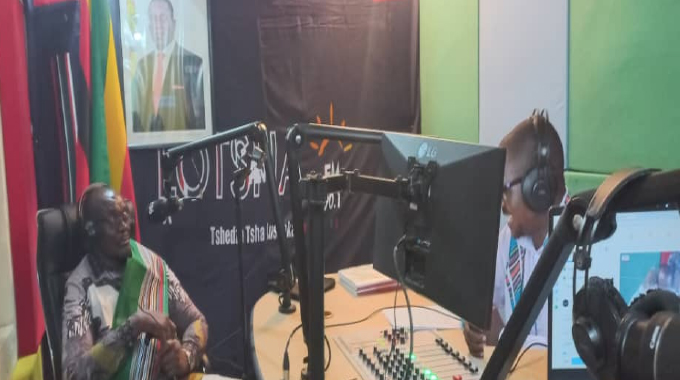
In Matabeleland South, four community radio licences have been issued, covering Venda, Sotho, Kalanga and Ndebele languages. In Beitbridge, Lotsha FM has quickly found its place at the centre of community life. Licensed under the Beitbridge Shashe Community Broadcasting Service, it has become more than just a station.
It is a place where people come to hear what is happening, to learn, and to share.
Many in the district say the station has changed how they get information. Farmers now listen for weather updates they can understand straight away. They hear about livestock diseases in time to act. Health workers speak openly about issues like HIV awareness and maternal health in languages people are comfortable with.
“It’s different when you hear the information in your own language,” said a farmer from Tshaswingo in Beitbridge East.
There is honesty in that statement, something simple but deeply true.
“In previous years, we would miss important Government announcements because they were only in English or Shona or Ndebele and in some parts of the district there was no radio reception. Now we understand, and we can ask questions live on air”.
That last part matters. People are no longer just receiving information — they are part of the conversation.
When Vice President Colonel (Rtd) Dr Kembo Mohadi visited Lotsha FM in March, he spoke about what this shift really means. He described the opening up of the airwaves as a major step forward for the country, one that has allowed more voices to be heard.
“They’re a vital tool for promoting national unity, democracy, and social transformation. In Matabeleland South, stations like Bayethe FM, Radio Bukalanga and Ntepe-Manama are doing remarkable work in promoting local languages and culture,” said VP Mohadi.
Standing there, the message was clear — these stations are doing far more than broadcasting.
“Community radio stations in Zimbabwe have significantly improved access to information in rural and marginalised areas, reaching thousands of listeners through 14 licensed stations. They enhance democracy, promote local languages and culture, and provide vital updates on health and agriculture, fostering community participation. In addition, Stations like Lotsha FM in Beitbridge show that community ownership, through local content, empowers residents to address local issues from an informed perspective”.
It is not hard to see what he meant. When people understand what is being said, they are more confident to act. They ask questions, make decisions and take part in shaping their communities.
“Lotsha FM is a testament to this, having received funding to set up and operate. With sustainable funding and editorial independence, these stations will continue to thrive. It has become a beacon of hope in Beitbridge, and is a shining example of this initiative. Established through the Broadcasting Fund, this station has improved access to information in rural areas, empowering residents to address local issues,” said the Vice President.
His visit was not only about words. He donated US$10 000 to the station and promised to provide a vehicle to help with its work. For a growing community station, this support will make a real difference, helping it reach more people and improve what it offers.
Still, he was honest about the road ahead.
“As the Government, we are aware that operational challenges exist, but with sustainable funding, local capacity building, and editorial independence, this station will thrive,” he said.
He also called on others to help — businesses, community members and leaders alike.
“However, as a community with stakeholders that have the zeal to develop their information space, we encourage collective efforts by the private sector, the community and the Government to improve the sustainability model at Lotsha FM,” said VP Mohadi.
He made it clear that community radio is not something that can stand alone. It needs support, but it also gives back in ways that are easy to see.
“Information dissemination through radio empowers urban and rural communities in the information age in several ways which include providing timely and relevant information on issues like health, education, agriculture, and governance, helping communities make informed decisions. Furthermore, community radios showcase local talent, culture, and languages, preserving heritage and promoting social cohesion,” said VP Mohadi.
At provincial level, the importance of the station has also been recognised. Minister of State for Provincial Affairs and Devolution Albert Nguluvhe spoke about its role in bringing people together and sharing important information.
“This is one of the four licenced community radio stations in our province among them Radio Bukalanga (Plumtree), Bayethe FM (Matobo) and Ntepe-Manama (Gwanda) is a testament to the Second Republic’s commitment to broadening access to information and promoting inclusive growth,” said Minister Nguluvhe.
For those running the station, the progress has been clear. Board chairman Mr Mekia Muyambo pointed to the milestones achieved since the station started.
“Since its inception, the radio station has achieved significant milestones, including broadcasting in local languages that include TshiVenda, Sotho, Shangani, Ndebele and others spoken in the community while hosting community events, and providing critical information on health, education, and agriculture, among other current affairs related issues,” he said.
Inside the station, young people are also finding their footing. For some, it is a place to learn, to grow, and to discover what they can do.
A young journalist working as a volunteer producer and assistant news editor, Miss Muvhuso Chibi, spoke about how the platform is opening doors for youths while promoting development and gender inclusion.
And for artists, the impact is just as real.
“Lotsha FM is one important facility that has made most artists break even and also get opportunities to showcase their talents. Previously, most budding artists would struggle to access slots on national radio stations,” said local artist Emmanuel Ndlovu commonly known as Christen Mirror.
In a place where many stories pass through and move on, Lotsha FM has become something steady. It is where people hear their own voices, their own languages, and their own lives reflected back to them. And in that simple act of listening, a community is finding itself more connected than ever before.