Online Reporter
Communion with Bishop Lazarus
Sometime in March 2015, which is more than a decade ago, Bishop Lazi’s crusade took him to a swelteringly hot Abuja in Nigeria.
Despite the humidity, the experience was quite pleasurable and enjoyable.
The food — jollof rice, pounded yam, egusi soup, snails — was divine, and the people, as is the case everywhere in Africa, were hospitable and amazing.
But for someone like Bishop Lazarus who was always told that Nigeria was the biggest oil producer on the continent, something stood out like a sore thumb in this West African country — the fuel queues.
Apparently, there was a shortage of oil at the time as the country did not quite have enough foreign currency to import petroleum products.
At every fuel station in Abuja, the queues endlessly serpentined through the streets.
True to nature, the shortages had given rise to the enterprising wheeler-dealer roadside fuel vendors — yes, those chaps who stash drums of fuel and dangle five-litre containers by the roadside to attract desperate motorists.
It was a scene that was all too familiar for the Bishop as Zimbabwe had suffered its fair share of bouts of fuel shortages over the years. But Zimbabwe was not an oil producer. So, this phenomenon was as mind-boggling as it was preposterous.
While Nigeria produced most of the crude oil in Africa, it shipped it overseas, where it was processed before being sent back. It was reminiscent of the general debilitating economic malaise that afflicts the continent, which produces raw materials, for which it is paid a pittance by buyers in the West and East, only for processed and value-added goods to find their way back at higher, if not extortionate, prices. A few examples will suffice.
Cote d’Ivoire and Ghana, for instance, export cocoa and import chocolate and confectionery products.
Kenya exports coffee and tea, only to import coffee products such as Nescafé.
South Africa and Zimbabwe export platinum and import catalytic converters.
Some countries even export cotton and buy secondhand clothing from the same countries.It is precisely this trend that has trapped Africa into a perpetual cycle of poverty, underdevelopment, strife, conflict and general privation.
One man saw all this and decided to do something about it. It was none other than Aliko Dangote. In 2016, he launched his most audacious business venture by beginning the construction of an oil refinery.
He threw everything he had on the project, which was far from easy.
He faced innumerable challenges — far more than he had bargained for — leading to speculation he would fail.
But, by the grace of God, refining operations began in earnest last year after an eye-watering US$23 billion was spent on the undertaking.
Let it this sink in.
Dear reader, put differently, the amount Dangote spent on this project is more or less half of Zimbabwe’s gross domestic product.
And its impact has been immense.
Not only are oil imports in Nigeria at an eight-year low, but the country has become a net exporter of jet fuel, naphtha (a solvent used in varnishes, laundry soaps, cleaning fluids) and fuel oil, according to S&P Global. As Dangote captures the West African market, imports from Europe have naturally plummeted.
It is, therefore, not surprising that some of the refineries in Europe and the Mediterranean region have been struggling to find buyers of late. In July this year, the United Kingdom’s Lindsey, which is owned by United States firm Prax, closed shop.
For Nigeria, it means it will save on foreign currency it will ordinarily have used to import petroleum products.
Its agriculture sector will also benefit from fertiliser — itself produced from byproducts of oil processing. All in all, this is set to turbocharge the Nigerian economy through solving problems that have long hamstrung and held back its economy. For Dangote, it means his fortune will continue to grow.
As a consequence of this humongous investment, his estimated net worth has since risen to a whopping US$29,8 billion, making him Africa’s richest person.
But more than that, he is now the richest black person alive, assuming the mantle that was once held by Mansa Musa in the 14th century.
By now, you might have heard about this fascinating and legendary ruler of the Mali Empire, which straddled parts of the modern-day Senegal, Mauritania, Mali, Burkina Faso, Niger, Gambia, Guinea-Bissau, Guinea and Cote d’Ivoire.
It controlled huge oil and salt resources, and reportedly produced half of the gold in the Old World.
The pious Mansa, we are told, was so obscenely rich that his fortune was believed to be incalculable.
It was only revealed to the world during the emperor’s famed pilgrimage to Mecca in 1324, during which he was accompanied by an estimated 72 000 men — all clad in Persian silk — as well as a baggage train of 80 camels, each carrying 136 kilogrammes of gold.
Cumulatively, Mansa carried with him more than 10 tonnes of gold. Kikikiki.
Whilst in Cairo, where he spent three months, he gave away so much gold that its value markedly dropped, triggering a 10-year economic downturn in Egypt and across the Middle East.
Historians believe his estimated stupendous fortune was between US$400 billion and US$500 billion in today’s value.
Wow!
Consummate industrialist
So, Dangote — the richest black person in the world — is the Mensa Musa of our times.But he is more than that.
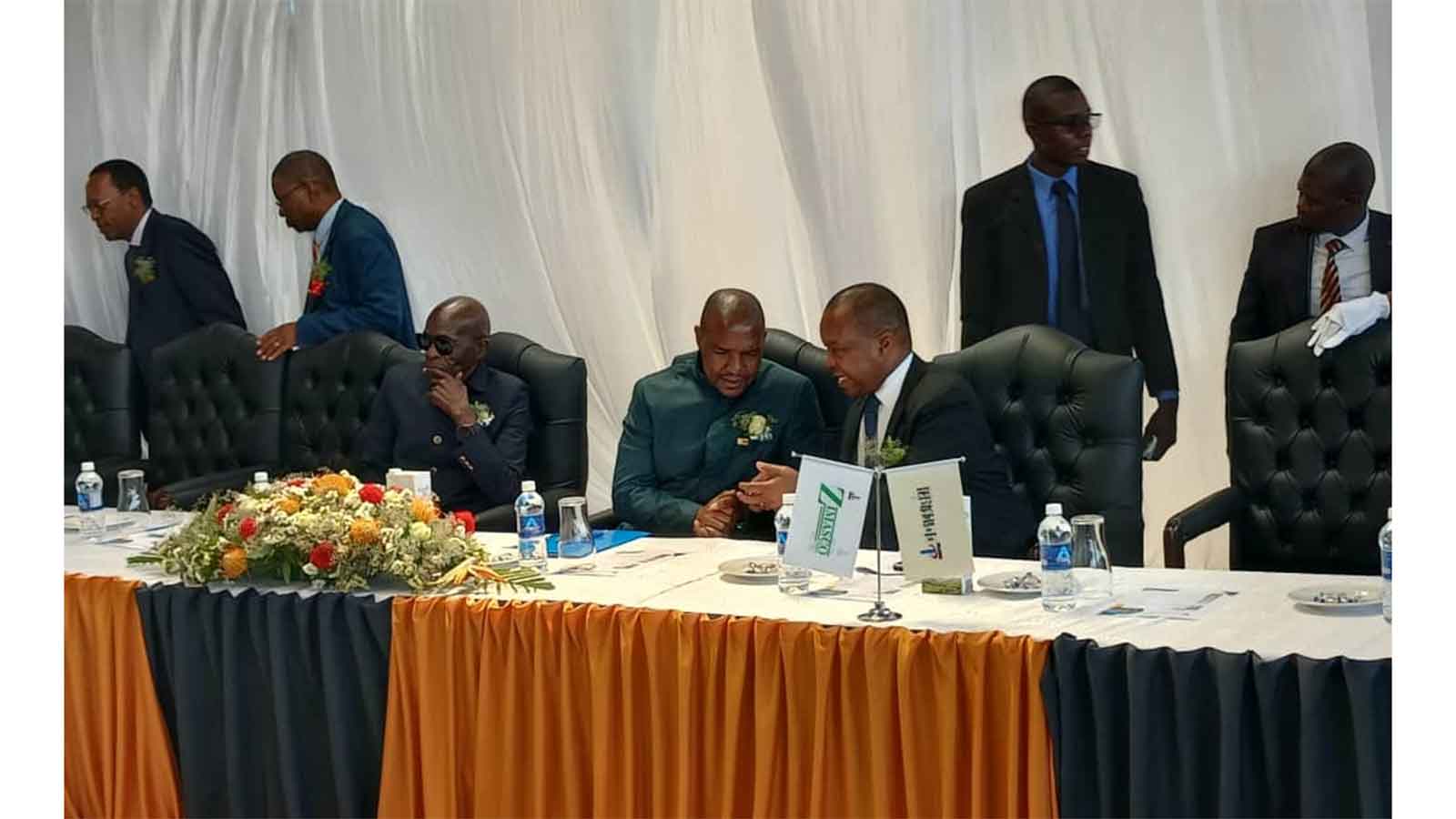
He is a consummate Pan-African businessman and industrialist who build things, unlike the condemnable breed of briefcase entrepreneurs. This makes his visit to Harare last week, especially after the abortive episode in 2015, a big deal. This time, the allure is of a Harare that has dramatically changed from the Harare of 2015.It is a Harare that has not only stabilised its economy but has grown it to become one of the fastest-growing economies in the world.
It is a Harare that is not only feeding itself but also looking to export to the world.
It is a Harare whose currency — Zimbabwe Gold (ZiG) — has enjoyed perhaps its longest run of stability — more than 12 months — creating ideal conditions for investment and economic growth.
And, most importantly, it is a Harare that is well and truly open for business.
Before Dangote, however, there were first movers such as Chinese billionaire Xiang Guangda, whose company Tsingshan — the world’s largest nickel and stainless steel producer — has since established Dinson Colliery and the Dinson Iron and Steel Company.
In November 2022, Guangda had to fly all the way to Zimbabwe to sign a deal with the Government.
Another Chinese billionaire Pei Zhenhua was also in Zimbabwe in January 2023 and has since invested in Zulu Lithium Mine.
Further, back in 2019, we also hosted a Nigerian billionaire, Benedict Peters, who previously worked with Dangote’s younger brother Sayyu Dantata.
His company, Bravura, is presently heavily investing in mining.
An overly cautious Dangote who decides to get off the fence and join in the action signals that Zimbabwe is now ripe and ready for big-ticket investments.
In an interview with Forbes magazine earlier this year, Dangote was quoted as saying: “We have to build our own nation by ourselves. We have to build our own continent by ourselves, not (rely on) foreign investment.”
This perfectly aligns with President ED’s philosophy and governance creed that “Nyika inovakwa, inotongwa, igonamatirwa nevene vayo (A country is built, governed and prayed for by its own people)”.
The next frontier
Ever since 2018, Zimbabwe has been sowing seeds for a prosperous future and now it is time to reap the bountiful harvest.
James 5:7 counsels: “Be patient, then, brothers and sisters, until the Lord’s coming. See how the farmer waits for the land to yield its valuable crop, patiently waiting for the autumn and spring rains.”
Hebrews 6:15 adds: “And so after waiting patiently, Abraham received what was promised.”
Whenever and wherever Dangote, whose interests are largely in cement, sugar, fertiliser, oil and energy, decides to sink his millions, we know it will definitely provide a huge lift to the economy.
His proposed billion-dollar investment could not have come at an opportune time, especially as the Second Republic is preparing the launch of its second five-year economic plan — the National Development Strategy 2 (NDS2) — which is premised on industrialisation. The highly successful NDS1 delivered as expected, with record performance in mining and agricultural production.
The next frontier, which must be delivered by the successor economic plan, involves value adding and beneficiating our resources into high-value products. Instead of exporting cotton, we must export clothing. Instead of exporting lithium, we must manufacture batteries and even aspire to produce electric vehicles.
This would naturally grow our economy multiple times and deliver the much-sought-after prosperity.
As we have seen with the Dangote Refinery, industrialisation, which involves value addition and beneficiation, is what Africa needs to turn its vicious circles to virtuous circles. It is the sure path to prosperity. Clearly, Zimbabwe is well on its way to the promised land.
Bishop out!