


 Online Reporter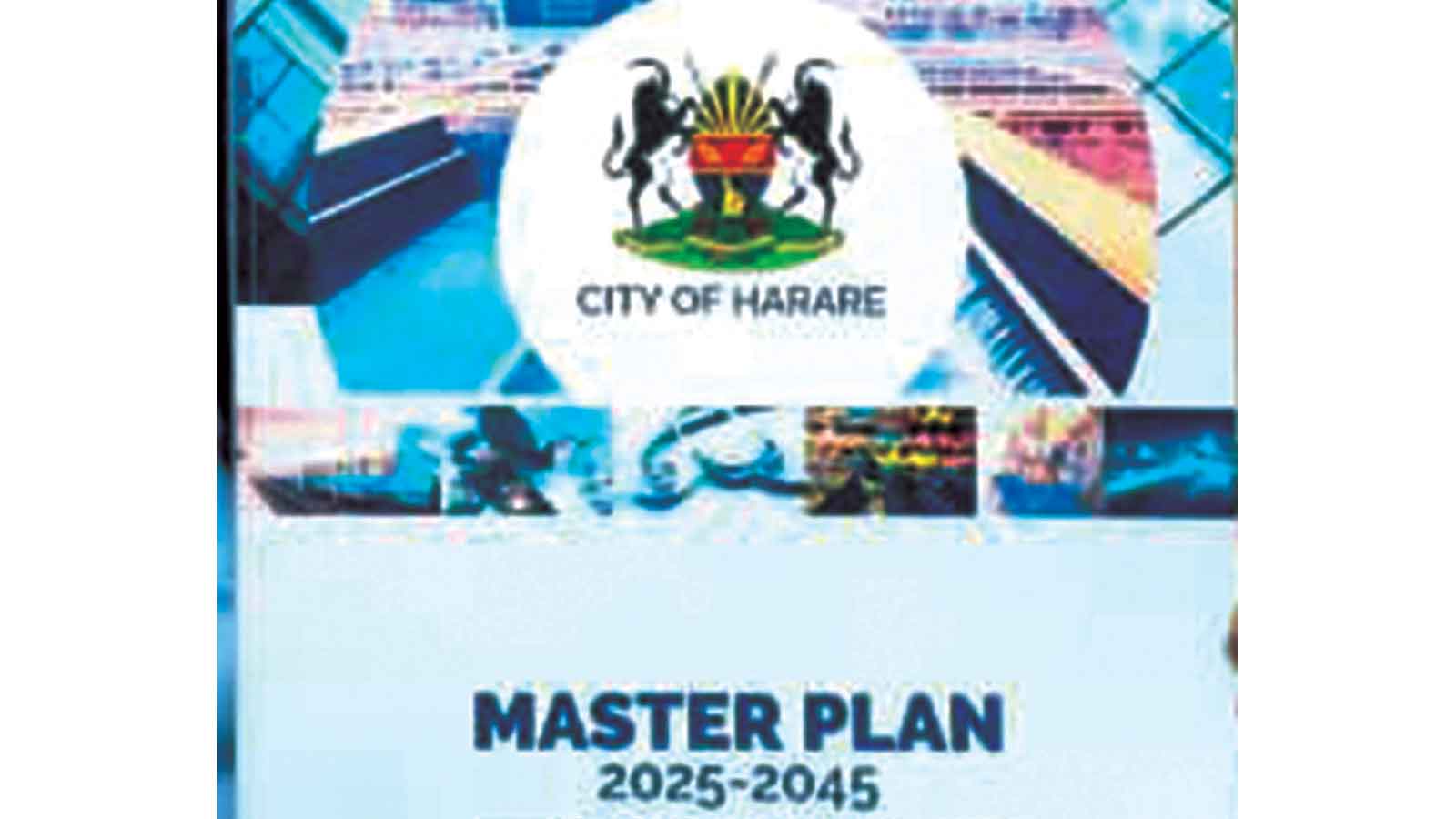
Samuel Nyabeza
Harare’s proposed master plan is a strategic document that sets out the agenda, policies and proposals for the development of the city over the next 20 years.
The master plan comprises two documents — a report of study and a written statement.
The report of study is the result of investigations pertaining to all land uses within the city. It investigates the state of commerce, the location of commercial nodes within the CBD (central business district) and the problems that are present in commercial developments. It also examines infrastructure.
We investigate the condition of roads through surveys. We assess the state of our roads, identify areas where there are conflicts, especially at intersections, and determine areas that require attention from the city.
The report also identifies places where new roads are required and where existing ones need upgrading.
The document goes further to examine water infrastructure. It looks at the location of water reservoirs and transmission lines, and identifies deficits that may exist. It then explores how such deficits can be addressed.
The report also talks about traffic and transportation issues. We assess the current situation, identify shortcomings and determine what can be done to address the challenges facing the transport sector. It examines electricity infrastructure, including the adequacy of electricity supply and location of substations.
The report looks at health services, assessing the adequacy of primary, secondary and tertiary health institutions. It identifies gaps and recommends measures to bridge those gaps. Environmental issues also form part of the report. We identify environmentally sensitive areas and determine what the city and stakeholders can do to reclaim spaces that have been degraded or destroyed.
The report studies population growth, population projections and demographic structures. Population data is important because it informs future planning. If we are planning schools, hospitals, commercial centres or industries, those plans must be informed by both current and projected populations.
For example, there are minimum service delivery standards. For every 10 000 people, there should be a hospital. Population studies help us identify where facilities are inadequate and what must be done to address the shortages.
Population also informs the location of commercial centres. A certain population threshold is required to support a particular commercial node.
It informs industrial development because industries must provide employment opportunities for the population.
The report examines all economic activities taking place within the city. It also evaluates the capacity of the City of Harare in terms of manpower and financial resources to implement development programmes.
After completing the report of study, we identify problems, opportunities, constraints and deficits. These form the first part of the research segment.
Thereafter, the written statement outlines strategies for the development of the city. It contains policies and proposals that the city, residents and stakeholders should implement to realise the objectives of the master plan.
If we are discussing housing, there are policies and proposals dealing with this matter. If we are discussing industry and commerce, there are policies and proposals dealing with these sectors. The same applies to health, education, infrastructure and land use management.
The master plan also contains an implementation framework. This identifies what must be implemented, when implementation should occur, who is responsible for implementation and how it will be monitored.
After preparing the master plan, the city also developed a strategic plan covering the period 2026 to 2030. Issues contained in the master plan are reflected in that strategic plan.
The master plan has already been recommended by the council for approval by the Minister of Local Government and Public Works. Once approved, the minister will advertise it in the Government Gazette and indicate when it will become operational. The plan becomes operative six weeks after ministerial approval.
This master plan is a result of extensive consultation and participation. When it was advertised, we received numerous submissions from stakeholders. These included residents’ associations, companies, professional organisations such as the Institute of Engineers and the Institute of Surveyors.
All those stakeholders were given an opportunity to make comments on the plan. As a result, we revised the draft to accommodate issues that were raised and which we considered important.
We met stakeholders individually and discussed their concerns. We also explained how the city intended to address the issues they had raised. This means the master plan is not merely a City of Harare document. It is a plan that reflects contributions from people across the city and even beyond the country’s borders.
Because the plan was available online, we received comments from Zimbabweans living in countries such as the United Kingdom.
This is, therefore, a master plan for all residents and stakeholders. It is not a City of Harare plan alone. It belongs to everyone who participated in its development and everyone who has an interest in the future of Harare.
Housing is one of the biggest challenges facing the city and the master plan contains several policies intended to address this issue.
We are proposing increased use of public-private partnerships in housing delivery. The National Housing Policy and National Human Settlements Strategy encourage such partnerships and we believe they will help reduce the housing backlog.
We expect greater participation by private developers in both housing construction and infrastructure development.
The master plan also promotes densification. Approximately 40 percent of future council and State-led housing developments will consist of flats and cluster houses.
We are encouraging densification not only in new developments, but also within existing low-density suburbs. Cluster housing developments will play an important role in addressing housing shortages. Urban renewal is another major component of the plan. Areas such as Mbare, Highfield and Glen Norah will be targeted for urban renewal programmes.
We also intend to address urban informality. There are settlements around the city that developed outside formal planning frameworks. The master plan proposes formalising such settlements by providing roads, water, sewer infrastructure and other services.
In some cases, structures will be regularised where circumstances permit.
There will, therefore, be extensive programmes for urban renewal, regularisation and infrastructure provision.
By 2045, there should be a significant difference between what residents see today and what they will experience then.
The master plan specifically addresses small and medium enterprises (SMEs) and vending activities. At the same time that we were preparing the master plan, we were also developing an SME policy.
The master plan proposes that vendors be relocated to designated vending centres. The city has identified a number of sites for this purpose and those spaces have already been shared with stakeholders involved in SME development.
Some of these sites are being developed by private investors, others by the council and others through partnerships involving individual developers. SMEs are now a major component of the economy and the city recognises that reality.
However, we do not want people operating from roadsides, shop frontages and other unsuitable locations where there is no water, no sewer infrastructure and where safety is not guaranteed.
We want traders to operate from proper facilities. In areas such as Mbare, Glen View Area 8, Amalinda, Chaminuka and Hatcliffe, significant work is already taking place.
By 2045, we envision modern facilities, including multi-storey structures, accommodating SMEs and vendors in a safer and more organised environment.
The master plan contains detailed proposals for roads and transport infrastructure.
These proposals were developed through consultations with the Ministry of Transport and Infrastructural Development, the Ministry of Local Government and other stakeholders.
We have identified intersections requiring upgrading in order to reduce congestion and improve traffic flow.
New financing models have also been developed. Historically, financing road infrastructure has been a major challenge. However, the city and the Government have now developed mechanisms that allow private developers to participate in infrastructure projects and recover their investments later.
These models are contained in the master plan and we believe they will significantly improve infrastructure delivery.
Regarding water, the city is already upgrading transmission lines and pumping stations in partnership with private sector players.
The Kunzvi Dam project is also expected to contribute significantly towards resolving water shortages.
Currently, substantial volumes of treated water are lost through leakages and illegal connections. The city is introducing smart metering systems and replacing ageing infrastructure to address those losses.
The master plan also provides for the expansion of reservoirs and the development of additional water infrastructure.
On sewer infrastructure, the plan contains proposals for rehabilitating existing treatment works and constructing new facilities where required. The budgets have already been outlined and what remains is identifying contractors and implementation partners.
The city plans according to established standards.For every 500 housing units, there should be a primary school site.
For every 1 500 housing units, there should be a secondary school site. The same approach applies to hospitals and health facilities.
Sites have already been reserved for primary, secondary and tertiary health institutions.
Immediately after approval of the master plan, the city intends to prepare a new CBD local development plan.
The current plan has been overtaken by events and no longer adequately addresses present realities.
The new plan will introduce mixed-use developments. Buildings will be allowed to accommodate commercial activities, offices and residence within the same development.
The objective is to create a CBD that remains active throughout the day and night.
Issues such as traffic congestion, parking shortages and vending will also be addressed.
Samuel Nyabeza is the Harare City Council acting director of Urban Planning. He was speaking to The Sunday Mail’s Remember Deketeke.


