Online Reporter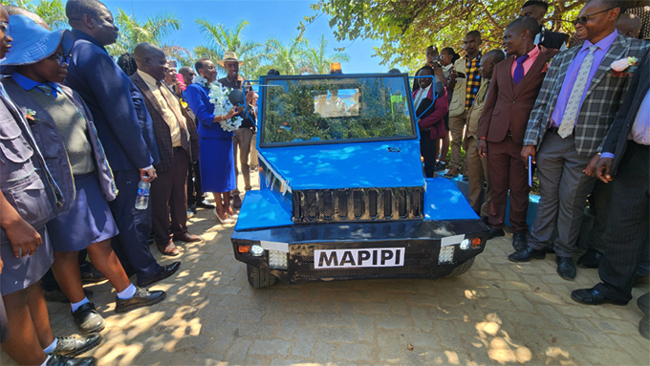
Lloyd Makonya
Correspondent
LAST week The Manica Post carried a story that should not quickly fade from public discourse.
The image of 18-year-old Tinotenda Mapipi standing beside a four-wheeled motor buggy he designed and built at Chibuwe Technical High School is more than a celebration of youthful ingenuity. It is a marker of Zimbabwe’s educational transition and a signal that the Heritage-Based Curriculum is beginning to produce tangible outcomes.
Mapipi’s project, constructed from salvaged motorbike components and refined into a functioning prototype, is precisely the kind of solution-oriented innovation policymakers envisioned when technical high schools were repositioned as hubs of production and creativity.
Primary and Secondary Education Deputy Minister, Honourable Angeline Gata, described the vehicle as evidence that the curriculum is working, noting that learners, when given the right tools and guidance, can produce remarkable results.
Chibuwe Technical High School head, Mr Needmore Maposa, was equally emphatic, arguing that education must empower learners with skills that are usable and productive, capable of contributing to Zimbabwe’s industrialisation.
They are both right.
But there is a crucial dimension that now demands urgent attention, and it is the systematic teaching of Intellectual Property (IP) in our schools.
Innovation without protection is vulnerability.
If Mapipi’s design proves commercially viable, what safeguards exist to ensure that he or Zimbabwe benefits from its replication and refinement?
Could another party replicate the mechanical configuration, patent a similar utility elsewhere and commercially exploit the concept beyond our borders? These are not abstract concerns. They sit at the centre of modern economic competitiveness.
Intellectual property is the currency of knowledge economies. Patents, utility models, trademarks, industrial designs and copyrights transform ideas into legally recognised assets. They enable inventors to attract investment, license technologies, build brands and prevent unauthorised copying.
Countries that dominate manufacturing, technology and creative industries do so not merely because they innovate, but because they protect and commercialise innovation.
Zimbabwe’s Heritage-Based Curriculum is correctly prioritising production, problem-solving and industrial relevance.
Across the country, innovation hubs are emerging in secondary schools and universities. Technical and vocational disciplines are gaining renewed respect. Learners like Sharon Chanduru, who told The Manica Post that seeing a peer assemble a vehicle changed how learners view technical subjects, are living proof that perceptions are shifting.
Technical education is no longer viewed as secondary to purely academic pathways. It is becoming aspirational.
Yet, if we stop at encouraging invention without teaching protection, we risk undermining the very economic transformation we seek. The logical evolution of the Heritage-Based Curriculum is the integration of intellectual property literacy. Learners must understand not only how to build, but how to own. They must grasp how patents secure exclusive rights, how industrial design registration protects aesthetic features, how trademarks build brand identity and how copyright safeguards creative works.
This knowledge should not be reserved for law faculties or postgraduate programmes. It should be embedded within technical, vocational and even creative arts subjects at secondary level.
Doing so will achieve several outcomes simultaneously. It will cultivate respect for originality and reduce plagiarism. It will encourage entrepreneurial thinking at an early stage. It will formalise innovation pathways so that prototypes do not remain school projects but evolve into market-ready products. Most importantly, it will align education with Zimbabwe’s broader industrial and economic goals.
Chief Manicaland Provincial Education Director, Mr Richard Gabaza, rightly observed that developments at Chibuwe Technical High School contribute to nurturing home-grown expertise in manufacturing and mechanical engineering. The next strategic step is ensuring that this expertise is commercially empowered.
Innovation must follow a deliberate progression: idea, prototype, protection, investment, production and market entry. Too often, Zimbabwe excels at the first two stages and stalls thereafter.
Encouragingly, the national trajectory is positive. Government has demonstrated commitment to strengthening technical high schools, supporting innovation hubs and promoting Science, Technology and vocational training.
The decentralisation of innovation as seen in Chipinge ensures that creativity is not confined to urban centres. This inclusivity broadens the national innovation base and reinforces equitable development.
Now the momentum must deepen. Structured intellectual property awareness programmes should be introduced within schools.
Mechanisms should be established to assist promising student innovators with patent or utility model filings. Partnerships between schools, industry and research institutions must be strengthened to facilitate prototype refinement. Seed funding models and incubation platforms should support the transition from demonstration models to scalable products.
When innovation is protected, it becomes bankable. When it is bankable, it attracts capital. When it attracts capital, it creates employment and industrial capacity.
Intellectual property is not merely a legal technicality; it is an economic strategy. The motor buggy at Chibuwe Technical High School is symbolic. It represents a curriculum taking root, a rural school rising to national prominence and a young Zimbabwean daring to transform an idea into a working machine. But its deeper significance lies in the question it poses to policymakers, educators and industry leaders alike: are we equipping our innovators not only to create, but to own and commercialise what they create?
Zimbabwe has the talent. Zimbabwe has policy momentum. Zimbabwe has youthful ingenuity in abundance. The next phase of reform must ensure that these attributes translate into protected, monetised and scalable innovation. Only then will the wheels of the Heritage-Based Curriculum drive sustain economic transformation.