admin
admin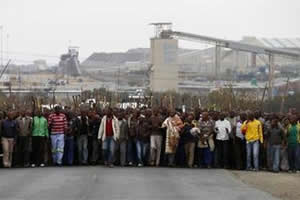
, threatening to bring Africa’s largest economy to its knees.
This comes as President Jacob Zuma said the mining unrest that captured international attention following the killing by police of 34 striking miners would be resolved through negotiation.
The massacre forced the South African government to deploy 1 000 to Marikana.
President Zuma, who is attending the 67th Session of the United Nations General Assembly in New York, United States, told the Associated Press that the August 16 killings at the Lonmin platinum mine in Marikana should not be viewed as “the kind of incident that will be a common occurrence” or “that things have gone out of control in South Africa”.
He said the strikes, which have spread to other mines, were a direct consequence of the strike at Marikana and that they too would be resolved through negotiation.
Arguing that the current strikes were part of the phase of the workers’ fight for economic freedom, expelled African National Congress youth leader, Julius Malema has supported the striking workers’ cause, and has called for the nationalisation of South Africa’s mineral wealth.
However, President Zuma has denied that the strikes reveal startling inequalities in post-apartheid South Africa, saying it was not a problem that has “arisen now”, blaming the problem on the legacy of apartheid.
As the mining unrest intensified, South African truckers swelled the ranks of workers on strike in the country to almost 100 000, escalating a conflict with mine owners and police that has shut 39 percent of the nation’s gold production.
“This truck drivers’ protest has been accompanied by serious provocations, intimidations, public violence and even elements of criminality,” Police Minister Nathi Mthethwa said yesterday in a statement.
“Workers must refrain from intimidating and assaulting those still working, or destroying property.”
Security forces yesterday fired rubber bullets at strikers at a factory in Howick, National Union of Metal workers of South Africa Regional Secretary Mbuso Ngubane said yesterday.
About 20 000 transportation industry workers are on strike, a development that has threatened the industry.
South African Transport and Allied Workers Union has warned motorists to fill up their tanks as petrol shortages are expected as early as this weekend.
The union is demanding a 12 percent wage increase while management is offering 9 percent.
The union has warned that the ongoing strikes will only end when an agreement is reached.
The union’s general-secretary Zenzo Mahlangu said, “It depends on the reservoirs of the garages and the volumes of cars that they are servicing. But if it runs for a week by weekend they will start experiencing some problem with petrol.”
As the unrest persists, Malema, who has backed the wildcat strikes, later cancelled his plan to address Implats workers yesterday to encourage them to press for higher wages.
“Tomorrow I’m going to a mine, Impala mine in Rustenburg. I’m going to encourage the workers to demand 12 500 (rand a month),” Malema had said outside a court in the northern city of Polokwane where he was charged with money laundering on Wednesday.
Malema, who was ousted from the ANC for indiscipline in April, is tapping into a swelling vein of anger among miners to revive his political career and campaign to unseat President Zuma.
Impala faced fresh demands from workers after agreeing to higher salaries to end a strike during January and February.
The miners won wage gains of 22 percent, more than four times the August inflation rate.
Miners also went on strike at all of AngloGold Ashanti Ltd. (ANG)’s mines in South Africa, which has the world’s largest platinum, chrome and manganese reserves.
AngloGold, the third-largest gold producer, employs more than 32,000 in South Africa, its 2011 annual report shows.
Gold Fields Ltd. (GFI), the fourth largest producer of the metal, said most of the 15,000 employees at its KDC West site are on strike, along with 9,000 at its Beatrix mine. It said today there aren’t any talks scheduled with employees.
Strikes at Anglo American Platinum Ltd. (AMS), the largest producer of the metal, may lead to job losses after at least 21,000 staff halted work without following required dispute resolution procedures, chief executive officer Chris Griffith said yesterday in Rustenburg.
The company began disciplinary action yesterday that may lead to dismissals, said the company in a statement.
Disruption may spread as mine workers demand “the Lonmin settlement,” David Davis, an SBG Securities Ltd. analyst said yesterday.
Workers at Coal of Africa Ltd’s Mooiplaats mine, employing about 370 people, have also downed tools.
Harmony Gold Mining Co., the nation’s third-largest producer, is unaffected by labour unrest, it said yesterday in an e-mailed response to a query. Xstrata Plc’s South African alloys unit hasn’t received any demands, it also said.
South Africa’s mining industry employed 498,141 workers in 2010, according to figures on the Chamber of Mines’ website. – Wires.


 Online Reporter