

 admin
admin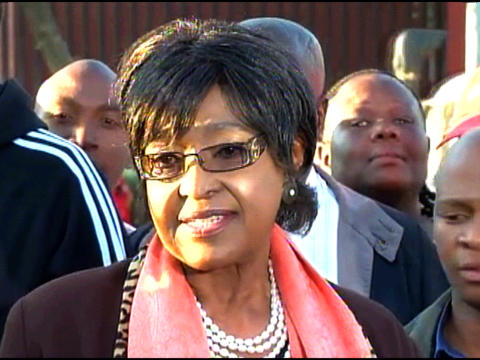
London — Nelson Mandela’s ex-wife Winnie Madikizela-Mandela strongly criticised yesterday a visit paid by President Jacob Zuma in April to the ailing anti-apartheid icon, who is again critically ill in hospital. Zuma and the ANC had come under fire at home and abroad for the visit in April to the former president, who was recuperating at home following a 10-day hospital stay.
“I honestly cannot put in words how hurt the family was. It was one of the most insensitive things for anyone to have done,” Madikizela-Mandela told Britain’s ITV News television.
In excerpts published on the ITV website, she added: “It was insensitive, it compromised the family, compromised his dignity and it should have never been done.”
Zuma said at the time Mandela was “up and about”, a description that was clearly at odds with televised footage that showed the revered ex-leader frail and dazed, sitting frozen in an armchair.
Mandela (94), is said to remain in a critical but stable condition after more than three weeks in a Pretoria hospital suffering from a recurrent lung infection.
In Durban hundreds of people held a prayer meeting for Mandela at the Durban City Hall yesterday.
They sang gospel and African National Congress songs.
On stage were banners bearing a picture of Mandela and the words, “We love you Comrade Mandela” and “Madiba, your presence inspires us, our prayers are with you”. Some people wore ANC regalia.
ANC KwaZulu-Natal chairperson Senzo Mchunu delivered the key note address.
The prayer meeting was attended by provincial secretary Sihle Zikalala, deputy chairperson Willies Mchunu, National Freedom Party general secretary Nnhlanhla Khubisa, religious leaders and traditionalists.
In Johannesburg, former president FW de Klerk has cut short his Europe trip because of Mandela’s ill-health, De Klerk’s foundation said on its website on Saturday.
“Mr FW de Klerk and his wife Elita have decided to suspend their current working visit and holiday in Europe because of Mr Mandela’s medical condition,” it said.
“They will arrive back in Cape Town tomorrow (Sunday). Their thoughts are with the Mandela family during this difficult time and they join in the prayers for an improvement in Mr Mandela’s health.”
There was no further information on whether De Klerk would be visiting Mandela.
It has been three weeks since Mandela was admitted to the Medi-Clinic Heart Hospital in Pretoria.
On Saturday, President Jacob Zuma said his condition was still critical but stable.
“We’re hoping that it Mandela’s health is going to improve,” Zuma said at a Press briefing on Saturday.
“I think with all the prayers and good wishes that are being made, certainly it would do something.”
In a historic move by the UK government, Britain has asked to hold a memorial service for Mandela at Westminster Abbey when the time comes — the first for an African and non-British citizen.
The queen has also requested to attend such a memorial service should South Africa agree, reported the Sunday Independent.
According to the newspaper, Westminster Abbey officials have contacted South Africa with the request while acknowledging the sensitivity of the matter given that Mandela is still alive in hospital. It is understood the officials were motivated by a request from the queen.
Westminster Abbey has been the coronation church of the British monarch since 1066 and the resting place of 17 royals.
Duncan Jeffery, head of communications at Westminster Abbey, confirmed that the church has had preliminary discussions with the South African High Commission regarding such a service.
Meanwhile, President Barack Obama is heading for Robben Island in Cape Town, where Nelson Mandela was jailed for 18 of his 27 years’ imprisonment under white apartheid rule.
Yesterday’s trip is part of the US leader’s three-nation Africa tour, which a day earlier saw him meet with South Africa President Jacob Zuma and members of Mandela’s family.
A visit to an AIDS clinic with Desmond Tutu, the retired Archbishop of Cape Town who received the Nobel Peace Prize in 1984, is also on the agenda.
Elsewhere, yesterday saw the announcement of a $7bn initiative over five years to double access to power in sub-Saharan Africa.
“We see this as the next phase in our development strategy and a real focal point in the president’s agenda going forward,” Ben Rhodes, deputy national security adviser, said.
Speaking a day earlier in Pretoria, just a few kilometres away from the hospital where Mandela is being treated, Obama said: “For me to be able to bring my daughters there and teach them the history of that place Robben Island and this country . . . that’s a great privilege and a great honour.”
Mandela’s illness has placed Obama in a tricky political spot, forcing him to balance his desire to push for a new economic relationship with Africa, with the need to properly honour his hero as the world braces for his passing.
On Saturday, Obama and his wife Michelle phoned Mandela’s wife Graca Machel.
“I expressed my hope that Madiba draws peace and comfort from the time that he is spending with loved ones,” Obama said in a statement using the 94-year-old Mandela’s clan name.
Machel said she drew “strength from the support” from the Obama family.
The example of Mandela, South Africa’s first black president, drew Obama into politics for the first time in the 1970s, putting him on a path that would make his own piece of history as America’s first black president.
“The struggle here against apartheid, for freedom, Madiba’s moral courage, his country’s historic transition to a free and democratic nation, has been a personal inspiration to me,” Obama said.
But Obama’s warm welcome has not been universal. Anti-Obama protesters in the township of Soweto, once a flashpoint in the anti-apartheid struggle, tried to stage a demonstration prompting police to fire one stun grenade at the crowd.
Under the group name “Nobama”, some of those against the president’s visit were at events yesterday.
Many Soweto residents, however, see Obama, the son of a white American mother and a Kenyan father, as a “fellow African”.
Not far from the protest, Obama held a town hall style meeting with 600 young African leaders with a video link up to young people in Nigeria, Uganda and Kenya.
Africa “is in your hands” Obama told the youngsters and urged them to use Mandela as a model for political leadership.
“Think about 27 years in prison . . . there were dark moments that tested his faith in humanity, but he refused to give up.” — Sapa/AP


 Online Reporter
 derick.khumalo