Chronicle Editor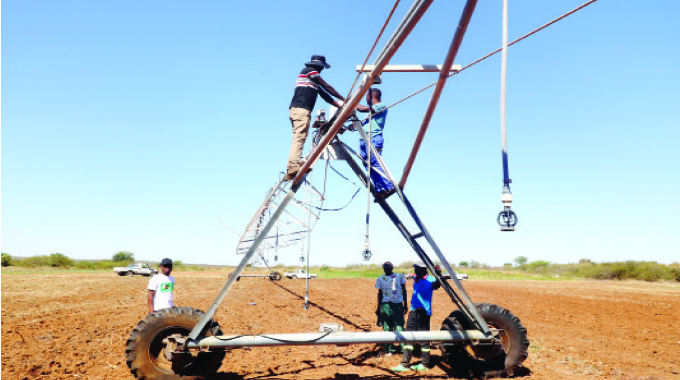
Nqobile Tshili, [email protected]
PREPARATIONS for this year’s winter wheat cropping season are in full swing across the country with some farmers in the Matabeleland region having started planting the crop while various interventions were put in place by Government to ensure a successful winter wheat season.
The Government has since assured farmers of an uninterrupted power supply.
Zimbabwe has not been spared from the effects of climate change and is pushing hard on investment in irrigation infrastructure across the country.
The country is targeting to put 120 000 hectares under winter wheat with the harvest expected to reach 600 000 tonnes, well above the 468 000 tonnes produced from 91 000ha last year.
This is 240 000 tonnes above the minimum of 360 000 tonnes needed for self-sufficiency.
Wheat stocks are currently at 244 705 tonnes, with up to 105 800 tonnes required till the next harvest in September this year.
More importantly, Zimbabwe wants industry to include more wheat products in the average Zimbabwean kitchen.
The Ministry of Lands, Agriculture, Fisheries, Water and Rural Development has set May 31 as the deadline for planting this year.
A Chronicle news crew yesterday visited selected farms in Umguza District and observed that some farmers, including Matabeleland North Provincial Affairs and Devolution Minister Richard Moyo, were concluding the planting process.
Minister Moyo said he was leading from the front in the province to ensure food security.
“We are responding to President Mnangagwa’s clarion call of contributing to national food security. The planting season has been set for May 1 to May 31, so I believe I’m on track. I have planted already and this will have a bearing on the yield,” he said.
“I’m expecting to get between four to six tonnes per hectare unlike when you delay where you will end up getting three tonnes or less. So, I appeal to all the farmers to swiftly move on the ground and contribute to food security.”

Managing director at Minister Moyo’s farm, Mr Peculiar Moyo, said they started land preparation at the beginning of April.
“We did our land preparation very early, and that was at the beginning of April when we did discing twice to break down the soil after which we started planting. We planted a new variety from Russia.”
Mr Moyo said planting early contributes to producing good quality wheat.
Umguza Ward 8 Agritex officer, Ms Emeria Tshuma, who was doing rounds in the area, expressed confidence with the level of preparations in the area.
“Farmers are being advised to start land preparation as we are considering that we are running out of time. The month of May is the period when we start planting wheat and the message that has been cascaded to farmers is that they should start land preparation,” she said.
“This is satisfying; we have something around 24ha that has been done, and planting is progressing well. We expect to see more towards the end of this week in this ward.”
Ms Tshuma said farmers have already started collecting Presidential inputs from the Grain Marketing Board depot.
Matabeleland South Agricultural Rural Development and Advisory Services officer, Mr Mkhunjulelwa Ndlovu said preparations were ongoing in the province.

He said they are targeting to plant 5 500ha of land.
“So far, we have planted 320ha, but we have a target of planting 5 500ha. Some of the farmers who have started planting are in Matobo, Beitbridge, Gwanda and Insiza.
“This year, we have said in every piece of land where there is water and irrigation infrastructure, farmers should be involved in wheat farming,” said Ndlovu.
“So, we are still engaging farmers to ensure that we meet our provincial targets. We want all the smallholder farmers this season from at least 0,2ha to plant wheat as opposed to planting maize.”
Mr Ndlovu said farmers are using all the available models of financing such as contract farming, Presidential inputs as well as self-funded schemes.
Energy and Power Development Minister Edgar Moyo said despite depressed power generation, the Government has worked out a plan that will ensure that winter irrigation farming is not disrupted.
“We have already lost 800 megawatts at Kariba Hydro Power Station due to low water levels as a result of the El Nino weather conditions.
“This means we have lost almost 50 percent of the power that we are generating as a country,” he said.
“However, in terms of farming, we are holding weekly meetings with the Ministry of Land, Agriculture, Fisheries, Water and Rural Development, farmers together with Zesa to ensure that there are no disruptions to cropping.”
Minister Moyo said Zesa has since established irrigation clusters for winter wheat farmers.
“This means that farmers have to be put in groups, depending on where they are located. Placing farmers in a cluster will enable the power utility to conduct scheduled power cuts, which would not affect farmers,” he said.
“We consider issues to do with farming very critical and we don’t compromise issues to do with national food security. We are putting them in a cluster to ensure there is sufficient power for them.”
Minister Moyo urged farmers to pay their bills. Boosting wheat production has been identified as one of the effective ways of guaranteeing food security and sovereignty in Zimbabwe. — @nqotshili


 Online Reporter