Tendai Gukutikwa
Post Reporter
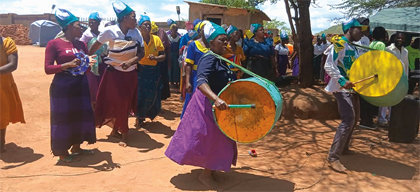
THE heavy banvos drum swings from her shoulders as she jumps, spins and beats its surface in rhythm with the other performers.
Around her, youthful male drummers match the demanding movements, but she keeps pace without surrendering her place in the band.
At 35, Mrs Maseline Matengavhu has become one of the women challenging traditional gender roles at St Luke’s Ejuwell Jekenisheni Church, where drumming was once considered a man’s responsibility.
She is not alone. Fifty-year-old Mrs Violar Chirombo has also joined the male-dominated drumming crew, demonstrating that age and gender need not determine who participates in the church’s musical traditions.
The banvos, popularly known as the Majeke drum, weighs between five and 10 kilogrammes. Its performers carry the instrument while jumping, spinning and dancing through energetic routines that accompany Jekenisheni church gatherings.
Traditionally, women at the church concentrated on singing and dancing while men handled the drums.
Mrs Matengavhu and Mrs Chirombo have challenged that arrangement through their determination to participate in an activity they regard as an expression of faith.
When The Manica Post caught up with Mrs Matengavhu after a three-hour performance, sweat covered her face, but remained enthusiastic about her role in the band.
A mother of three, she said she had played the drums since 2015, and had grown increasingly attached to the instrument despite its weight and the physical demands of performing.
“I am a mother of three and my 11-year-old son is also a drummer. In fact, when we play, I play beside him. He even learnt his moves from me,” she said.
The mother-and-son partnership gives Mrs Matengavhu another reason to remain involved. Beyond encouraging her son to participate in church activities, she has become an example of how children can learn through observing their parents.
Her journey into drumming began despite expectations that women should remain in the singing and dancing sections of the congregation.
She said she had always wanted to join the band and participate fully in the performances that form part of worship.
“Traditionally, at our church, men are the ones who should be in the band playing drums, while women should be dancing or singing. However, I wanted to be part of the crew, part of the fun of praising God. It is in my blood. I never get tired, even if we have to play the whole day in the scorching sun. As long as I get water breaks, then I am fine,” she said.
For Mrs Matengavhu, drumming provides personal fulfilment that goes beyond entertaining fellow congregants.
“When I am playing, I will be feeling so good, knowing that even if God takes me at that moment, I will die a happy woman. I love playing the drum. Yes, the drum is a bit heavy, but for the love of drumming, I no longer feel the heaviness,” she said.
Her commitment was evident even before she gave birth to her son.
Mrs Matengavhu said she began playing the church drums while five months pregnant, continuing to jump and spin with the instrument as other congregants watched with surprise.
“I started playing these church drums when I was pregnant with my son. I was five months pregnant, and that is how my son also came out a drummer. I would jump and spin with the drum while pregnant, and people would be impressed and shocked at the same time,” she said.
Her husband has also embraced her participation in church activities. He supported her decision to join the band despite its traditionally male membership.
“When I started taking part in church activities like drumming, he loved it. I thank the church for allowing me to be part of the band, a space that was originally meant for male church members,” she said.
Mrs Matengavhu also enjoys the physical activity involved in drumming, which she believes helps her remain active.
“Being active is healthy, actually, not just spiritually but physically as well. I rarely get sick because of that and my immune system is very strong,” she said.
While Mrs Matengavhu’s story challenges expectations about motherhood and women’s participation, Mrs Chirombo’s experience shows that age has not stopped her from pursuing the same passion.
The mother of five said she grew up in the church at a time when women playing drums attracted disapproval.
She developed an attachment to the banvos while watching the church’s musical activities, but the opportunity for women to participate remained limited.
Mrs Chirombo jokingly describes her passion for drumming as a demon, saying she struggles to feel complete when she misses an opportunity to play during the week.
“I have a demon of playing the drum. That is what it is, actually. If I do not play the drum, I do not feel okay that week. I make sure that I go to church every week so that I get a chance to play the drum for God and for the church,” she said, adding that her family understands the importance of church participation because they have watched her work towards earning a place in the drumming crew.
Mrs Chirombo wants younger girls within the church and beyond to recognise that drumming is not beyond their reach.
She believes beginners can develop their skills without immediately accessing the large church drums, using everyday objects to practise rhythm and coordination.
“I believe that beginners do not even need access to the massive church drums to start developing their skills. To girls out there who want to play the drum, know that you can and no one should stop you. The church is now open and giving everyone opportunities. Start practising even on your thighs and with cooking oil bottles. Eventually, you will get better and become a professional,” she said.
Her message is simple – young girls should not allow traditional expectations to discourage them from pursuing their interests.
“It is hard at first, but just know that you will eventually get it. I do this for myself as well as to inspire young girls out there in the church who might be feeling that they cannot do it. You can, only if you put your mind to it,” she said.
For her, joining the band represents more than personal enjoyment. She wants younger female congregants to see women playing the banvos.
The church’s leadership says the growing participation of women reflects changing attitudes towards traditional roles within the congregation.
Bishop Osbrain Pferedzai confirmed that men traditionally played the drums, but said the church had become more open to women who showed interest and a willingness to learn.
He said the banvos carried spiritual significance within the church and that participation required members to respect the instrument’s religious meaning.
“It used to be against church doctrine but now, we let women play as long as they are clean and they are willing to learn because that drum is a spiritual drum, a symbol of cleanliness and should not be held by people who are not clean in spirit. The name banvos is a spiritual term actually and as a church we respect that drum sound. Women are slowly joining the band and as a church we welcome it,” he said.
Bishop Pferedzai said the church welcomed women’s participation and viewed their involvement as an opportunity to encourage younger girls.
“Women have shown that there is no reason why drumming should be reserved for men.
“They are doing it with so much energy and commitment, and we are happy to have them among us. Their participation is also encouraging younger girls to realise that they can take part in activities they previously thought were meant for men,” he said.
Women challenge tradition through Jeke drumming