

 dyton mupawaenda
Conrad Mupesa-Mashonaland West Bureau
THE late former United States President Abraham Lincoln once said the greatest fine art of the future would be the making of a comfortable living from a small piece of land.
Margaret Mitchell, an American novelist and journalist, said land was the only thing in the world that amounts to anything, for ‘Tis the only thing in this world that lasts, ‘Tis the only thing worth working for, worth fighting for — worth dying for.”
Because of its worthy value, President Mnangagwa has, on several occasions, reiterated that the land reform that has benefitted over 300 000 Zimbabweans and a pending additional of close to 10 000 youths this year was irreversible.
The post-2000 land reform which then made Zimbabwe fully independent, has seen thousands of new farmers become financially stable.
As the nation joins the rest of the world in commemorating International Women’s Day, failure to recognise two women in Mashonaland West’s Chegutu District who now stand as icons and beacons of the agrarian revolution’s success will be a disservice, for they embody the spirit of the Zimbabwean women.
The two, Mrs Gertrude Mandizvidza and Gogo Letwinner Nyagano have transformed their respective homesteads into worthwhile business ventures.
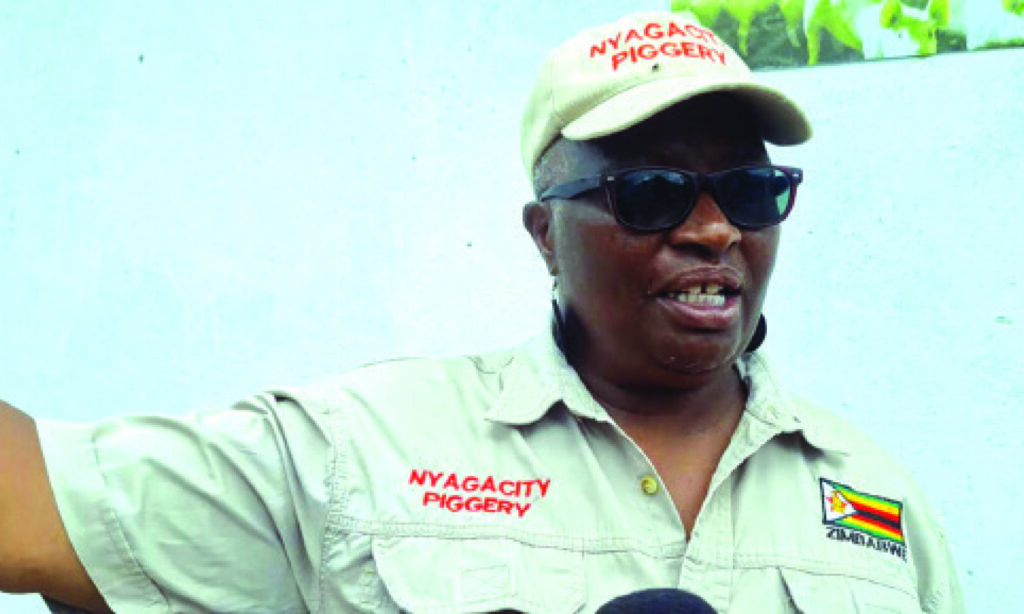
Mrs Letwinner Nyagano
Despite having been allocated small pieces of land, the two stand out as perfect examples of how much can be realised from little.
Mrs Muzvidziwa of Gandiwa Village in Mhondoro-Mubaira’s Ward 5 is making use of less than one hectare from the land she was allocated together with her husband to run a thriving chilli project.
She is dedicated to sustainable farming practices that safeguard the environment and promote the health of the community, having turned her farm into a haven for diverse, free-range chickens and a variety of nutritious crops.
It is from this small piece of land that she produces the organic chilli crop before value-adding it into powder and bottled hot-chilli sauce products.
“I make use of not more than one-hectare piece of land for my chilli production. Everything is done organically, we don’t make use of fertilisers but rather manure from our livestock.
“After harvest, I take the majority of the chilli, which I then mix with a few items and then bottle it. All this is done here in Mhondoro,” she said.
The other crop is dried in the shed before it is crushed into powder and later packaged for the market.
Both products have since won the hearts of many, with retail outlets in Mhondoro, Norton and Harare now stocked with the chilli sauce and powder.
She also supplies restaurants and hotels with her products.
Mrs Muzvidziwa, used a blend of knowledge passed down from institutional memory and training by the Government to empower women, to run her farm operations.
Apart from chilli production, she also has free-range chickens, turkeys, geese and guinea fowls.
This is in addition to a wide range of crops such as finger millet, ginger, turmeric, groundnuts, maize, okra, sweet potatoes, sunflower, garlic and cassava among others.
The supposedly small piece of land has also made a name in the area producing sugarcane, pineapples and bananas.
Mrs Mandizvidza thanked Government and the liberation fighters who made it easy for her and other women to be allocated farming land that they are using to transform their lives.
“Our lives as women take a lot of borrowing from liberation heroes and heroines who sacrificed their lives for Zimbabwe to be free. We will celebrate this day against the backdrop of the success brought by these gallant sons and daughters and efforts being made by the Second Republic,” she added.
Some 30 kilometres north of Mrs Mandizvidza’s thriving farming venture is Gogo Nyagano who has transformed and defined pig production from a woman’s perspective at her Nyagacity Piggery, a sanctuary and haven in Ward 15, Norton, under Chegutu District.
She turned her small plot not only into a pig production farm but, a learning facility open to those eager to acquire knowledge.
Gogo Nyagano, a former human resources and accounting officer, is not just a farmer but a certified pig farming trainer who has trained over a thousand within four years.
Some of her students were drawn from neighbouring Mozambique, Zambia, South Africa, Mozambique, Lesotho and Botswana.
Gogo Nyagano was also certified as an artificial inseminator by the Pig Industry Board (PIB).
Using only one hectare of the family’s plot, Gogo Nyagano has built 10 pigsty units where she is breeding and growing pigs. Presently, she boasts a herd of 1 000 pigs.
She also harvests semen for sale to other farmers for artificial insemination.
“I am a living testimony that you don’t need vast tracts of land to be productive. On average, one sow produces 60 piglets per year and a single weaner is sold at US$60. If you are to calculate that, it shows that one can make a lot of money on a small piece of land,” she said.
The 62-year-old farmer, who has received local and regional accolades, told this publication that her journey in piggery production started with only three piglets around 2014.
The determined Gogo Nyagano would receive a boost of 40 more pigs from the Presidential Pass On programme to increase her herd in 2020.
“I received a boost from the President although about 11 of them died on the way to my farm due to stress,” she said.
She also imported Dalland Boers, Large white, Landrace, and Duroc from South Africa and Zambia and now boasts of a sow unit of 97 pure breeds from South Africa.
Due to her growing passion for pig farming, the Government last year availed her 15 hectares of land which she is going to turn into a pig farming training community college.
It is at this new impending facility that she hopes to train farmers and students on the best ways to grow pig production.
“The Government last year availed 15 hectares towards the establishment of a community college. This is going to be a game-changer in pig production.
“Piggery production requires the correct knowledge, conditions and passion. I managed to build pigsties that were well-covered so that the pigs wouldn’t experience cold or too much heat.
“This means we don’t use electricity at the pens. We are not connected to the grid, and the borehole runs on solar while the feed mixer is on diesel,” she said.
To keep production costs low, Gogo Nyagano practices mixed farming.
She grows maize and other grains to use for stockfeeds while her students’ meals are made up of food grown on her plot except a few things such as bread.
Half of her grains which she uses for stock feed is irrigated.
Gogo Nyagano has also ventured into value addition of the pork she produces at the farm.
She now makes pork sausages that are sold mainly in Norton and surrounding places.
The Government has commended the two women as torch-bearers.
Mashonaland West Minister of State for Provincial Affairs and Devolution Cde Marian Chombo who toured Gogo Nyagano’s project recently where over 40 students were undergoing training said the attainment of Vision 2030 was a reality.
“The Government commends this kind of production, particularly from a small piece of land. Our youths are earmarked to get pieces of land under the Presidential Scheme, and we want them to get this kind of knowledge to increase production,” she said.
She added that assistance will continue to be rendered to women by the Government as part of empowering them.


 Online Reporter