admin
admin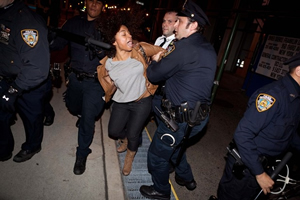
business delegations, including Chinese Vice President Mr Xi Jinping, while President Obama’s first port of call in the “comeback to Asia” strategy was Australia. So, afterall, there is a lot to learn from each other; a lot to share and a lot to give out. Both leaders are pursuing the same goal – how best to strengthen bilateral relations and the economies of their sovereign states for the betterment of their people’s livelihoods.
I make these remarks in view of the anti-capitalist Occupy Wall Street protests that started off in the United States of America on September 17, but which are under threat as the administrations and police want protesters off their encampments.
Some of our analysts have remarked about these protests. The 99 percent versus the one percent are issues that both leaders should be concerned about, although one observer believes that the
United States which is run through special interest groups and not the people will ensure that the one percent’s wishes prevail, with people as a by-line in the matrix.
The observer said that if the US loses the economic war, then the people will have an upper hand.
When Zimbabwe almost lost the economic war, we saw Western countries having an upper hand trying to determine what the people of this country wanted. And the US citizens agreed with that. The international community also gets obsessed with what goes on in the United States because when the US sneezes, the whole world catches a cold.
Since the first Occupy Wall Street, how has this affected the world, Zimbabwe included? Has Zimbabwe realised the dangers of creating the huge disparities between the rich and the poor? With the on-going indiginesiation of economic empowerment programmes, what lessons do we learn from the Occupy Wall Street? The 99 percent might not succeed for now, but what does the long term scenario look like?
As the protests continue, we also witness unprecedented police brutality and heavy-handedness prompting us to ask crucial questions: In pursuit of protecting economic interests, why should a system become so ruthless? Why also ask banal and trite questions that the protest movement has not elucidated that which they are complaining about?
When they demonstrate with placards and banners, and when they talk every second on social networks, does it need a rocket scientist to tell these interest groups behind Western governments what it is that they are demonstrating about? Does wanting a JOB need a statement of intent? Isn’t it a right?
The double standards and paradoxes are also there for the world to see. As one of the banners read, “you cannot evict an idea”, and once the collective mind has caught on to the idea, it is difficult to let go. The US administration is discovering that. The tents at Zucotti Park in Wall Street and other encampments around the country might have been removed, but the protesters are back and more determined than ever to see that there is equality in wealth sharing.
The sentiments were captured on Tuesday by protesters at St Paul’s Cathedral in London who said, “We’re in agreement that the current system is undemocratic and unjust. We need alternatives.”
Occupy Wall Street protesters also said “Such a movement cannot be evicted. Some politicians may physically remove us from public spaces – our spaces – and, physically, they may succeed. But we are engaged in a battle over ideas. Our idea is that our political structures should serve us, the people – all of us, not just those who have amassed great wealth and power. We believe that is a highly popular idea, and that is why so many people have come so quickly to identify with Occupy Wall Street and the 99 percent movement.”
The Obama administration cannot imagine that those people have to endure the bitter cold weather and rain for naught, especially when they are people that are supposed to have jobs and homes.
How often have the US and other Western nations where these protests are taking place accused Zimbabwe of police brutality against innocent protesters?
Why is it that their law enforcement agents can easily explain it off as maintaining law and order, but in Zimbabwe’s case, it becomes a human rights issue? Why also play hard core politics by using drones in far-off parts of the world, when the real problem is on your door step? Why is it so difficult to turn drones against the protesting American people, but it is so easy to do it in Pakistan, Libya, Afghanistan and other places?
Why should an election to the highest office require that so much innocent blood is spilt in foreign lands, when those billions could be used to pay off debts and employment creation? To me, the Occupy Wall Street are an event “prophesied” in the eighties by award-winning journalist Tom Wolfe in his novel, “The Bonfire of the vanities, which mirrors a system that has broken down.
Tom Wolfe is a “satirist, social commentator . . . who has what it takes to slice The Big Apple (New York) to its rotten core . . .” And, right now the Occupy protesters have sliced the whole capitalist system to its “rotten core”.
At the G20 summit in Cannes, France President Obama was mesmerised and said that he had “learned a lot in two days about the complexity of the EU’s ‘laborious’ decision-making process”.
If the EU that colonised Africa has systems that are laborious, why lecture Africa and treat it like a school boy? Why bully it? I could do a PhD dissertation on this, but there are some questions that still bother me. Why are human rights organisations so conspicuous by their silence of how the Western system is maltreating its own people and making them look like they do not have issues that need addressing?
Are human rights organisations also working for big corporations, and why is their application of justice so faulty? Where is the United Nations when people are teargased, beaten up and harassed by law enforcement agents? Where are they when they are not allowed to protest as they did initially?
Occupy, occupancy, occupation – how can these terms be unpacked within the context of the Occupy Wall Street protesters? In our case, we know what occupation means and its consequences. When Zimbabwe re-occupied its stolen land it was demonised, and issues such as property rights were raised. With the Occupy protests, should we also ask about property laws, rights and ownership since they occupy as they wish?
Finally for Zimbabwe, two former US soldiers who fought the Iraqi war were victims of police brutality.
The injury and the death of another “Iraqi veteran” became rallying points for the protesters. It galvanised the protests countrywide and won sympathies abroad.
One of them, Scott Olsen is 24 and fought in Iraq for two years, but he is now their hero. We have heroes who were brutalised by the British and Rhodesian systems. They fought for Zimbabwe’s self-determination, for years, but Scott Olsen in Occupy Wall Street is getting more accolades than Zimbabwe’s own freedom fighters. The more reason why I said that there is so much to learn from each other.


 Online Reporter