Online Reporter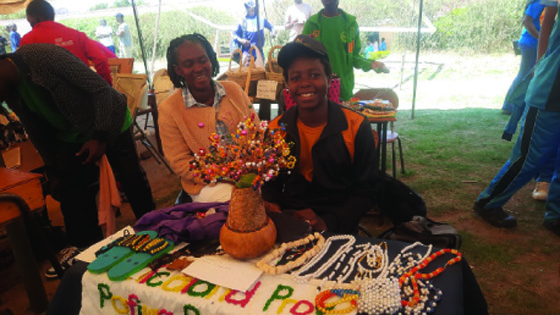
Tendai Gukutikwa
Entertainment Reporter
COLOURFUL beaded products and tie-dyed fabrics set Manicaland’s young exhibitors apart from the rest.
Exhibition stands at the fifth edition of the National Annual Science, Sports and Arts Festival (NASSAF) held at Chancellor Primary School this week, buzzed with laughter, vibrant colours, and the rhythmic sound of music.
Children in bright uniforms and proud smiles moved between stalls showcasing handmade soaps, wood carvings, dresses, and musical instruments, a lively celebration of skill, innovation, and imagination.
But among the crowd, three Manicaland girls stood out for their passion, creativity, and hope for the future, all grounded in Zimbabwe’s Heritage-Based Curriculum.
One of them, 12-year-old Vimbai Chawasima, a Grade Six learner from Pafiwa Mutasa Primary School, sat behind a table that looked like a rainbow had spilled onto it, a table with products that lured the news crew straight to her.
Her exhibition space shimmered with the sparkle of beads, necklaces, bangles, flowers, handbags, and even shoes.
Every item told a story, not just of colour and craft, but of culture and creativity rooted in her heritage.
With her ever-smiling face and bright eyes that seemed to hold endless dreams, Vimbai said she had discovered her love for beading during a class activity last year, and has not looked back since.
“I started by making small things like key holders. Then I made flowers, bangles and bags. Each time I finish something, I feel happy inside because it shows what my hands can do.
“I want to keep doing this even when I grow up. Maybe one day, I can have my own shop,” she said shyly, running her small fingers over a necklace made of green and white beads.
Her teacher, Cecilia Majaha, smiled as she looked at her learner, clearly proud.
She said the Heritage-Based Curriculum had opened doors for learners like Vimbai to explore their talents and connect with Zimbabwean tradition in a meaningful way.
“The idea of using beads comes from our tradition, our people have always used beads for beauty and identity. When Vimbai showed an interest in beautification, we encouraged her to make flowers, jewellery, key holders, headgear, and even home decorations. We mixed different products to bring beauty to the world while honouring our culture. We also used natural materials such as calabash (dende) and tree seeds as beads. The idea is to make something beautiful, useful, and true to who we are as Zimbabweans,” she said.
Vimbai nodded eagerly as her teacher spoke, her face lighting up as if the future she dreamt of was right there on the table before her, in every bead and thread.
“I want people to wear what I make and feel happy. Beading is something that helps me think about my grandmother too, because she used to wear beads every day. It reminds me of her,” she said.
A 100 metres away from her table, but coming from Nyazura, which is 100km from Mutasa, are two other girls from Sharara Secondary School – Tapiwa Musharumbi and Molline Tafura – both aged 15, also showing what happens when creativity meets cultural roots.
Their display of garments caught the attention of visitors and judges alike, not only because of the design but because of the process behind them.
Their colourful fabrics were dyed using natural plant-based dyes, something that speaks directly to the heart of the Heritage-Based Curriculum.
Tapiwa explained how they made the dyes.
“We use murumanyama and mupfura to make natural dyes. We crush the barks and boil them to get colour, and then we use that to dye our fabric before sewing. It is exciting because everything comes from our environment. It’s like we are wearing nature,” she said, proudly showing off a neatly folded cloth with earthy brown tones.
Beside her, Molline smiled shyly, but spoke with purpose that belied her age.
“When I sew, I feel like I am already becoming who I want to be. I want to study more and become a designer one day, maybe even a big one who makes clothes that represent our country. But even if I do not get a job after school, I know I will never be poor because I have skills that can feed me and my family,” she said.
Their teacher, Gladys Muhambi, could not hide her pride in the girls’ work.
“We are proud to be Zimbabweans, and you can see that pride in what our girls made. The dyes they used were naturally made from local tree barks. This shows how our environment is not just something to admire but something to use wisely. With these skills, they can earn a living and also teach others. This is what the Heritage-Based Curriculum is about, using what we have to build what we need,” she said.
When Primary and Secondary Education Deputy Minister, Honourable Angeline Gata, toured the exhibitions, she stopped by the Manicaland stands for a while, listening to the learners’ and their teachers explain their crafts.
In her address during the official opening of the festival, Deputy Minister Gata said she is proud to see how learners are turning lessons into life skills that carried the wisdom of their heritage.
“This year’s theme: ‘Promoting Skills Development through the Heritage-Based Curriculum,’ reminds us that our past is not a limitation, but a foundation. Our heritage is rich with wisdom, creativity and development. From traditional weaving, stone carving, pottery, iron smelting and indigenous agriculture to storytelling, music and dance, these are not just cultural expressions, but skills that can build businesses and solve problems,” she said.
Minister Gata stressed that her ministry fully supports the implementation and achievement of all initiatives that ensure that every learner participates meaningfully in schools’ sport, science and arts activities and not concentrate on academic studies only.
“Our heritage is rich with wisdom, creativity and development. From traditional weaving, stone carving, pottery, iron smelting and indigenous agriculture to story-telling, music and dance, these are, not just cultural expressions, but are skills that can build businesses.
“They are skills that can solve problems, skills that root pupils to identity and self-expression. These festivals act as a catalyst that provides opportunities to sustain, grow and further develop pupil exit profiles,” she said.
Minister Gata said education is not only about books.
“It is about discovering who we are, and what we can create with our hands and minds,” she said while applauding the young exhibitors including the three Manicaland girls.