admin
admin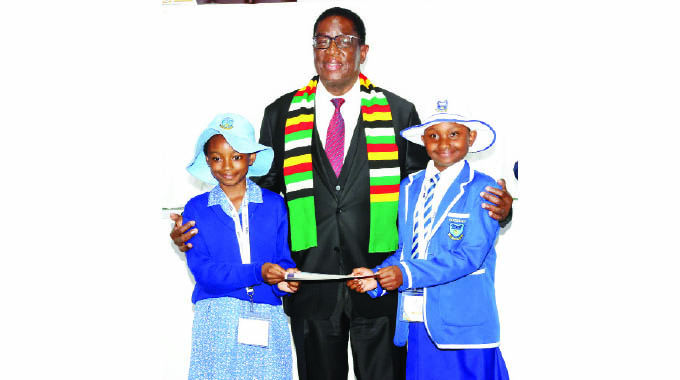
Sifelani Tsiko-Innovations Editor
YOUNG scientists and researchers from Zimbabwean universities and schools have been honoured for their exceptional achievements in diverse fields of research that are in line with the Government thrust to promote innovations anchored on the Heritage-based Education 5.0 philosophy.
Hilda Kaitano, a National University of Science and Technology chemical engineer, scooped the biggest prize, the Robert Gabriel Mugabe award of US$15 000, plus the Presidential Award of US$7 000 for an outstanding female researcher.
President Mnangagwa presented the winners with the prizes at the 13th Zimbabwe International Research Symposium held on Monday in the capital.
The awards were presented in 15 categories, each recognising exceptional achievements across diverse fields of research.
Ms Kaitano is a PhD candidate at NUST and has made significant contributions in the field of chemical engineering through her cutting-edge research on microwave purification of graphite for use as an anode in lithium-ion batteries.
Her work aligns with global efforts to enhance the efficiency and sustainability of green technologies, such as electric vehicles and energy storage systems.
The NUST chemical engineer’s research work has the potential to transform Zimbabwe’s energy sector and others beyond.
“By introducing this technology in Zimbabwe, the nation can reduce reliance on imports and be positioned as a leader in sustainable battery materials,” read part of the citation.
“The socio-economic benefits of her research are profound, including reopening of the Lynx Mine in Karoi, where graphite reserves are abundant and is envisaged to create jobs, stimulate local infrastructure development, and generate substantial revenue through taxes and royalties.”
Hatify Enterprises Private Limited, trading as Robestos Products won a Presidential Award and a US$ 7,500 cash prize for its innovation on the extraction of essential oils and butter from local field and forest plants, which are rich in omega-3 fatty acids.
These products offer critical health benefits, particularly in cardiovascular health, anti-aging, and cognitive function.
“The research project has a huge impact, is profound, and it aligns with global efforts of reducing environmental footprints by offering an eco-friendly alternative to marine-derived omega-3 oils,” read part of the citation.
“By making use of underused local resources, such as indigenous plants and edible insects, Robestos promotes sustainable production practices while providing healthier alternatives to conventional products.
“The company’s innovation has not only contributed to the commercialisation of essential fatty acids, but has also created employment opportunities for women especially those in the rural communities, thereby advancing Zimbabwe’s socio-economic development.”
Shingirayi Zengeni, a PhD candidate in the Department of Pharmacy and Pharmaceutical Sciences at the University of Zimbabwe won the Presidential Award for the most outstanding early career researcher.
Her research focusing on the development and optimisation of traditional herbal remedies using cutting-edge nanotechnologies has immense potential in revolutionising how traditional herbal remedies are formulated and commercialised.
Dr Tendai Nhenga of the Africa University won a Presidential Award for Community Innovation for the most outstanding research project that explored the factors influencing the uptake of vaccinations and essential health services among socio-economic and cultural groups across Zimbabwe’s 10 provinces.
It highlighted barriers such as inadequate healthcare financing, shortages of specialised health professionals, religious objections to vaccines, and the over-reliance on out-of-pocket healthcare payments, which are prevalent in rural and marginalised areas.
These challenges led many to seek alternative treatments from traditional healers or unregistered service providers, exacerbating the health equity gap.
Dr Nhenga’s research findings were crucial in shaping Zimbabwe’s National Health Strategy to enhance uptake, demand and quality of health services.
Apart from researchers in higher and tertiary institutions, young scientists from schools dotted in various parts of the country won big cash prizes for their innovations.
Young scientists from Coghlan Primary School in Bulawayo won a US$500 award for the most outstanding research project on a self-irrigating robot (system) that uses a soil moisture sensor.
The sensor is able to detect whether the soil moisture levels are low or high. The system initiates the irrigation process automatically when necessary and alerts the farmer of the ongoing processes.
Tynwald High School of Harare won a US$1000 prize for a research project that demonstrated a robot that can be used for removing landmines planted during the liberation struggle in Zimbabwe. The robot uses an advanced sensor system that can navigate any terrain. The school has registered a prototype for this project.
Jessica Pullen from the Lupane State University won a USD$2 000 prize for a project on artificial insemination as a reproductive technique to improve productivity in chickens.
“The emerging frontiers of scientific discoveries and technological advancement require us to be bold, innovative and relentless in our pursuit for shared progress that realises the broader aspirations outlined in the Africa Union Agenda 2063,” said President Mnangagwa.


 Online Reporter