Online Reporter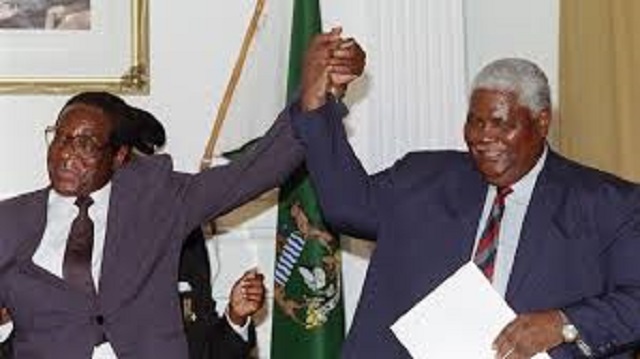
Alexander Rusero and Ranga Mataire
Every December 22, Zimbabwe pauses to mark Unity Day — a date that commemorates the 1987 Unity Accord between ZANU PF and PF ZAPU.
Unity Day is not a ritual of convenience; it is a hard-won political settlement forged in the aftermath of one of the darkest chapters of Zimbabwe’s history, Gukurahundi. It is precisely because of that painful backdrop that unity must never be trivialised, downplayed, or treated as optional.
Unity in Zimbabwe is not merely sentimental. It is constitutionally obligatory. The Constitution of Zimbabwe places national unity, peace, and cohesion at the core of statehood, reflecting a national consensus that emerged from struggle, fracture, and reconciliation.
The State and every person, including juristic persons, and every institution and agency of Government at every level are mandated to promote national unity and stability.
Section 10 of the Constitution establishes a shared responsibility for maintaining Zimbabwe’s social fabric. Unlike many constitutions that assign peacekeeping solely to Government, this provision extends the duty to all entities- individuals, businesses, and organisations. It recognises that stability requires universal participation and creates a constitutional obligation for positive action rather than merely prohibiting disruptive behaviour.
Testament to resilience
National Unity Day is more than a public holiday; it is a testament to Zimbabwe’s resilience and determination to move forward as one people. As the country continues to traverse its path, the values of unity and reconciliation remain as relevant as they were in 1987.
December 22 stands as a beacon light of hope, reminding all Zimbabweans that their strength lies in their unity.
The inclusion of unity as a cardinal principle in the national constitution of the country was not accidental drafting. It was a deliberate recognition that Zimbabwe’s survival as a nation depends on its ability to rise above historical trauma and political difference in pursuit of a shared future. Unity, therefore, is not a political favour granted by one group to another, it is a constitutional duty owed to the republic itself.
The dividends of unity are often understated, yet they are foundational. Development does not occur in fractured societies. Roads, schools, hospitals, industries, and institutions do not grow in environments of perpetual suspicion, conflict, and fragmentation.
Peace and unity underwrite development; they create the predictability, trust, and collective purpose without which economic transformation collapses. Where unity is absent, resources are diverted to conflict management rather than nation-building. Zimbabwe’s development agenda, regardless of political persuasion, stands or falls on the strength of national cohesion.
Unity Day must also be read as a moment of remembrance and respect for the gallant daughters and sons of the First, Second, and Third Chimurenga. Their struggle was not for factional victory or narrow political dominance. It was for land, dignity, sovereignty, and the right to call themselves Zimbabwean.
Torn apart
They fought so that a nation could exist, not so that it could be endlessly torn apart by internal antagonisms long after independence. To honour their sacrifice while casually undermining unity is a contradiction Zimbabwe cannot afford.
Crucially, unity must not be misrepresented as uniformity. National unity does not mean the absence of differing opinions, political preferences, or ideological contestation.
Zimbabwe must remain a plural society, and political diversity is not a weakness, it is a democratic reality. Unity means something far more demanding, the ability to suspend partisan impulses when the national interest is at stake.
It means recognising that while we may disagree fiercely on policy and leadership, there are moments and matters where being Zimbabwean must precede being partisan.
Upon signing the Unity Accord on 22 December 1987, one of the signatories to the agreement, the late Dr Joshua Nkomo was clear in saying: “The accord is the beginning of unity, unity is just not signing of documents, unity is what follows.”
What follows the signing of the accord was a period of peace and stability that has become a testament and a template for African solutions to African problems. Zimbabwe did not need external mediators to solve its own internal challenges. The progenitors of the Unity Accord had the wisdom to realise that none but themselves could solve the challenges of instability that afflicted the country at the time.
Fast forward to the ushering in of the Second Republic, that Unity Accord that the two Zimbabwean luminaries (Mugabe and Nkomo) signed is still the guarantor of the peace and tranquillity being enjoyed in the country.
In his commemorative message four years ago on 22 December 2021, President Mnangagwa exhorted Zimbabweans to value unity saying: “The accord ushered in unity, peace and stability in our great motherland, Zimbabwe, and laid a firm foundation for national cohesion and development that subsists to this day. Those early years of post-independence unrest unnecessarily delayed our socio-economic growth and cast a dark cloud of disharmony among our people.”
The President said Unity Day serves as a reminder of the collective duty to uphold peace, unity and love as the guarantors of sustainable development.
Territorial integrity
There are fundamentals that must always place Zimbabwe before political affiliation. Territorial integrity, peace, constitutional order, national institutions, and social cohesion are not negotiable assets to be sacrificed on the altar of political point-scoring. Once these fundamentals are weakened, no political formation ruling, or opposition emerges stronger. Unity is therefore not a favour to the state; it is self-preservation for society.
The regional context should sober us. The disturbances in the Sahel, the instability in the Great Lakes region, and the ongoing onslaughts in Sudan and the Democratic Republic of Congo are stark reminders of how quickly nations unravel when unity fractures and politics militarises.
These are not distant tragedies; they are cautionary tales. Zimbabwe’s peace is not an accident of geography, it is the product of political choices, restraint, and an enduring commitment to togetherness despite unresolved tensions.
Unity Day must be cherished precisely because instability is not hypothetical; it is visible across the continent.
Within this context, it is not accidental that the milestones of the Second Republic have been premised on unity and peace. Economic reform, infrastructural development, international re-engagement, and institutional rebuilding require a stable national foundation. Whether one applauds or critiques these milestones, it is undeniable that progress, however uneven, cannot occur in a climate of perpetual national self-sabotage.
Unity is not the responsibility of the state alone, it is a civic duty. Every citizen carries the burden of being a unity ambassador in daily discourse, political engagement, and social conduct.
This responsibility is especially urgent in the digital age. Social media has become a fertile ground for narratives of self-hate, self-blame, and dangerous nostalgia for the colonial Smith regime, often pushed by misguided malcontents who mistake provocation for patriotism.
Colonial myths
Romanticising colonialism or internalising its narratives of African inadequacy is not dissent, it is epistemic surrender. Unity Day must stand as a rebuttal to such thinking, reminding Zimbabweans that their future cannot be built on the glorification of oppression or the recycling of colonial myths.
Finally, unity is indispensable to the consolidation of democracy and the strengthening of national institutions. Courts, parliament, electoral bodies, security services, and civic institutions do not function effectively in a climate of mutual de-legitimisation.
Democracy requires contestation, but it also requires a shared commitment to the rules of the game and the permanence of the state beyond electoral cycles. That level of institutional maturity demands an excess of unity, not its erosion.
Unity Day is not about forgetting the past. It is about learning from it without being imprisoned by it. It is about recognising that peace and unity are not passive conditions but active choices that must be renewed annually, consciously, and collectively. Zimbabwe did not emerge from struggle to disintegrate into permanent hostility.
Unity is not a luxury. It is the scaffolding upon which the nation stands and without it, everything else collapses.