

 admin
admin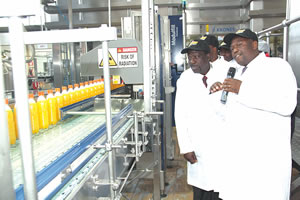
multi-sectoral.
He was speaking during the commissioning of Schweppes Zimbabwe (Pvt) Ltd’s new US$14 million hot fill line yesterday.
“My ministry has received appeals from the beverages sector on harmonisation of excise duties to match the prevailing rates in the region. We will engage all other sectors on the same issue, upon which I will liaise with my finance counterpart on the need to harmonise tariffs,” he said.
The harmonisation of tariffs is among a cocktail of measures by the ministry to improve the competitiveness of locally manufactured goods on both the regional and global markets.
The general uncompetitiveness of locally produced goods has resulted in the crowding out of Zimbabwean products, with dampening effects on efforts to rejuvenate industrial production.
“We will also advocate for the removal of duties on critical raw materials for our manufacturing sector to enable it to compete fairly in the region,” said Deputy Minister Bimha.
Zimbabwe’s trade promotion body, ZimTrade, has also called upon the Government to improve export incentives for local manufacturers, as part of the broader National Trade Policy launched earlier this year.
Deputy Minister Bimha also applauded Schweppes Zimbabwe for its continued investment in the country, which he said was contributing to industrial growth.
“Such efforts are compatible with our Industrial Development Policy objectives and strategies, where we seek to — among other issues — re-equip and replace obsolete machinery with new technologies for import substitution and enhanced value addition.
“The investment will go a long way in promoting utilisation of available local raw materials,” he said.
Schweppes’ new production line, installed by German firm Krones AG, has basically doubled the beverages manufacturer’s capacity. It can process 18 000 bottles an hour.
Since the line started operating, Schweppes has launched the new Minute Maid Pulpy Orange in a 400ml PET bottle, with Zimbabwe becoming only the second country in sub-Saharan Africa after Kenya to launch the product.
Schweppes board chairman Mr Sternford Moyo said the new line would help the company to boost its exports to the region. “The new hot-fill line has also presented an opportunity to drive some export business from excess capacity once domestic demand is fully satisfied,” he said.
“We will supply both the new and old portfolio of products to various African countries and hence make our modest contribution to the reduction of the country’s balance of payments deficit,” he said.
The Government this year launched the IDP and NTP (2012- 2016) whose overarching objective is to restore the manufacturing sector’s contribution to the Gross Domestic Product from the current 15 percent to 30 percent and its contribution to exports from 26 percent to 50 percent by 2016.



 Online Reporter