


 malvernmugadzikwa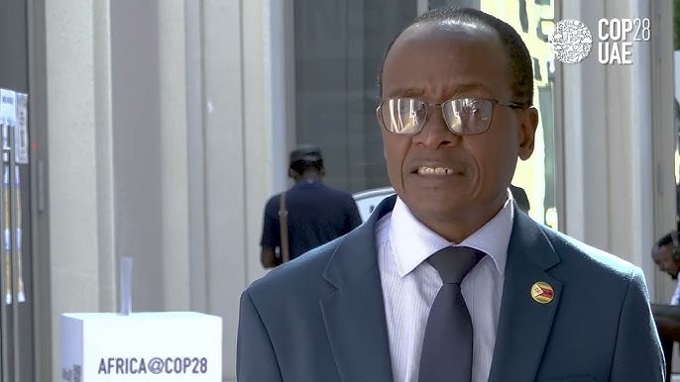
WORLD leaders and various stakeholders will converge on Baku, Azerbaijan, this week for the annual United Nations Climate Change Conference, also known as the Conference of the Parties (COP29). Our Political Editor KUDA BWITITI spoke to the vice board chairperson of the Adaptation Fund of the United Nations Framework Convention on Climate Change, MR WASHINGTON ZHAKATA, on what to expect from the summit. Below are excerpts of the interview.
**********************
Q: What are the key goals of COP29?
A: COP29 is a meeting of all parties to the United Nations Framework Convention on Climate Change; they meet annually to discuss issues of concern to the globe, societies and biodiversity with respect to changing climate.
The meeting seeks to try and map out ways to ensure that climate change does not continue at its current rate. Also, those who are being impacted should manage to survive better under the changing climate. The COP is divided into three broad categories.
One is the need to slow down the rate at which climate is changing. This includes emission reduction of gases, which we refer to as greenhouse gases, such as carbon dioxide, methane and nitrous oxides.
These have to be reduced because they have been responsible for causing climate change through global warming.
Second is climate change adaptation, where those countries or communities that are being impacted by climate change would require actions and resources for them to adapt.
The third issue, which is all-encompassing, is finance.
Finance is required for any actions and programmes that would result in climate change adaptation or mitigation.
Q: Who will be attending COP29?
A: Initially, it was meant for Government representatives who would negotiate on behalf of their countries, looking at the impacts in their nations after consultations with all stakeholders. But, right now, it has been expanded to also incorporate non-state actors to participate and bring in some knowledge and expertise that would assist in addressing some of the climate change concerns, challenges and technologies. This assists in ensuring that climate change mitigation is achieved and, at the same time, adaptive capacities also enhanced.
Q: What were the milestones from the last summit — COP28?
A: One of the milestones was the agreement on the establishment of a Loss and Damage Fund that is going to assist countries that are being impacted by climate change. And so, this fund will be acting like an insurance that once a community is impacted by climate change negatively and you can demonstrate that this has been climate change-related, then you can claim compensation from this fund.
This fund, although it is not yet big, has managed to raise, upon its adoption at COP28, about US$700 million in pledges. However, some of the pledges are yet to be met.
Q: What are the areas of special focus at this year’s COP29?
A: The special area of focus for this year is finance. This was after we noticed that all the actions require finance, be it capacity-building, education, training or technologies that would enable developing countries to transition from fossil fuel-dependent energies to other forms of energy. These other forms of energy include hydro, solar and other forms of renewable energies.
All of it requires financing.
We have managed to develop a national adaptation plan that has been adopted and approved by the Cabinet, which is going to drive the country towards mainstreaming climate change in development planning and budgeting to ensure that we are very resilient.
This plan needs to be financed to the tune of US$100 billion by 2030 for us to be called a resilient nation as we thrive to become an upper middle-income economy by 2030. So, finance will be central to all the discussions at COP29.
Q: What tangible benefits can the ordinary person expect from COP29?
A: Through implementation of recommendations and provision of resources by global forces to financial mechanisms established under what we call the Paris Agreement, the country becomes exposed to these finances and can also benefit from what comes out of this COP.
The funds for adaptation and mitigation can go into the provision of solar-powered water in communities and at irrigation schemes, among others.
These are some of the areas from which the ordinary person can benefit.
Q: What else does Zimbabwe stand to gain from COP29?
A: At the summit itself, we rally behind the Africa Group, which is also called the Group of 77+ China, in negotiations. When we negotiate, we have got a country position that has to feed into the Africa position, and the Africa position also feeds into the Group of 77+China, which is the bigger group of 132 developing states.
In these negotiations, you may not gain directly as a country, but as a group of developing countries.
Then later you fight for specific issues depending on the national circumstances, what you need, because each and every country is different and the way the impacts affect each and every nation are also different.
So, Zimbabwe stands to gain from uniting with other forces to move the climate change agenda forward and advocate resources into the adaptation funds, green climate change fund and special climate change funds, among other funds.
And we become more prepared to meet the vagaries of climate change as we move into the future.
Q: Are you confident that the growing calls for increased climate funding for developing countries will yield positive results?
A: This is one of the areas that, of course, is the focus of this conference.
And we need to be close to where these negotiations are happening in order for us to know where the resources have been channelled through the decisions of the COP.
Information is very critical when it comes to climate change action.
And so, being at the COP is very critical that we also sit in the discussions, advocate with others on the increased and enhanced financing from the developed world, and also fight together with the rest of the world on the simplified modalities for access of these funds, advocating grants.
Q: There have been suggestions that the Loss and Damage Fund will be enhanced to give more funding to developing countries. What is your response?
A: The chances are very high because already it has been operationalised. What is needed now is to establish where it’s going to be, how it is going to be administered and how it is going to be accessed so that it does not have bottlenecks when it comes to access itself.
Q: Zimbabwe has set a target to achieve a green economy by 2030. What is the progress so far?
A: In terms of the green economy, the country has come up with a low-emission development strategy that will see Zimbabwe gradually transform into a green economy through the transformation, mostly in the energy sector.
We want to ensure that we are going to be using more of renewable forms of energy as we move into the future, as compared to fossil fuels.
Our energy and water use efficiency should also change so that we do not demand excess electricity from the sources that would be emitting these gases.
We want to see a country that is energy efficient and water-use efficient. We need to promote the recycling and reuse of materials that we produce.
On vehicles also, we need to move together with the rest of the world as it transforms into electrical mobility.
We want to see how Zimbabwe could position itself in terms of electric mobility.
Also, agriculture uses a lot of fuel, but climate-smart agriculture will see a reduction that is substantial in ensuring that we reduce our emissions.
In the forestry sector, afforestation and reforestation projects are to be promoted effectively so that we move to a position where we become very green and reduce deforestation, as well as rampant wildfires, and engage in catchment protection, among other areas.
All this will contribute towards greening Zimbabwe’s economy.
Q: What milestones has Zimbabwe scored in climate change mitigation?
A: We have done quite a lot. A lot of off-grid solar power stations are coming on board, expansion of our hydropower generation in the Eastern Highlands and the plants that are there now for the Zambezi Valley with respect to the Batoka Gorge and other future plants. Really, it’s already a commitment towards transformation to cleaner forms of energy.
On carbon trading, Zimbabwe is coming up with robust legislation which will ensure that while mitigating climate change, we will also be benefitting the country, communities and local authorities.
It’s one milestone that Zimbabwe is having and will also be highlighted in
the discussions at the Conference of Parties to show how we have provided an enabling environment for implementation of
carbon trading itself, which would also contribute positively to climate change mitigation.



 Online Reporter