

 admin
admin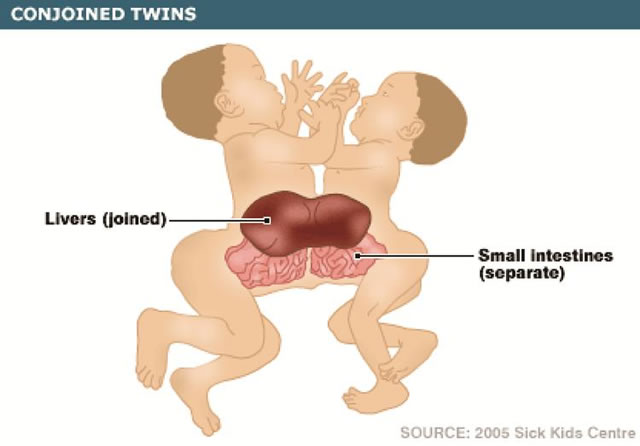
 Harare Bureau
ZIMBABWE will write a piece of national medical history next week when local paediatric surgeons perform the country’s first major operation on conjoined twins at Harare Central Hospital.The only known local operation on Siamese twins was a “very minor” one successfully carried out at the same hospital a few years ago.
Harare Central Hospital’s clinical director George Vera said the twins – joined at the stomach – would be operated on next Tuesday at the Children’s Hospital at the institution.
“We are hoping for the best, but get in touch on Thursday for more details,” he said.
One of the surgeons scheduled to carry out the procedure said they were ready for the big day.
“All is set for the operation which has been scheduled for June 17,” said the doctor. “We are hopeful that we will succeed because we have all the expertise and knowledge required for the surgery.”
The doctor said the entire team consisted of local surgeons and they had not received any assistance from their colleagues from outside Zimbabwe.
When our Harare Bureau visited Harare Central Hospital on Tuesday, the surgeons were preparing a “dry run” of real thing.
“Today we are having a drill where we will be mimicking the same process that is likely to take place on Tuesday, but in this case we will use teddy bears,” said one of the doctors. “We hope all will go according to plan.”
It could not be established how long the surgery could take.
“We have nothing for the Press at the moment,” one of the doctors said.
The conjoined twins’ parents said they were not giving interviews.
“Often people are interviewed, but do not benefit anything to take them out of their situation,” said the father of the twins. Zimbabwe has had five documented cases of conjoined twins since Independence and only one was referred outside the country, while in two instances the babies died before surgery.
The other two are the “minor” one referred to above, and the one that has been scheduled for surgery next week.
In 2005, conjoined twins were successfully separated in Canada.
In 2009, a Tsholotsho woman gave birth to Siamese twins, but they died a few days after birth when Mpilo Hospital failed to secure enough human resources and funding to operate on them.
Early this year, a woman from Kadoma gave birth to Siamese twins who died a few days after birth due to heart complications.
Siamese twins are a result of either fission, in which the fertilised egg splits partially; or fusion, in which a fertilised egg completely separates but stem cells search for similar cells on the other embryo and fuse the twins.
So rare are conjoined twins that their occurrence is estimated to range from 1 in 50,000 births to 1 in 200,000 births in the world.
The overall survival rate for conjoined twins is approximately one in four.
They are known as “Siamese twins” after the famous pair of Chang and Eng Bunker from Siam, now Thailand.


 Online Reporter