Online Reporter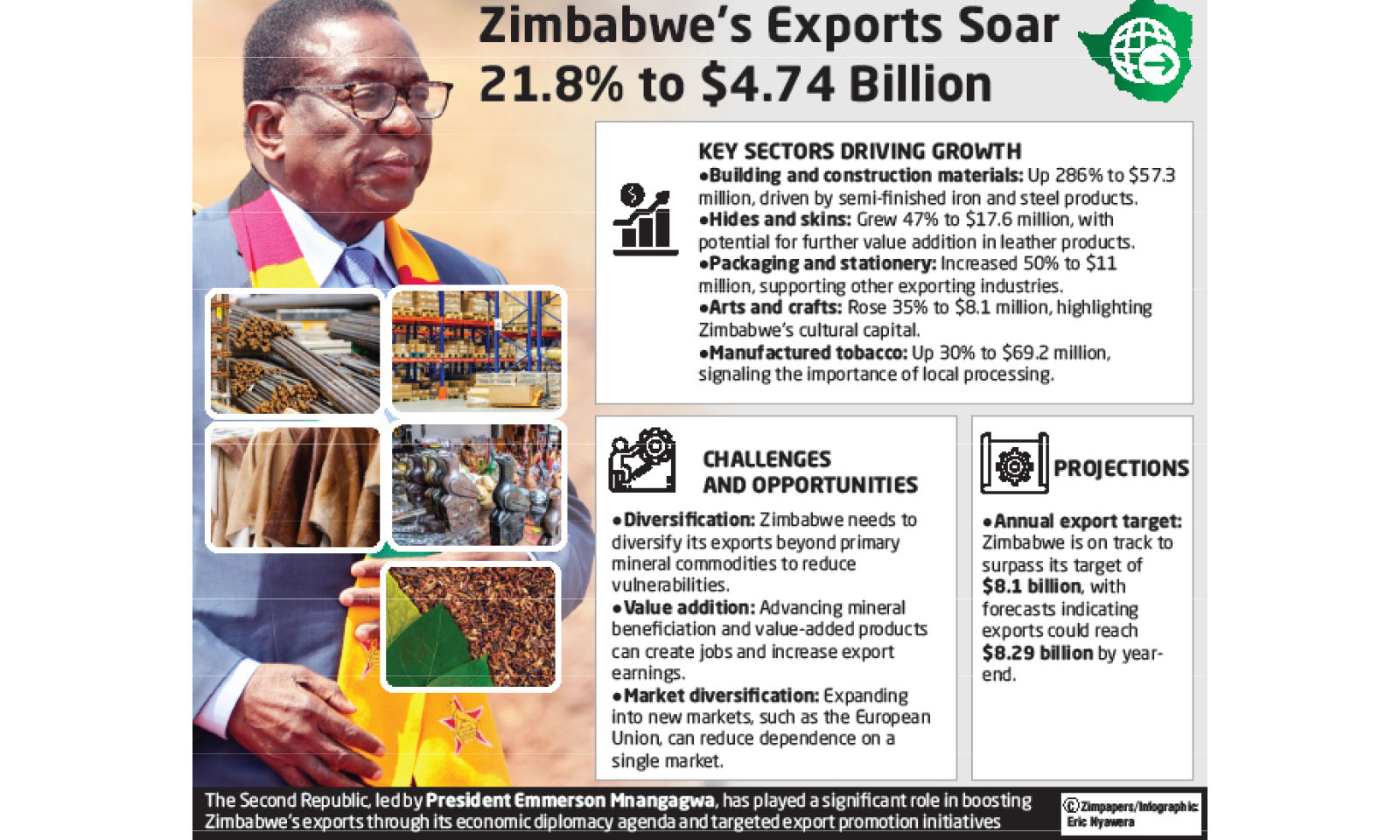
Trade Focus
Allan Majuru
ZIMBABWE’s exports rose by 21,8 percent to US$4,74 billion in the January to July period this year, from US$3,89 billion in the same period in 2024, according to Zimbabwe National Statistics Agency figures.
In the period, the trade deficit narrowed by 31 percent, demonstrating the effectiveness of both the country’s economic diplomacy agenda and targeted export promotion initiatives.
This success comes on the back of deliberate policy direction by President Mnangagwa’s Second Republic, whose diplomatic engagement and re-engagement strategy has resulted in the deepening of existing markets and the opening up of new ones.
High-level visits and bilateral engagements are yielding strong results, as demonstrated by the exponential growth in trade with the Middle East and new linkages in Europe.
This approach is repositioning Zimbabwe as a trusted trade partner.
At the same time, export development and promotion programmes by ZimTrade — the national trade development and promotion agency — are ensuring Zimbabwean products gain visibility across regional and international markets.
The combined effect of diplomacy and trade promotion has positioned Zimbabwe as an increasingly competitive player in Africa and beyond.
As the year progresses, projections confirm that Zimbabwe remains on course to surpassing its annual export target of US$8,1 billion. Forecasts indicate exports could close the year at US$8,29 billion.
Movers
The biggest performer in terms of export growth between January and July 2025 were building and construction materials, which rose by 286 percent, from US$14,8 million in 2024 to US$57,3 million this year.
The increase was largely driven by semi-finished iron or non-alloy steel products, which contributed US$29 million, complemented by iron and steel bars and rods worth nearly US$10 million. This performance reveals the potential of Zimbabwe’s industrial base to diversify beyond traditional commodities.
It also reflects rising demand for construction materials across regional markets, where infrastructure development remains a priority.
Going forward, the sector’s resilience can be enhanced through further investment in downstream steel processing and forging capacity, which would strengthen competitiveness and deepen regional market penetration.
Another strong mover was hides and skins, which recorded 47 percent growth, from US$12 million during the review period in 2024 to US$17,6 million in 2025.
The bulk of exports were raw hides and skins, particularly preserved but untanned.
While encouraging, this still points to untapped potential in domestic leather value chains.
Converting hides into processed leather for footwear, furniture and automotive use would increase export earnings while creating jobs in local manufacturing.
Further, packaging and stationery exports also grew impressively, up by 50 percent, from US$7,3 million in 2024 to nearly US$11 million in 2025.
This reflects a growing regional uptake of Zimbabwean packaging solutions, which are becoming integral to cross-border agro-processing and manufacturing value chains.
Strengthening capacity in this sector is vital, as it supports other exporting industries such as horticulture, processed foods and pharmaceuticals.
The arts and crafts sector posted a 35 percent increase, reaching US$8,1 million from US$6 million last year.
This growth was primarily supported by exports of zoological collections, alongside original sculptures and statuary.
The sector highlights Zimbabwe’s cultural capital and the global appetite for authentic artisan products.
With better branding, e-commerce integration and fair trade certification, this industry can further boost its presence in niche international markets.
In addition, the clothing, textiles and footwear sector recorded modest but steady growth, going up by 1,5 percent, from US$9,8 million to almost US$10 million.
Though small, this growth is commendable considering the stiff competition from low-cost Asian producers.
Expanding regional partnerships and leveraging rules of origin under the African Continental Free Trade Area could give the sector a competitive edge.
Livestock and livestock products recorded a 10 percent rise, from US$3,9 million to US$4,3 million.
This growth is largely driven by poultry and egg exports, demonstrating potential in animal protein markets if production is scaled up and sanitary standards are strengthened.
Among value-added sectors, manufactured tobacco stood out with a 30 percent increase, from US$53,1 million in 2024 to US$69,2 million this year.
This growth is particularly significant when contrasted with the 7 percent decline in unmanufactured tobacco exports.
It signals the importance of processing tobacco into cigarettes, cut rag and other finished products locally.
Strengthening investment in cigarette manufacturing plants and expanding distribution networks into African and Asian markets could further lift this sector.
Attention must also be given to minerals and alloys, which, while already dominant, rose by a further 28 percent to US$3,87 billion from US$3 billion, representing over 81 percent of total exports.
While this performance underpins Zimbabwe’s overall trade growth, it also exposes the country to vulnerabilities.
Continued reliance on primary mineral commodities effectively exports jobs and value.
The long-term sustainability of Zimbabwe’s trade success will depend on advancing mineral beneficiation, such as refining gold and producing finished products, smelting platinum group metals and developing battery-grade lithium products.
Shakers
Despite the overall gains, some sectors faced negative growth.
Unmanufactured tobacco exports fell by 7 percent to US$519 million and pharmaceuticals also declined by 16 percent to US$2,8 million.
Although these declines are notable, they are unlikely to derail the broader upward trend.
In fact, most of the subdued sectors have strong recovery prospects in the second half of the year, when exports typically accelerate.
Opportunities and risks in export markets
The geographic spread of Zimbabwe’s exports reveals both opportunities and challenges.
The United Arab Emirates (UAE) continue to dominate as the largest buyer, absorbing US$2,3 billion or 48,5 percent of total exports, up from 31,9 percent in 2024.
However, the heavy concentration in one market exposes Zimbabwe to risks as any shifts in demand, policy or prices in the UAE could have disproportionate effects on overall performance.
Diversification, therefore, remains urgent.
Encouragingly, exports to the Netherlands grew by 18 percent to US$46 million, while those to Belgium rose by 12,5 percent to US$49 million.
These gains are particularly significant as they demonstrate Zimbabwe’s growing penetration into the European Union, a high-value market where brand recognition and quality standards are critical.
The horticulture and value-added sectors, supported by ZimTrade’s interventions, are well-positioned to expand further in these markets.
Closer to home, Mozambique continues to be a reliable partner, with exports rising by 7 percent to US$166 million.
This growth highlights the success of regional integration efforts and the increasing competitiveness of Zimbabwean products within the Southern African Development Community.
Meanwhile, exports to South Africa and China declined by 5,5 percent and 13 percent, respectively.
However, these countries remain strategic given their proximity and scale, and there is scope for recovery through improved trade facilitation and targeted promotion.
Allan Majuru is the chief executive officer of ZimTrade.