admin
admin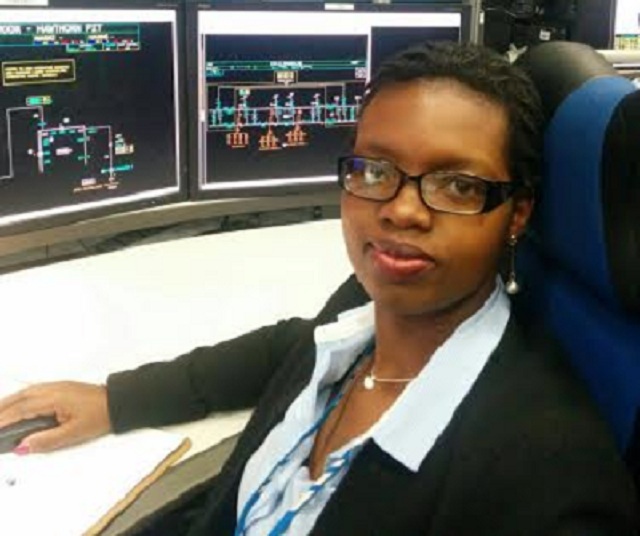
Here is a story of a dreamer born in a middle class family in Bulawayo, Zimbabwe.
Last month Senamiso Mathobela (ABOVE) became the first woman in the United Kingdom (UK) heading power stations that cater for Northern England and Walesa�� electricity needs. If she drops the ball economies sneeze, she strongly feels 12 million electricity consumers in the areaA� are in capable hands with her.
A�Q: You are a Power System Control Engineer (CE), what does your job entail?
A:A� I ensure that the system stays stable for any anticipated faults, for instance I see to it that equipment is not overloaded. I also make sure faults get attended to by the right people. In a few words, I oversee the smooth flow of electricity from the generation source to the consumer.
Q: Before you left for the UK you worked for the Zimbabwe Electricity Supply Authority (Zesa) in Zimbabwe. What was your job there?
A:A� I was a dispatch engineer in the National Control Centre, more or less doing the same job I am doing now. A big part of the job in Zimbabwe was maintaining the power supply balance, which meant calculating the demand to be shed throughout the day and monitoring for opportunities to restore supply.
Q: How did you end up in the United Kingdom?
. A:A� I left at the peak of the economic crisis in 2008. At that time any opportunity outside the country was better. I applied for the job at the National Grid (UK) online and got an offer. I was glad to be able to continue doing a job I enjoy which is power system control.
Q: In this cut-throat trade where most especially in management where you are now, is male dominated, what are the challenges at home and at work?
A:A� The job is challenging and the authorisation is quite rigorous but when you enjoy doing something, the challenge motivates you to work harder. My biggest challenge was balancing work and family life, with young children. My husband has been very supportive which helped a lot.
This is the hardest part of my life, child care is expensive, balancing with hubby a�� working shifts works, when I work nights I can look after the kids during the day. When we are both at work we send them to childcare. Shifts help me to balance work and home life. That is how I get time to cook and do homework with the kids.
Q: What is your long-term goal in the industry?
A: I do eventually want to go back to Zimbabwe, mainly to help develop the power system at home, and look at ways in which Africa can draw lessons to innovate and improve the way in which power systems are driven.
I have gained a lot of knowledge in my years in the UK and the innovative ways used to drive efficiencies are impressive and can go a long way towards improving or enhancing the way of doing work back home. I see a lot of opportunities for development in Zimbabwe.
Q: Back in Africa, there is a serious power problem, especially in your home country Zimbabwe. What do you think could help ease this situation?
A: An investment in large solar farms would benefit Zimbabwe given that ita��s sunny for most of the year.
I am currently working on a project researching ways of reducing system demand without actually cutting customers off. The method is called Conservation Voltage Reduction. Ita��s used in the UK for emergency generation shortages. I think Zimbabwe would benefit from that but further research is needed.
Zimbabwe needs to also invest in power stations to supply our demands, if anything happened to the power stations that we have in the country, there will be nothing a�� and so there is a need to really invest in power stations, so that we are able to generate sustainable electricity and become more self-sustaining.
Q:A� I presume you studied science subjects at Advanced Level of education. Roughly how many girls were in your A-level class and why do women shy away from the technical stuff, in your own opinion?.
A: There were three girls in my A-level class and only two of us at university. In my opinion, physics and engineering have always been labelled as a�?mena��s rolesa�?.
There arena��t enough role models to get girls interested in science subjects. Even from a young age, girls are made to play with dolls and boys with cars. At that stage the stereotypes are set which affect decisions in the future.
We need parents and teachers to encourage girls towards science and engineering. If change is going to happen it needs to start at the grassroots. In primary and secondary schools to be specific.a�� Online



 Online Reporter